

The Philippines has issued a formal protest to the Chinese government over an AI-generated video created by a Chinese state media outlet that portrays the nation as a monkey, describing the depiction as “racist.”
The bizarre 58-second video, which was posted online by the state-controlled China Daily on July 10, shows a monkey in Filipino traditional dress being forced by the United States and Japan to parrot the arbitral award that was handed down by a tribunal in The Hague in 2016. The award ruled that China’s expansive maritime claims in the South China Sea were invalid under international maritime law.
When the monkey refuses to obey the U.S. and Japan, it is thrown into the ocean and then shot with a high-pressure water cannon by the China Coast Guard, before a whale surfaces and describes the arbitral award as “litter.”
In a characteristically forthright statement, Defense Secretary Gilberto Teodoro said the video offered a “revealing insight into what the Chinese communist apparatus thinks of the Filipino people.”
“This mockery of the lawful 2016 Arbitral Award and the video’s glorification of violence against the Filipino people and soldiers expose the moral and intellectual bankruptcy of China’s propaganda machine,” he said.
A screenshot of the AI-generated video produced by China Daily. (The Diplomat)
In a separate statement, the Philippine Department of Foreign Affairs (DFA) said that Foreign Affairs Undersecretary Leo Herrera-Lim met with Chinese Ambassador Jing Quan yesterday and conveyed the government’s “firm objection” to a series of “offensive” cartoons and videos published by China Daily about the arbitral award.
“The Department has since issued a formal diplomatic protest condemning the videos and cartoons, noting that China Daily went beyond legitimate political debate by resorting to demeaning, dehumanizing, and racist depictions of Filipinos,” it stated.
Warning that such content “only widens distrust between the two countries,” it urged the material’s “immediate takedown” – a demand that it also claimed to have sent to the editor-in-chief of China Daily in Beijing.
Last week, the Philippines marked the recent 10th anniversary of the South China Sea arbitral ruling, which marked the end of the legal case that it brought against China in 2013, after the stand-off over Scarborough Shoal. On July 12, 2016, an arbitral tribunal in The Hague handed down its verdict, supporting most of the Philippines’ claims. Among other things, it found that China’s expansive “nine-dash line,” which asserts Beijing’s sovereignty over nearly all of the South China Sea, had no standing under the U.N. Convention on the Law of the Sea (UNCLOS), a treaty signed by both nations.
Last week, 14 nations issued a joint statement in support of the ruling, stating that it was “final and legally binding,” and rejecting any “destabilizing” actions in disputed waters. The 27-nation European Union also released a statement that reaffirmed the ruling as a “landmark decision in the peaceful settlement of disputes.”
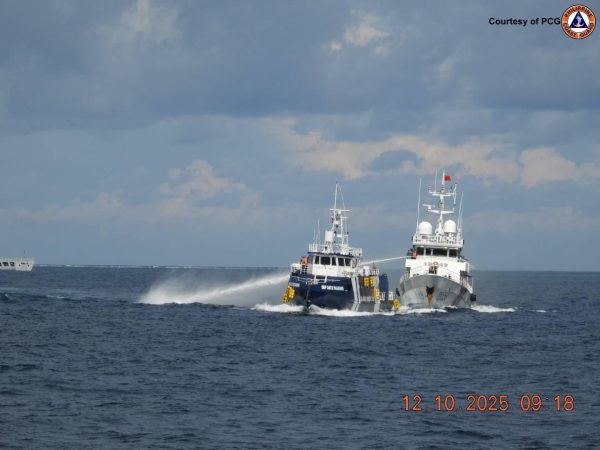
China’s government has refused to accept the award, declaring it “null and void.” Ten years on, its coast guard continues to menace Philippine vessels in contested waters, leading to a string of high-seas confrontations that have seen Chinese coast guard vessels ram Philippine ships, and target them with high-pressure water cannons.
While the AI-generated monkey video was produced by a media organization, giving the Chinese government a degree of plausible deniability, it accurately encapsulates the Chinese tendency to view the Philippines and its actions as an outgrowth of U.S. policy. In this view, the recent efforts of the Marcos administration to push back against Chinese incursions into Manila’s exclusive economic zone stem not from legitimate security concerns but from machinations in Washington.
While it is true that the resolution of the South China Sea disputes has undoubtedly been complicated by the geopolitical competition between the U.S. and China, treating the Philippines as a U.S. proxy will do little to advance a peaceful resolution of the disputes in the South China Sea. Indeed, it is fast deepening the alienation between the two neighbors.
