

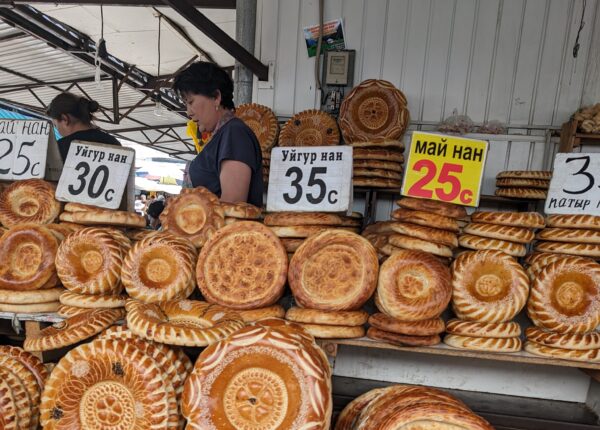
Language politics – and the politics of language – are a hot topic across much of Central Asia. Stemming largely from the 70-year Soviet era, Russian remains a veritable lingua franca across the Central Asian region, including in Kyrgyzstan. In recent years, however, there has been a surge in attention to the role and development of Central Asia’s local languages, and heated debates about the role of Russian (and Russia) in Central Asian societies.
But those debates, often argued in absolutist terms, fail to wrestle with the nuanced reality of Central Asian’s multilingualism.
“From my perspective, multilingualism is not a problem to be solved but a valuable resource,” Dr. Mahabat Sadyrbek – a political scientist, legal anthropologist, linguist, and interpreter – told The Diplomat in an interview.
“The challenge is to ensure that Kyrgyz continues to develop while preserving the cultural, educational and international advantages that multilingualism offers.”
Sadyrbek is the author of two Kyrgyz grammar reference books, in German and English. These texts are the first of their kind, and as she explained, were created out of necessity: “A language needs more than native speakers to flourish.”
In the following interview with The Diplomat’s Managing Editor Catherine Putz, Sadyrbek outlined the fluid dynamics of language in Kyrgyzstan, why debates over languages can be divisive, how learning other languages – English, German, Spanish – brought her back to Kyrgyz, and how she ended up not just publishing two grammar texts but becoming a court-certified Kyrgyz and Russian translator in Germany.
From your perspective, what is the current reality of language in Kyrgyzstan? What positions do Russian and Kyrgyz occupy – in government, in public, in interpersonal communication?
Spend a day in Bishkek, and you will quickly notice that conversations move effortlessly between Kyrgyz and Russian. A discussion may begin in Kyrgyz, shift into Russian when talking about work, higher education, or technical subjects, and then return to Kyrgyz a few moments later. This natural code-switching reflects not only the country’s multilingual reality, but also its history, education system, and social experience.
From the outside, the linguistic situation is sometimes portrayed as a competition between Kyrgyz and Russian. In reality, it is far more nuanced. Since independence, Kyrgyz has steadily expanded its role in government, education, the media, and public administration, while also becoming a stronger symbol of national identity. Russian, meanwhile, continues to play a central role in higher education, science, business and interethnic communication.
Historical experience also continues to shape language attitudes. For many people, Russian remains associated with educational achievement, professional success and social mobility. These perceptions are gradually changing, but they continue to influence language choices, particularly in urban environments.
The real question, however, is not whether one language should replace another. The challenge is ensuring that Kyrgyz has the educational, scientific, and institutional foundations it needs to function confidently in every sphere of modern life. I see Kyrgyzstan’s future not as a choice between languages, but as a multilingual society in which each language fulfils its own role while Kyrgyz continues to strengthen its place in public life.
Debates over language in Central Asia can often be divisive, I think because language is so personal. We speak the languages our parents, our communities, our schools teach us to. It’s also political. What do you make of Russian efforts to reinforce the weight of the Russian language in Central Asia? Have you seen this play out in Kyrgyzstan??
Language is deeply personal because it shapes how we understand the world from childhood. At the same time, it is also political. Every country seeks to promote its language through education, the media, cultural institutions, and international cooperation. In that sense, Russia is not unique. Language has long been an important instrument of soft power.
Russia’s historical, cultural, and educational ties with Kyrgyzstan remain strong, and Russian continues to provide access to a vast intellectual and digital space. Beyond literature, higher education, and scientific publications, it opens the door to an extensive Russian-language internet, online education, professional networks, and media. These connections remain highly relevant in everyday life and help explain why Russian continues to play such an important role more than three decades after independence.
At the same time, Kyrgyzstan has steadily strengthened the position of Kyrgyz as the state language. I see this not as a rejection of Russian, but as a natural process of nation-building. Every independent state seeks to ensure that its own language can fully serve public life, education, culture, and national identity.
In everyday life, however, language choices are often far more pragmatic than political debates suggest. Most people move comfortably between Kyrgyz and Russian depending on the situation rather than making an ideological statement. From my perspective, multilingualism is not a problem to be solved but a valuable resource. The challenge is to ensure that Kyrgyz continues to develop while preserving the cultural, educational and international advantages that multilingualism offers.
How have the politics of language evolved over the years in Kyrgyzstan? What drives change in language usage patterns?
Language policy certainly matters, but it is only one of many factors shaping how people actually use language. In my view, language change is driven just as much by education, migration, urbanization, economic opportunities, technology, and everyday communication as by legislation itself.
Since independence, Kyrgyzstan has made considerable efforts to strengthen the role of Kyrgyz as the state language. Today, Kyrgyz is far more visible in public administration, education, the media, and political life than it was three decades ago. This reflects not only state policy but also a growing appreciation of the country’s linguistic and cultural heritage.
At the same time, society itself has become one of the most powerful drivers of linguistic change. Young people increasingly choose to speak Kyrgyz with confidence, create content on YouTube, Instagram, TikTok and other digital platforms, and use the language in contexts that barely existed a generation ago. Meanwhile, the digital world and artificial intelligence are creating entirely new opportunities, but also new challenges. A language that is present in digital communication, online education, and language technologies has very different prospects from one that is largely absent from these domains.
For me, the future of Kyrgyz will depend less on symbolic debates and more on practical opportunities. People naturally choose the language that allows them to study, build careers, access knowledge, and participate fully in modern society. A language begins in the family, but it reaches its full potential when it is also used in education, research, public institutions, and the digital world.
Ultimately, languages do not develop by themselves. They develop because people use them, teach them, translate them, create new knowledge in them, and adapt them to changing realities. Language policies can create favorable conditions, but it is society that ultimately determines the future of a language.
Last year, you published a “Comprehensive Grammar of the Kyrgyz Language” in English, which built on a German version that came out in 2023. Why are texts like these important? What purpose do they serve?
People often ask me why I devoted so many years to writing grammar. The answer is quite simple: I did not begin with the intention of writing a book. I began by trying to answer one student’s questions.
Around 2011, while I was living in Berlin and working on my Ph.D., I was asked to teach Kyrgyz to a German diplomat preparing for his posting to Bishkek. As I searched for suitable teaching materials, I quickly realized that something essential was missing. There were valuable publications on individual aspects of Kyrgyz, but no comprehensive reference work that explained the language systematically for an international audience. I started writing my own explanations, and those teaching notes gradually evolved into what eventually became two grammar books. What began as a few teaching notes gradually developed into a long-term independent research project that required years of work, persistence, and a considerable personal commitment of time, energy, and resources.
That experience also changed the way I thought about my own language. Growing up in Kyrgyzstan, I had never questioned how difficult it was to study Kyrgyz outside its own linguistic environment. Later, I experienced the opposite myself. When I began learning German, many language-learning materials were available only in Russian. Without Russian, access to foreign languages and academic knowledge was often much more difficult. It made me realize that access to knowledge should not depend on having to learn another language first.
A language needs more than native speakers to flourish. It also needs infrastructure: comprehensive grammars, dictionaries, teaching materials, standardized terminology, translations, and digital resources. Today, that infrastructure also includes language technologies and artificial intelligence. AI systems can only work well with languages that are supported by reliable linguistic resources. Without these foundations, universities struggle to offer courses, researchers cannot easily conduct comparative studies, students have fewer opportunities to engage with the language, and smaller languages risk becoming less visible in the digital world.
My hope is that this grammar will make Kyrgyz more accessible to students, researchers, translators, diplomats, and Kyrgyz communities around the world. When a language becomes accessible, it becomes visible. And when it becomes visible, it becomes part of international scholarship and global dialogue.
Ultimately, this book is not simply about describing Kyrgyz grammar. It is about opening a door to a language, a culture and a way of understanding the world that deserve to be far better known.
You have an accomplished academic career in anthropology but have devoted considerable time and resources to the Kyrgyz language and its speakers. Can you tell us a little about the work you’ve done as a translator in Germany? How did you get into that work and why?
My work as a researcher and as a court-certified translator have never been two separate careers. They have always complemented one another.
My academic background is in political science, linguistics, and legal anthropology, but I never originally planned to become a translator. The opportunity arose from a practical need. As more Kyrgyz citizens came to Germany to study, work, and build new lives, courts, public authorities and private individuals increasingly required certified translations. At that time, there was a clear shortage of qualified court-certified translators and interpreters for Kyrgyz in Germany. I therefore decided to qualify as a court-certified translator and interpreter, and what began as a response to an urgent need has since become an integral part of my professional life. Since then, I have contributed to the growing use of Kyrgyz in legal and administrative contexts in Germany.
Every document tells a human story. Behind a birth certificate, university diploma, or court decision is someone applying for citizenship, seeking recognition of professional qualifications, reuniting with family, or beginning a new chapter in life. This experience has taught me that translation is never simply about words. It is about rights, opportunities, and trust.
Working between the German and Kyrgyz legal systems has also changed the way I think about language. Legal and administrative concepts often have no direct equivalent in Kyrgyz. I compare terminology across Turkic languages, consult linguistic and legal sources, and sometimes develop new formulations that accurately convey modern legal concepts while remaining natural in Kyrgyz. In this sense, translation is not only about transferring meaning; it also contributes to the continuing development of the language itself.
At the same time, I have watched Kyrgyz gradually establish itself beyond the borders of Kyrgyzstan. As more students, skilled professionals, and families settle abroad, the language is increasingly present in universities, courts, public institutions, and everyday life. Seeing Kyrgyz become a language of education, law, and international communication has been one of the most rewarding aspects of my work.
For me, research and translation have always pursued the same goal: making Kyrgyz more accessible, more precise and more visible in a changing world.
What do you wish more people understood about the Kyrgyz language?
One of the greatest surprises of my life was discovering my own language through the lens of other languages. As a young student, I was fascinated by German, English, and Spanish because they seemed to open the door to the wider world. Ironically, learning those languages brought me back to Kyrgyz with a completely new perspective. I began to appreciate not only its elegant grammatical structure, but also its remarkable ability to express subtle meanings with clarity, precision, and nuance.
Many people assume that languages spoken by relatively small populations are somehow simpler or less developed than global languages. My experience has been exactly the opposite. The more deeply I studied Kyrgyz, the more I admired its internal logic, expressive richness, and extraordinary flexibility. It is equally capable of expressing everyday experience, poetry, and highly sophisticated academic or legal discourse. The Manas epic is perhaps the best-known example, yet it represents only one part of a much broader intellectual and cultural tradition.
What fascinates me most is that Kyrgyz is not simply a language to be preserved; it is a language that continues to grow. Through my work as both a linguist and a court-certified translator, I regularly encounter concepts for which no established Kyrgyz terminology yet exists. Rather than seeing this as a limitation, I see it as evidence that the language is alive. Every generation expands its vocabulary as society itself evolves.
I also hope more people will stop measuring languages by the number of their speakers. Every language represents a unique way of understanding the world. By learning Kyrgyz, we gain access not only to another grammatical system, but also to a distinct cultural perspective shaped by centuries of history, values, and lived experience. Preserving linguistic diversity also means preserving humanity’s diversity of thought.
Is there a Kyrgyz word or phrase you’d like to share with our readers? It could be a saying, a greeting, or simply a word you find beautiful.
If I had to choose one Kyrgyz word, it would be мурас (muras). It is often translated as heritage or legacy, but neither word fully captures its meaning. For me, muras is not only what we inherit from previous generations; it is also what we consciously choose to leave behind for future generations.
That is how I think about language. We inherit our mother tongue, but every generation also has the responsibility to enrich it, develop it, and pass it on. Through education, literature, research, translation, and everyday communication, each generation contributes something of its own.
When I think about my own work, I see this grammar as my contribution to the intellectual legacy of my mother tongue. I hope it will help future students, researchers and language learners while encouraging others to continue building on it. No grammar is ever complete, and no language ever stops evolving. Every generation adds another chapter.
Perhaps that is the true meaning of muras. It is not only about preserving the past, but also about creating something meaningful for the future. Because, in the end, a language does not live in books alone. It lives through the people who continue to speak it, teach it, study it, and pass it on.
