

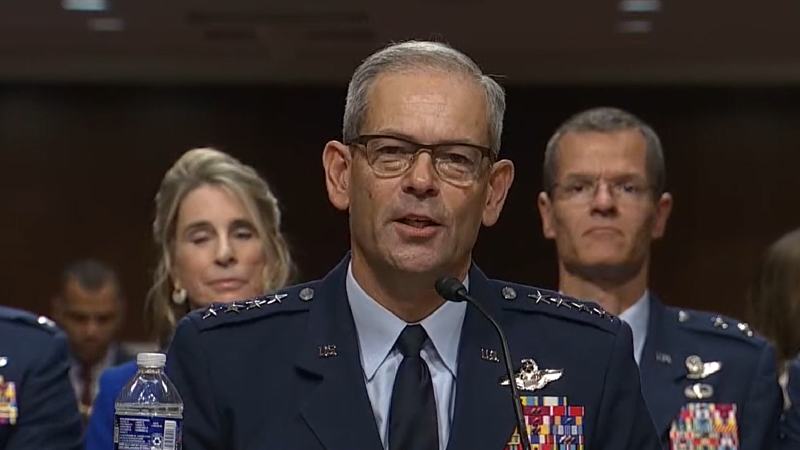
LONDON — The war against Iran has strained the Air Force’s budget, and the US military needs “all three” Trump administration military spending proposals — a base budget of $1.1 trillion, a reconciliation boost of $350 billion and a multibillion-dollar supplemental package — to keep its edge, the Air Force’s top officer told Breaking Defense.
“Here’s the dilemma: In 2026, we executed and are executing Epic Fury. Wasn’t budgeted for. So what we’re doing is, we’re cash flowing payments to pay for Epic Fury, and the way that we’ve cash flowed is, we have stopped spending money on other things that needed to be done this year,” Gen. Kenneth Wilsbach said in an interview on the sidelines of the Global Air & Space Chiefs Conference here.
“There’s a wide array of things that we have stopped spending money on so that we could pay for the bills that are associated with Epic Fury,” he continued, referring to the Pentagon’s nomenclature for combat operations in Iran. “That’s why you need a supplemental for this year.”
Wilsbach did not describe where the Air Force has shifted money from, but a recent $4.3 billion Pentagon reprogramming request for “unforeseen military requirements” offers some clues. According to the document, the Defense Department plans to cut $1.5 billion from the Air Force, including a reduction of $774 million from aircraft procurement programs and $99 million from personnel accounts. (The document does not mentioned Epic Fury, and some spending shifts may not be associated with the conflict.)
The Air Force declined to discuss specific cuts. “We are using all resources available to ensure we are supporting operations and maintaining readiness within the limits of the budget,” an Air Force spokesperson said in a statement to Breaking Defense.
Trump administration officials have floated a $67 billion supplemental spending package to pay the Iran war’s bills and other defense programs, though its fate now seems in doubt. On Wednesday, House GOP leaders unveiled a new reconciliation package that includes $60 billion for defense spending — a figure that falls short of the administration’s request, and signals that the White House’s dream of a $1.5 trillion defense budget in fiscal 2027 is “effectively dead,” budget expert Todd Harrison at the American Enterprise Institute previously told Breaking Defense.
The $350 billion blueprint for reconciliation spending released by the Pentagon earlier this year would surge cash for top priorities like munitions production — where stockpiles have been stressed by the Iran war — drone manufacturing, and shoring up the industrial base. Failure to pass a reconciliation package could also imperil key administration priorities like the Golden Dome missile defense shield, as well as procurement of platforms like the F-35 stealth fighter.
Wilsbach, for his part, asserted the total $1.5 trillion figure is essential for the Air Force to sustain operations and modernize. Without it, he said priorities like readiness and modernization would suffer, as programs will have to be “throttled back.”
“Why we need all three of these — the supplemental, the base [budget], and the reconciliation — is because the country wants the Air Force to do a wide array of things,” the general said, listing a range of missions from humanitarian response to nuclear deterrence.
On July 10, the Trump administration notified Congress that combat operations against Iran have formally resumed after a fragile ceasefire with Tehran collapsed. The resumption of fighting threatens to exact an even greater toll: As of July 14, over 400 American troops have been wounded and 14 killed. Estimated financial costs vary, but the Center for Strategic and International Studies in June projected a tab of roughly $40 billion.
While Wilsbach declined to discuss lessons learned from the first round of fighting, reasoning that doing so could jeopardize operational security, he noted that the nature of the conflict has challenged US forces in new ways, and praised troops’ composure amid Iranian barrages.
“This conflict has been a bit different than what we’ve seen in the past because our airmen have been almost continuously under fire,” Wilsbach said. Those airmen, he added, have “been doing a remarkable job of defending their airfields and continuing to keep pressure on Iran by keeping the airfields open.”
