

“With the sunset, Shahi Bazar may seem dead and quiet,” wrote Syed Zahoor Shah Hashmi in his 1959 memoir essay in Sichkan magazine, “but soon after, it comes back to life with the lamps lit everywhere, and people crowding to the small tea shops where they would quietly listen to the old mullah [Muslim cleric] who would read the book, “Tilism-e-Hoshruba,” an epic of the magical adventures of the legendary Persian hero Emir Hamza, to his audience, as though the listeners were the mullah’s most devoted disciples.”
Hashmi was one of the greatest Baloch writers and scholars. In the 1950s, when he wrote these words, he lived very close to Shahi Bazar. His accounts of the early and mid-20th-century Gwadar and Shahi Bazar are among the very few written by a local writer. To him, Shahi Bazar was not just a market; it was a place where people gathered. It was a public space important for everyday life.
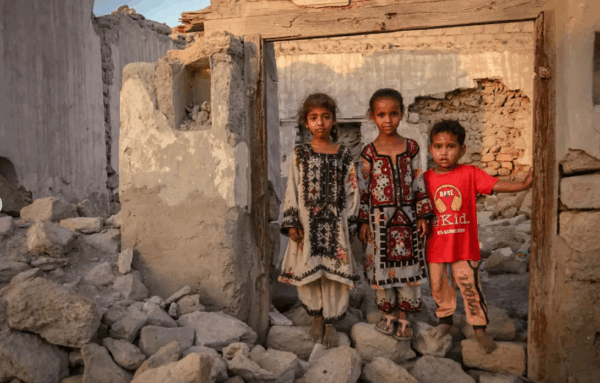
Today, along with most of the bazaar, Hashmi’s home is abandoned and under threat.
Elsewhere in the world, such houses that are rich with history and culture are preserved as literary museums that offer an opportunity to experience the atmosphere where some of the best literary works of the time were written.
The bazaar Hashmi wrote about emerged out of centuries of trade, migration, and interaction with the Indian Ocean, the rest of Balochistan, Iran to the west, and the Indian coastal belt to the east. It is located along the deemi zir (east bay) of Gwadar, one of the very first parts of the town to be settled.
Abandoned shops in Gwadar’s Shahi Bazar. Photo credit: Mariyam Suleman
Like most old towns around the world, Shahi Bazaar has narrow alleyways that are all connected with each other. There are old buildings with shops on the ground floor and residential homes above them, with their balconies opening into the market. There are open spaces like Mullah Fazul Chowk (public square), which to this day is a space for public gatherings and political speeches. There are religious sites, a mosque, a Hindu temple, and a jamaat khana (a place of worship for Ismaili Muslims), all very close to each other, and the remnants of the Omani and colonial-era architecture.
Recently, the Gwadar Development Authority (GDA) launched an Old Town Rehabilitation Plan that aims to conserve key landmark buildings, including the Omani Forts, the British rest house, and the telegraph office.
It has thrown up several questions. What legal frameworks do Pakistan and Balochistan have for the protection of such valuable sites? And, is conservation only, and that too of the key landmark architecture alone, enough to safeguard Gwadar’s history, memory and identity spanning several centuries?
One of the earliest laws is The Federal Antiquities Act 1975, which sets up a framework for the protection of archeological sites, historic buildings, and other antiquities of national importance in Pakistan. It prohibits construction or alterations within 200 feet of the protected monuments without official approvals. This legislation also established penalties for damage and other activities that threaten cultural heritage. Some of these responsibilities were transferred to the provinces to safeguard and manage heritage sites in their respective jurisdictions after the 18th constitutional amendment of 2010 was enacted.
Following this amendment, the Balochistan assembly passed the Balochistan Antiquities Act in 2014, which confers the responsibility to protect antiquities, regulate excavations and restore architecture of heritage and cultural importance on the provincial government.
Alongside laws that provide important legal frameworks for identifying and protecting individual heritage sites in Pakistan, there are also international mechanisms for recognizing cultural heritage, like the UNESCO World Heritage List. Pakistan currently has six sites in the list.
But since 1997, no additions have been made to this list.
Being on the UNESCO list is valuable as it increases international visibility, which in turn puts pressure on local and national governments to protect and manage recognized heritage sites.
Gwadar’s Shahi Bazar was only recently identified by the GDA for protection and conservation efforts, that too after local communities advocated for its protection. However, even after that, the master plan shared on the GDA site, which dissects the city into different zones, does not mention any protected zones.
On the ground, GDA has recently initiated conservation work on various landmark architectures in and around Shahi Bazar. But the broader heritage-sensitive plan – if there is any – for historic Gwadar is still not clear, or at least not in the public domain.
In 2011, UNESCO proposed a Historic Urban Landscape (HUL) approach. Earlier, heritage conservation was mainly about protecting individual buildings and monuments.

View from the upper floor of the rest house. Gwadar Port’s cranes can be seen in the distance. Photo credit: Mariyam Suleman
However, the new approach recognizes that cities are constantly transforming and expanding, and climate change and real estate development are contributing to changing historic centers. So, HUL advocates not only for the adaptive reuse of buildings but it also emphasizes preservation and improvement of the whole historic urban landscape. This includes integrating streets, public spaces, and traditional neighborhoods into the city’s future development instead of treating them as isolated areas.
So, what comes next for Shahi Bazar? How will its restored buildings be repurposed and integrated into the city’s future? Will abandoned houses and shops in the old town be revitalized? And how will the bazaar be physically and functionally connected to the rest of Gwadar? Even basic issues, such as how to improve Gwadar’s narrow sandy alleyways, the half-collapsed walls of many buildings, its broken-down sewerage system, and other services remain unaddressed.
Gwadar can draw inspiration from nearby cities like Muscat, for example, with which Gwadar has a long history. Muscat’s historic market, the Souq Muttrah, was redesigned and transformed into a larger market through several phases of redevelopment and continuous improvements.
Even within Pakistan, the Walled City of Lahore has better restoration, improved pedestrian movement, and adaptive reuse of many buildings.
The federal and provincial governments in Pakistan already have the legal frameworks in place. What is needed now is implementation and policies for continuous improvements.
Hence, Shahi Bazar does not only need conservation of key landmark buildings; it needs a very comprehensive heritage-sensitive plan that connects the historic town with the rest of the city through adaptive reuse, streets and public space improvements, upgraded infrastructure like sewerage and power systems and an increased government and public partnership.
Only then will Shahi Bazar become as vibrant as the district described long ago by Syed Zahoor Shah Hashmi.
