

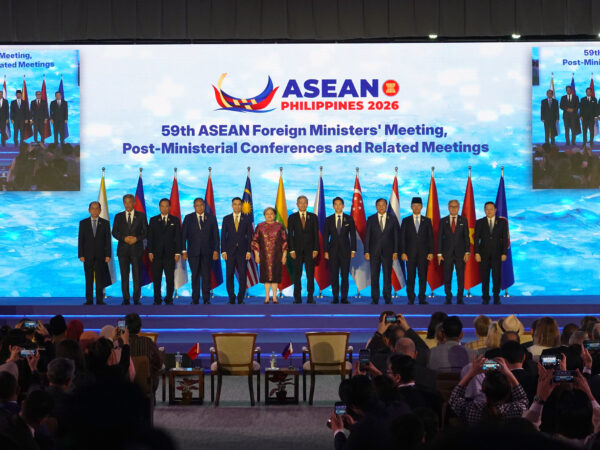
Foreign ministers from the Association of Southeast Asian Nations (ASEAN) formally opened their annual meeting in Manila this morning with a call for unity in the face of maritime tensions and growing global instability.
In her opening address at the 59th ASEAN Foreign Ministers’ Meeting, Philippine Foreign Secretary Ma. Theresa Lazaro said that in a world marked by “upheaval, uncertainty and unpredictability,” the region had to respond with “active, deliberate problem solving.”
“In a fractured global landscape, no single nation can weather these storms alone. Our strength and resilience lie in our community,” she said. “If we do not move forward as one, we risk being pulled apart.”
Today’s meeting kicks off a week of diplomatic conclaves in Manila, involving their counterparts from the United States, China, Japan, Russia, and numerous other countries.
U.S. Secretary of State Marco Rubio, Chinese Foreign Minister Wang Yi, and Russian Foreign Minister Sergey Lavrov are among the confirmed attendees for the East Asia Summit Foreign Ministers’ Meeting and the ASEAN Regional Forum, both of which will be held on Thursday. These major summits will be interspersed with dozens of sideline bilateral meetings between representatives of the participating nations.
Regional security issues are expected to dominate the meetings, including renewed fighting in the Middle East, ongoing tensions in the South China Sea, and efforts to revive ASEAN’s stalled initiative for resolving the conflict in Myanmar.
The Associated Press reported yesterday that at today’s meeting, ASEAN’s foreign ministers were set to express their alarm about the renewed hostilities between the United States and Iran and threats to shipping in the Strait of Hormuz, on which the region is heavily dependent for its supplies of crude oil.
In a draft statement of concern, a copy of which was obtained by the AP, the bloc’s foreign ministers “called for the restoration of the safe, unimpeded, and continuous transit passage of vessels and aircraft in the Strait of Hormuz.”
“We underscored the importance of maintaining regional peace, stability and prosperity, upholding international law … including the need for a complete and immediate cessation of hostilities across all fronts in the Middle East,” they said in the statement, which the AP said would be made public after the meeting.
“We acknowledged the further implications of the continued tensions in the Middle East on regional trade, energy and food security, including energy markets and supply chains, agricultural production.”
The week is also expected to see renewed efforts on the regional energy security front, including the ongoing push for ratification of the bloc’s Framework Agreement on Petroleum Security fuel-sharing plan. The purpose of the plan is “to enable coordinated emergency fuel sharing and collective responses to supply disruption,” Philippine Trade Secretary Cristina Roque said in April.
Another of the issues expected to dominate the agenda today is the situation in Myanmar, which will be the subject of a standalone “extended informal consultation” today.
The meeting, which is intended to address the implementation of the bloc’s Five-Point Consensus initiative for resolving the country’s conflict, comes after ASEAN’s foreign ministers held their first face-to-face meeting with their Myanmar counterpart since the 2021 coup, which plunged the country into prolonged conflict and economic instability. At the July 12 meeting in Bangkok, the bloc said it wanted to reboot the Five-Point Consensus, an April 2021 initiative that calls for an immediate cessation of violence and inclusive dialogue involving “all parties” to the conflict. The following day, Lazaro, the current ASEAN special envoy on Myanmar, held talks with military-backed negotiators and six rebel groups in Pattaya, which she and Thai Foreign Minister Sihasak Phuangketkaew reported were open to dialogue.
ASEAN remains divided on how to deal with its errant member state. Despite agreeing to the Five-Point Consensus in April 2021, the Myanmar military has done little to implement its most important points, prompting ASEAN to bar its representatives from the organization’s annual summits. At the same time, since taking office in April, the country’s new civilianized military administration has pressed hard for readmission into the ASEAN fold, with the support of sympathetic member states. The leading member of this camp is Thailand, whose foreign minister has pushed to bring Myanmar back into the “ASEAN family.”
Other member states, albeit a shrinking coalition of them, have bemoaned the lack of progress on the Five-Point Consensus, which Myanmar’s military-dominated parliament earlier this month rejected as an unwarranted “interference” in Myanmar’s internal affairs. Malaysian Foreign Minister Mohamad Hasan told reporters in May that his country remained opposed to high-level talks while “oppression is still taking place.”
Today’s meeting will see ASEAN’s foreign ministers reaffirm their commitment to the Five-Point Consensus, and call for Naypyidaw to make greater actions to implement its terms, but is unlikely to marks a substantial shift in the bloc’s approach. The Philippines’ ASEAN spokesperson Dominic Imperial told reporters yesterday that it was important that “there is engagement … continuous engagement with not only with the Myanmar authorities but with other Myanmar stakeholders.”
The South China Sea is also set to feature once again at this week’s meetings, following an incident yesterday in which Chinese and Philippine personnel again exchanged physical blows in contested waters. The Philippine military reported that one of its marines was injured sustained a head injury after being struck with a baton by China Coast Guard personnel during a confrontation at Second Thomas Shoal. Both nations have accused the other of instigating the clash.
Chinese Foreign Minister Wang Yi is expected to hold talks with Lazaro, which, according to the South China Morning Post, are “tipped to focus on the South China Sea.” The issue is also likely to be a subject of discussion during the planned meeting between U.S. Secretary of State Marco Rubio and Philippine President Ferdinand Marcos Jr.
