

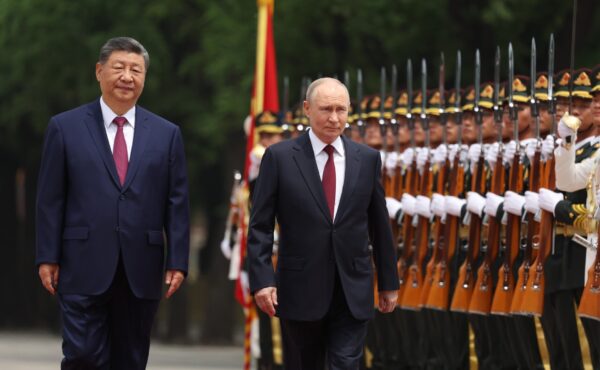
The Diplomat author Mercy Kuo regularly engages subject-matter experts, policy practitioners, and strategic thinkers across the globe for their diverse insights into U.S. Asia policy. This conversation with Mathieu Boulègue – senior fellow with the Transatlantic Defense and Security Program at the Center for European Policy Analysis (CEPA) and co-author of “The China-Russia Meta Threat: The Architecture of Authoritarian Power” (CEPA 2026) – is the 518th in “The Trans-Pacific View Insight Series.”
How have China-Russia relations changed since the start of the Ukraine war in 2022?
I think the relationship evolved significantly after 2014 and Russia’s first invasion of Ukraine, rather than in 2022 per se, after the full-scale invasion. The weight of international sanctions and Moscow’s growing isolation pushed Russia closer to China. This consequently forced the Kremlin to replace Western dependence with dependence on Beijing and effectively created a new form of over-reliance.
Over-reliance applies to economic subsidies, investments, and in the military sphere, to the procurement – legal and illegal – of dual-use and military technology, spare parts, and equipment. Supply chain dependency is particularly evident in microelectronics, semiconductors, circuitry, and machine-building tools used to sustain Russia’s war machine. Now the issue for Moscow is that trading one dependence for another is not ideal, but they don’t have much choice but to court China for continued support.
Examine the “asymmetric interdependence” of China-Russia economic relations.
The report we recently published underscores the idea that Russia can only be a “junior partner” to China, and never an equal. No amount of great power propaganda from either side can hide the fact that Russia needs China more than China needs Russia.
Such a relationship, far from being “no limit,” is also quite fragile. The Russian leadership is perfectly aware of the increasingly asymmetric nature of bilateral relations. Meanwhile, Beijing must navigate the intricacies of using Russia as a barking dog while avoiding antagonizing Moscow or bruising Putin’s ego. Call it genuine authoritarian diplomacy.
Military cooperation might be the area where Russia is the least dwarfed by China, mainly because Beijing is in a listen-and-learn mode.
Analyze the “parallel play” nature of military cooperation between China and Russia.
“Parallel play” is an interesting concept, reflecting how kids in early childhood tend to play side by side but never fully together. I think it illustrates precisely how Russia and China approach military cooperation at large – interaction without the full extent of actual interaction.
Western analyses generally tend to assume Russia-China military relations should take the form of what we see at NATO level for instance, and we tend to placate known concepts of cooperation such as “interoperability” or “strategic alliances.” Beijing and Moscow don’t need any of that to have meaningful military cooperation.
Western-style interoperability is not something they are trying to replicate. They drill together, conduct joint patrols and overflights, etc. But it does not mean they are seeking to go further with joint security guarantees, integrated command and control, or joint operations. Actually, there are areas where their respective military interests may clash, such as in Africa, Central Asia, or the Arctic.
Identify the obstacles to closer China-Russia security ties.
It’s important to frame Russia-China relations by what they don’t do together rather than by how they cooperate. Friction points, limitations, and obstacles in this relationship equally define the nature of their interaction. There are several obstacles in defense and security ties that can be made out.
First, historical mistrust. There’s a long history of mistrust, especially from the Russian side, regarding military-technical reverse engineering and technology theft. Furthermore, Moscow is none too happy about perceived Chinese inroads in what the Kremlin defines as its “sphere of influence,” for instance in Central Asia and in the Arctic.
Second, the absence of shared strategic culture that could cement greater integration. Simply put, Russia thrives on military coercion, while Beijing is more subtle in its sharp power. Both countries have focused on ironing out the easy things (for instance, border issues, nonaggression, and institutional and legal frameworks) but they have not pushed for deeper military integration. From a geographical perspective, the centers of gravity are also misaligned – Russia focuses on the “NATO border,” while China focuses on the Asia-Pacific region.
Finally, a key factor is that both Moscow and Beijing are too independent to enter an alliance that could infringe on their sovereignty and impose self-restraint. They will not be fighting each other’s wars anytime soon.
Assess the semblance of China-Russia “strategic alignment” on the trajectory of global governance and implications for the United States and European Union.
I don’t think the alignment is “strategic” in the sense that we generally understand it. Russia-China relations are not those of NATO, the EU, or ASEAN, for that matter. It remains a fundamentally opportunistic relationship based on self-interest and scoring short-term wins.
On top of that, they both want us to talk about it – symbols and signaling are just as crucial as substance in their relations. Beijing and Moscow want to inflate the reality of their cooperation as a form of informational-psychological warfare. This is part and parcel of how they frame their relation as anti-U.S. Yet if we look at “strategic” aspects, such as future governance models, trade, etc., it appears both countries are not aligning on long-term goals.
It remains that even a modicum of cooperation between both countries represents a potential threat to U.S. and European interests. Exploring the limitations of the relationship should not overshadow the force-multiplier effect it has in disrupting Western governance.
