

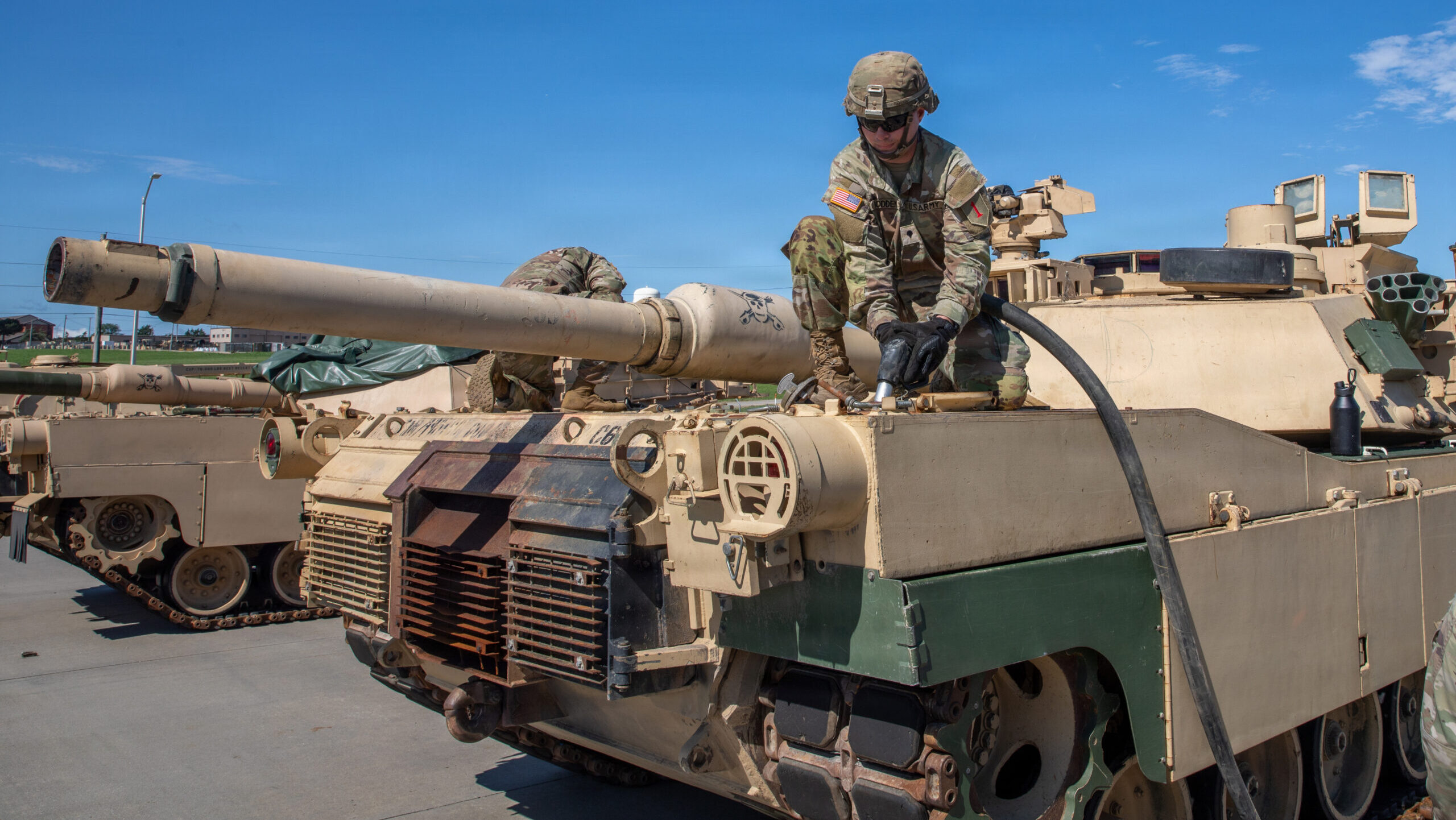
WASHINGTON — The Army is looking to industry to help resolve supply chain bottlenecks affecting production of its M1 Abrams tank engine, which officials in turn said reduces readiness rates.
The bottlenecks are mainly affecting subcomponents of the engine, the AGT1500, made by Honeywell Aerospace. Those parts come from subvendors who report to Honeywell, and supply chain issues can result in delays of months to a year, Brandon Pender, chief technology investment officer for the Army’s DEVCOM Ground Vehicle Systems Center, told Breaking Defense in an interview today. As a result, troops have numerous Abrams tanks sitting idle unable to operate.
The Army kickstarted its quest to solve the supply chain woes with an industry day dubbed the “TIGER hackathon,” on July 14. (Despite its name, the event did not involve any hacking, officials told Breaking Defense.) The event brought together over 40 vendors and high level officials, like Lt. Gen Christopher Mohan, head of Army Material Command, to accomplish three goals: find second sources for the AGT1500’s subcomponents; find companies that can utilize complex advanced manufacturing for the parts; and find companies who can provide raw materials for the subcomponents.
“The primary reason we did the hackathon was to identify solutions to resolve some critical sourcing and manufacturing bottlenecks that we had with the engine, and ultimately help increase and maintain, more importantly, operational readiness for the Abrams platform,” Phil Labut, a logistics management specialist within the service’s Tank-automotive and Armaments Command, told Breaking Defense in an interview today.
“We have the backing all the way up our chain to Gen. Mohan to make this work. When you have that kind of brass behind this, it helps things move,”Labut continued.
According to the service, there are 166 “critical and single source components directly impacting delivery timelines and fleet readiness” for the engine, often nicknamed the Tiger. (TIGER when referring to the “hackathon” event actually stands for the Total Integrated Engine Revitalization program)
Out of the 166 components the Army deems as affecting readiness, the Army owns the intellectual property to 122, Rick Harris, division chief of the Stryker and Infantry Squad Vehicle programs at Army Contracting Command–Detroit Arsenal, told Breaking Defense in an interview today.
He said that within the next “few days” the Army will release an Area of Interest (AOI) solicitation posting the 122 critical components in which it’s looking for industry to partner with the government and Honeywell to either be second source suppliers for the components, offer its advanced manufacturing services or its raw materials that go into such components. Harris added that “ideally” the Army would like to gain the IP for the remaining critical components as it would give the service “the ability to increase the industrial base” and “create more resiliency in the supply chain for the engine parts.”
Out of the three officials interviewed, none were able to detail exactly what components or materials are causing the most trouble, though materials for casting and molding processes for components have “long lead times,” Pender said. Further, Labut confirmed previous reporting that stated the manufacturer who makes the impeller component of the turbine isn’t meeting the delivery schedule. As was previously reported, the issue with the impeller is that it was made in a “specific vacuum forge process,” for which Mohan told Inside Defense in March only one company in the US does this.
But with new companies potentially partnering with the Army for complex advanced manufacturing tools, Pender said hopefully the choke points will be alleviated. The Army does much of its own 3D printing and advanced manufacturing at Rock Island Arsenal, but for the Abrams engine, more complex tech is needed, Pender said.
“This is a very deliberate, engineering intensive, almost aerospace level of quality that goes into these parts,” Pender said.
In terms of what comes after the AOI is posted, Pender said the Army is hoping to have vendors on contract by Oct.1 of this year, though he acknowledged that would only happen in a “perfect world.”
Regarding what those vendors may look like, he said most of the players who attended the hackathon were nontraditional or commercial vendors that are looking to add defense work into their portfolios.
“I’m very excited to see where this goes because of having those sorts of vendors looking at this problem,” Pender said.
