

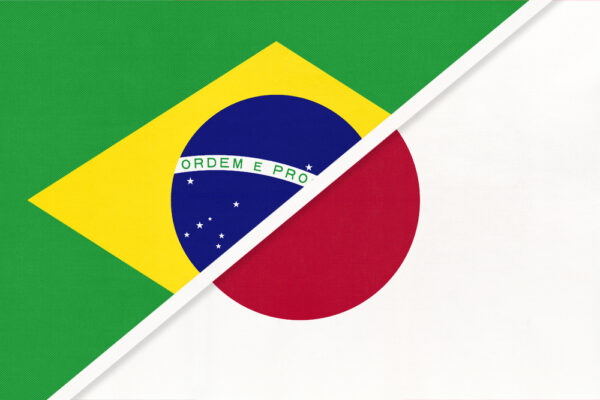
The Japan-Brazil Foreign Ministers’ Strategic Dialogue was held in Tokyo on May 18 between Japanese Foreign Minister Toshimitsu Motegi and his Brazilian counterpart Mauro Vieira. Both countries are working to strengthen their relationship under the “Strategic and Global Partnership Action Plan Japan-Brazil (2025-2030).” reflecting a shared belief that the relationship has substantial untapped potential.
With a population of over 200 million and roughly 2 million people of Japanese descent, Brazil has long been an important Latin American partner for Japan, as demonstrated by repeated visits from Japanese leaders and members of the Imperial Family. The relationship, however, has not lived up to its economic and political potential. Trade remains narrowly concentrated: Brazil exports iron ore, chicken, and coffee, while Japan exports automotive parts and machinery. Japan’s share of Brazil’s overall foreign trade has been declining (currently standing at 2 percent). The Japan Business Federation (Keidanren), which continues to engage in discussions with the industry in Brazil, has been pushing for an economic partnership agreement (EPA) with Mercosur (Southern Common Market) for over a decade, viewing Brazil as a crucial partner in leading regional integration.
As the U.S., once the standard-bearer of global free trade, turns toward protectionism, Brazil is moving in the opposite direction, having signed a free trade agreement with the EU in January after years of negotiations. This presents a real opportunity: Brazil seeks to diversify its trading partners, while Japan aims to grow trade volume, broaden the range of goods traded, and secure agricultural products and rare earths for economic security. The recent Strategic Dialogue, progress was made in discussions on entering EPA negotiations, and for Japan, it was a significant achievement to have Brazil’s agreement on economic security cooperation.
Among Asian powers, China has already established a close relationship with Brazil. Its rapid economic growth has driven significant imports of food, feed crops, and mineral resources from Brazil, alongside growing exports of Chinese goods. China has become Brazil’s largest trading partner by a wide margin over the U.S., with Chinese investment in clean energy also rising in recent years. That the Trump administration’s 50 percent tariff, introduced last summer to pressure Brazil, had minimal impact illustrates just how far U.S. leverage has diminished as China’s economic ties with Brazil have deepened. China and Brazil countries also stand together politically and diplomatically as leading voices of the Global South, opposing a U.S.-dominated world order.
Brazil, however, is pursuing a multipolar international order, and is not seeking to distance itself from Japan, nor treat it as an adversary, even as it deepens ties with China. Brazil’s foreign policy emphasizes autonomy and avoids excessive reliance on any single country, including China. Latin American nations were invited to join the Belt and Road Initiative in 2017, but Brazil has notably declined to participate, even as others in the region have signed on. If anything, the more Brazil depends on China, the more it seeks to diversify its economic relationships with other major partners, including Japan. Japan and Brazil also share common diplomatic objectives, including advocacy for U.N. Security Council reform, and uphold similar values, including democracy, human rights, and the non-use of force — values China does not share.
Brazil has long considered itself part of the West and is working toward OECD membership, positioning itself as a bridge between the Global North and South, collaborating with both. More recently, in Asia, Brazil it has been developing its strategic partnership with India, another major Global South power, into meaningful economic and technological collaboration. While unlikely to join the Free and Open Indo-Pacific (FOIP) initiative, given its China-containment focus, Brazil should nonetheless be able to embrace the underlying principles of freedom and the rule of law. Drawing Brazil closer to the Asia-Pacific and cultivating a productive strategic relationship would serve Japan’s national interests and contribute to a peaceful, stable regional order.
The recent Strategic Dialogue marks a meaningful step in that direction. Realizing the relationship’s latent potential, however, will require building social mechanisms that translate shared values and existing pro-Japanese sentiment into durable engagement. That means sustained investment, over the medium to long term, in people who understand both countries; continued effort from government and business organizations alike; and practical support for companies navigating the relationship. Young Brazilians can encounter Japanese manufacturing and craftsmanship through exhibitions at Japan House in São Paulo. For the Japanese government, the task is to give them a path to build careers, businesses, and friendships that bind the two countries together more closely.
