

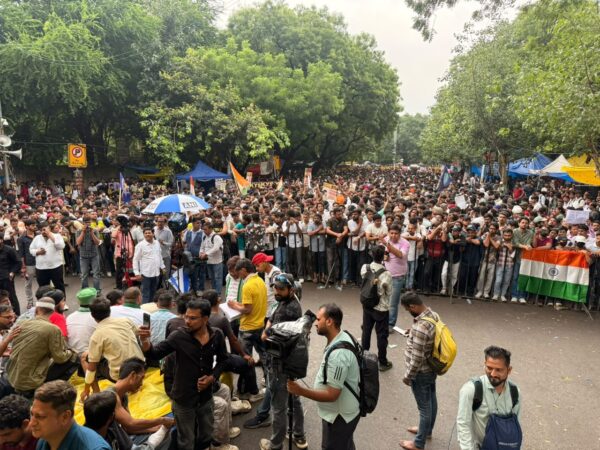
It is tempting to compare the students’ protest at New Delhi’s Jantar Mantar with Cairo’s Tahrir Square, the epicenter of the uprising that brought to an end Hosni Mubarak’s nearly 30-year rule.
The comparison, however, is only partly valid. Equating what is happening in New Delhi with Egypt’s iconic protest would be unrealistic, even if the two movements share striking similarities. In Egypt, calls to gather at Tahrir Square spread rapidly through social media, including YouTube and Facebook. Likewise, the Cockroach Janta Party, which emerged on Instagram, has used social media to mobilize thousands to assemble at Jantar Mantar and protest against the National Eligibility cum Entrance Test (NEET) examination paper leak, which has fueled widespread anger among students and, according to the movement, contributed to a tragic wave of student suicides.
The objectives of the two protests, however, are fundamentally different. The protesters at Jantar Mantar are demanding accountability from the government and the resignation of Education Minister Dharmendra Pradhan. The demonstrators in Tahrir Square sought nothing less than the end of Hosni Mubarak’s three-decade authoritarian rule. Yet the deeper similarity lies elsewhere: both movements are driven by the frustration of a generation that believes its government has become unresponsive to its aspirations and grievances.
The Jantar Mantar protest is not an attempt to overthrow the state, but a determined demand that the state honor its constitutional obligations and restore young people’s faith in public institutions. It is a physical mirror of a generation’s quiet desperation, where broken promises, shrinking opportunities, and unresponsive governance are finding a collective voice.
If the Egyptians were expressing their anger against Hosni Mubarak’s three-decade rule, during which every voice of dissent was often silenced by the butt of a gun, Jantar Mantar has lifted the lid on years of frustration over misgovernance and, perhaps more importantly, what many perceive as the arrogance of the Narendra Modi government over the past 14 years.
Calls for public accountability have frequently been met with disdain. Those seeking answers on corruption, administrative failures, or misgovernance are often dismissed, insulted, or humiliated rather than engaged with. The government’s response to successive examination paper leaks has done little to restore public confidence. Beyond transferring the education secretary to another department, no major structural reforms have been announced. Nor did Education Minister Dharmendra Pradhan publicly reach out to assuage the feelings of the students who were forced to retake the examination after the paper leak.
Another feature that demonstrates public anger against the government is that people across India and abroad are using online food delivery apps such as Zomato and Swiggy to send bulk meals — ranging from pizzas and burgers to local snacks — directly to protesters at Jantar Mantar in New Delhi. This spontaneous act of solidarity has overwhelmed the protest site with food, prompting organizers to appeal to people to stop sending more. Perhaps the biggest sign of the movement’s growing public support is that people who are unable to join the protest physically are choosing to express their empathy and solidarity by sending food to the protesters.
The movement is gathering momentum with each passing day. As the authorities attempt to curb it through brute force, the protests have only grown stronger. The more the police and paramilitary forces resort to violence, the more determined and steadfast the protesters become. History offers many examples of governments inadvertently strengthening protest movements when they respond to public anger with force rather than dialogue. Democracies possess an advantage unavailable to authoritarian regimes — they can absorb dissent through accountability and reform. Whether this government chooses that path may determine whether Jantar Mantar remains a protest site or evolves into something far more politically significant.
Jantar Mantar today stands as a barometer of India’s social contract. When thousands of educated young people travel hundreds of miles to sleep on Delhi’s pavement, they are sending a clear message that the institutions meant to hear their voices — through petitions, representations, and democratic processes — have failed them.
At its heart, this movement is demanding accountability, not upheaval. It is asking the government to restore the promise that education, merit, and hard work will once again open the door to opportunity. Whether the Cockroach Janata Party survives as an organization is almost beside the point. The larger question is whether the government chooses to listen to the generation or not.
The roar of slogans at Jantar Mantar is growing louder. It is now for the government to break its silence before it’s too late.
