

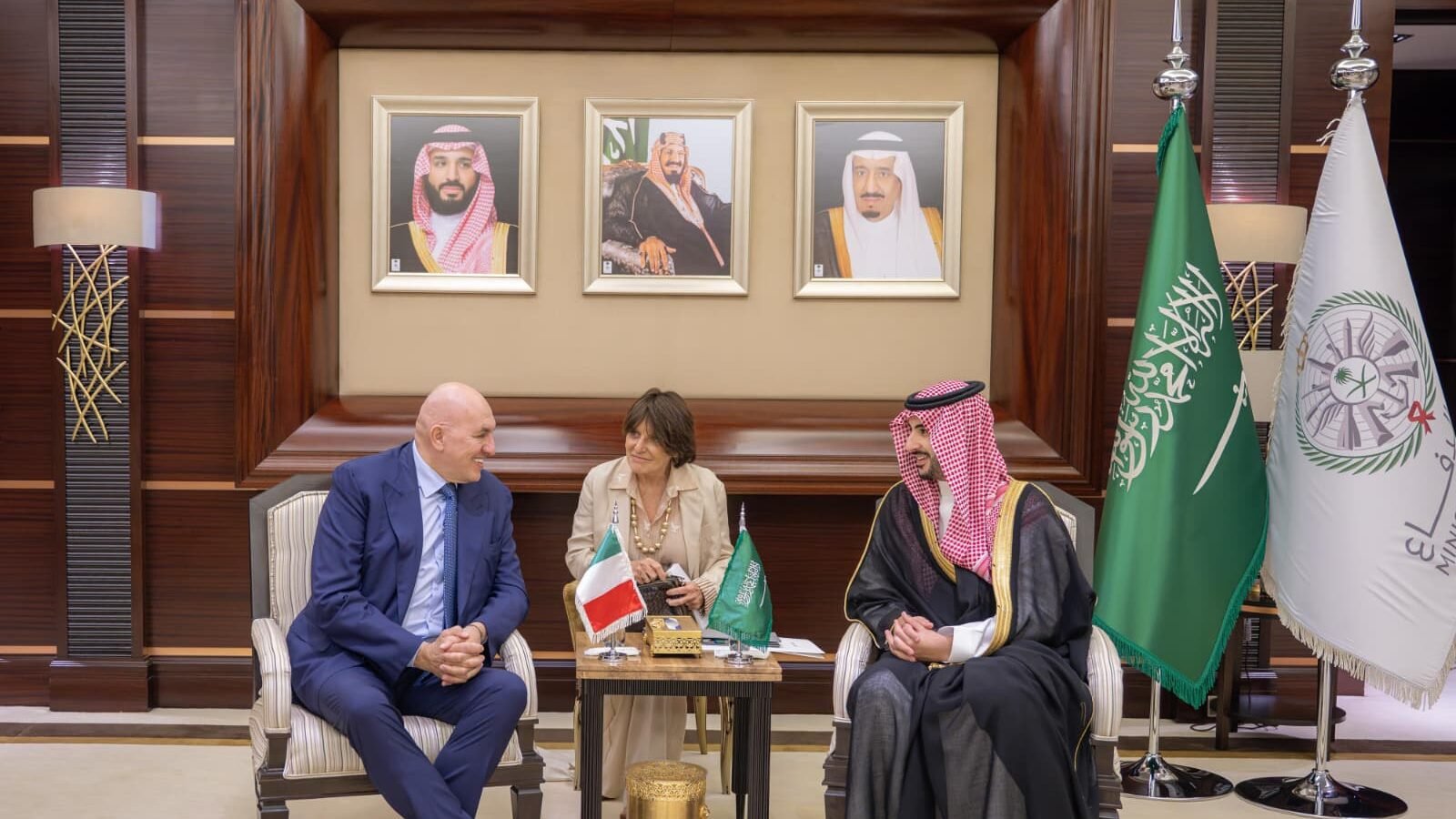
MILAN — Italy has about 700 military personnel deployed to the Gulf region to help partner nations counter Iranian attacks, a fact that recently entered the public spotlight in the country, drawing criticism from opposition parties in parliament.
Last week, the Italian Ministry of Defense disclosed publicly on its website the presence of two Italian task forces deployed across various Gulf countries to contribute to the surveillance and defense of the area.
The Italian newspaper Il Giornale first noticed the new webpage and brought Task Force Arabia to national attention on July 30 as part of a report outlining the mission’s air component. The Italian Ministry of Defense did not return a request for comment from Breaking Defense, but has argued that deployment of forces shouldn’t be a surprise since the mission was approved by parliament in March, as publicly reported at the time.
According to the ministry’s website, approximately 400 Italian Air Force personnel have been in Saudi Arabia, Bahrain and Kuwait since March, following targeted attacks on those countries from Tehran.
Under Task Force Air-Arabia, notable military capabilities have also been provided: four Eurofighters tasked with supporting the defense of the assigned airspace, E-550A CAEW aircraft for early warning of air threats, and a KC-130J transport aircraft for operational support in “key theaters of national interest in the Middle East and the Horn of Africa.”
Rome has also deployed Task Group Kuwait as part of the mission, which it said on its website “ensures air surveillance capabilities through an AN-TPS-77 air defense radar” as well as Task Group C-UAS, equipped with the Leonardo-made ACUS-E anti-drone system designed to counter small drones.
Alongside the Air Force contingent, a 260-strong Italian Army component, called Task Force Land-Arabia, has been deployed to the region, noted Matteo Mazziotti di Celso, a visiting research fellow at the Center for Military Maritime Studies, the think tank of the Italian Navy. This brings the overall Italian deployment to the Gulf region to roughly 700 personnel.
“This is certainly one of Italy’s most significant deployments to the Gulf in many years — its importance lies not only in the number of personnel, but, above all, in the quality and scarcity of capabilities sent,” Mazziotti di Celso said. “It has provided a considerable package of sophisticated air-defense, missile-defense and counter-UAS assets, some of which have only recently entered service and are available in limited numbers. Their loss or damage would therefore be significant.”
The expert pointed to a report from the Italian military magazine RID, which said that the land task force includes a SAMP/T air defense battery and a Kronos radar in Saudi Arabia.
Push-Back From Opposition
The decision to send troops has sparked criticism from some Italian opposition lawmakers, who say the deployment was made without a parliamentary mandate — a criticism the ruling Brothers of Italy party has rejected.
“Sending hundreds of soldiers to crisis areas, without Parliament’s knowledge, is not only an unacceptable overturning of an already flawed law, but is contrary to every rule of political seriousness,” a statement published last week and signed by members of Italy’s Partito Democratico said.
In an interview with the national newspaper Corriere della Sera, Italian Defense Minister Guido Crosetto defended the government’s choice, citing a parliamentary resolution adopted on March 5 that authorized Prime Minister Giorgia Meloni’s government to deploy air-defense and surveillance systems to the Gulf region, though the full scope of what that would entail appeared to have caught some in parliament off-guard.
“The deployment was possible under the new legislation allowing the government to redeploy personnel and assets within the same geographical area where Parliament has already authorized one or more missions,” Mazziotti di Celso said.
The expert called the deployment one of Italy’s riskiest active missions. However, he added that it was an opportunity for the Italian military to gain operational experience against Iranian capabilities and to collect valuable lessons on air and missile defense, counter-drone operations, and the integration of different sensors and effectors. Additionally, Mazziotti di Celso said there’s an industrial dimension to the deployment.
“Deployments are used to demonstrate advanced national capabilities — deploying systems such as SAMP/T and Leonardo’s ACUS counter-drone system showcase them under demanding operational conditions,” he said.
