

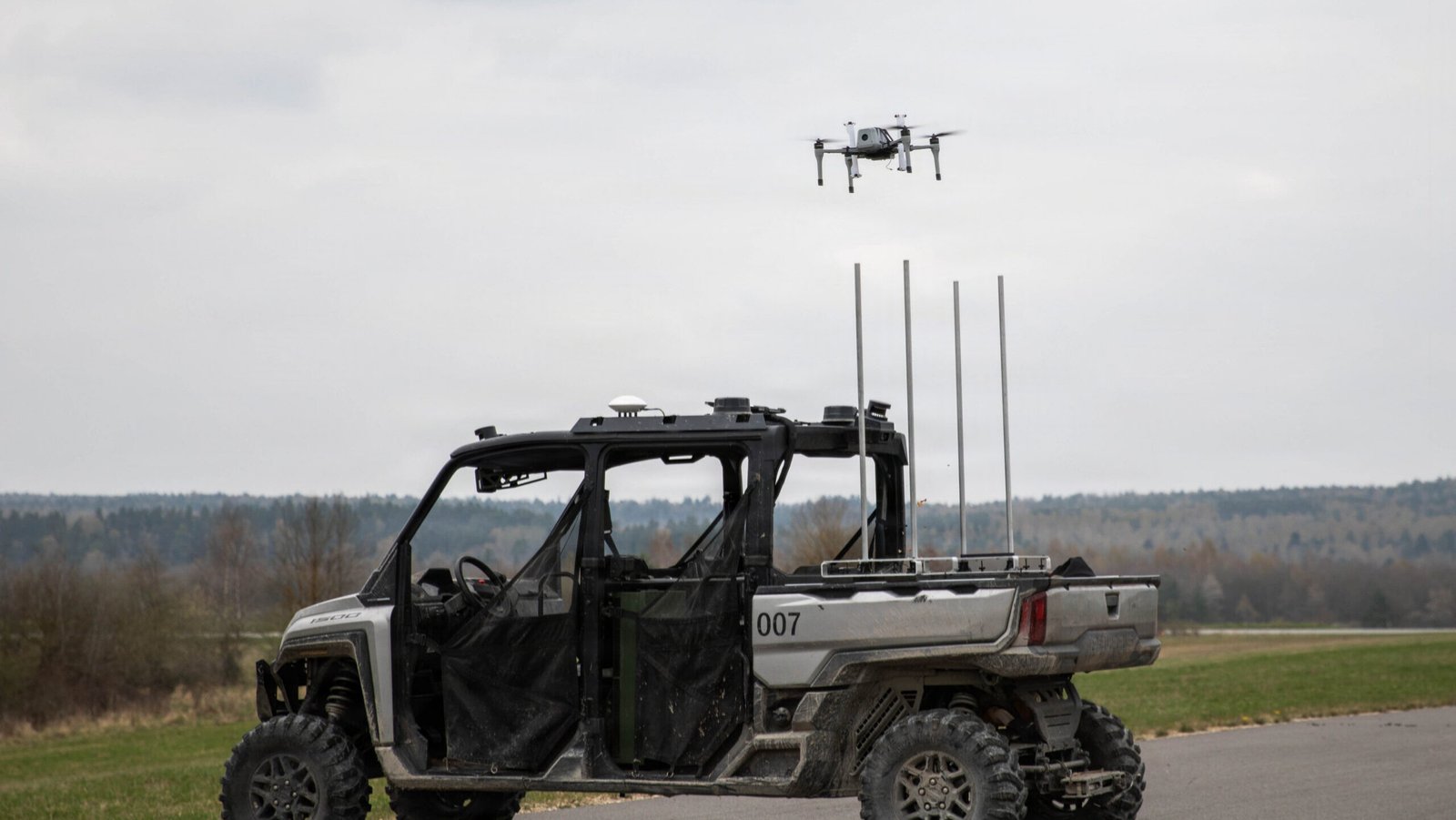
DETROIT — After ditching its original software strategy for autonomous vehicles, the Army has decided to lean on industry to build case-specific autonomous capabilities for different mission sets, an Army official told Breaking Defense.
The initial idea to have the Army develop a software backbone for its envisioned fleet of autonomous vehicles in what was called the Army Robotic Software (ARCS) program “made sense before there was robust industry investment in all of autonomy,” Michael Rose, chief technology officer for the Army’s Mission Autonomy capability program office, told Breaking Defense on the sidelines of the GVSETS conference.
“The whole premise behind ARCS was not necessarily single software, but a modular approach to acquire the pieces of autonomy from different vendors,” Rose told Breaking Defense on the sidelines of the GVSETS conference. “Now there’s awesome vendors in the space that are doing great stuff, as they demonstrate.”
The old architecture was design to allowed a few vendors to plug and play their software into the architecture on top of the Army-developed backbone, formerly known as the Robotic Technology Kernel, with hopes that a combination of capabilities would solve a given problem.
But as Breaking Defense reported late last year, ARCS was put to bed as the Army underwent a holistic reevaluation of its autonomy portfolio following a massive acquisition overhaul and long-festering struggles to get the autonomy piece of the puzzle working. Ultimately, the service decided to “stop things that don’t make sense anymore,” as Army CTO Alex Miller said at the time.
Speaking to Breaking Defense on Tuesday, Rose said now that industry has shown more robust capability, the plan is to let contractors offer more top-down solutions, teaming together ahead of time.
“GVSC [Ground Vehicle Systems Center] in particular realized that, ‘Wait a second,’ there’s better places to be investing their [the Army’s] S&T [science and technology] dollars instead of what was perceived as competing with industry,” he said. “They said, ‘We need to be figuring out what are the best ways to support the industry.’”
That way, Rose said, is to have vendors “self organize” into teams of teams that can “deliver a formation-based solution” for a specific problem set, such as logistics and sustainment or breaching.
Rose gave the example of the recently awarded Engineer Autonomous Breaching Capability (EABC) program that aims to find unmanned systems that can quickly breach obstacles and minefields on future battlefields. For the effort, Caterpillar, Forterra, IDV USA and Overland AI, who were each awarded a prototyping contract for their autonomy software solutions, organized themselves into teams where they would find a partner to provide the unmanned ground vehicle (UGV).
The Army’s reworking on how it approaches procuring autonomous software comes as the service recently moved CPE Mission Autonomy out from under Program Acquisition Executive (PAE) Maneuver Air to PAE Layered Protection and Integration. Rose said during a presentation on Tuesday that such a change was made because autonomy “can’t be easily clumped into one particular vertical” and moving the office under PAE Layered Protection and Integration allows it to support “a variety of different use cases, from fire, sustainment to maneuver, etc.”
