

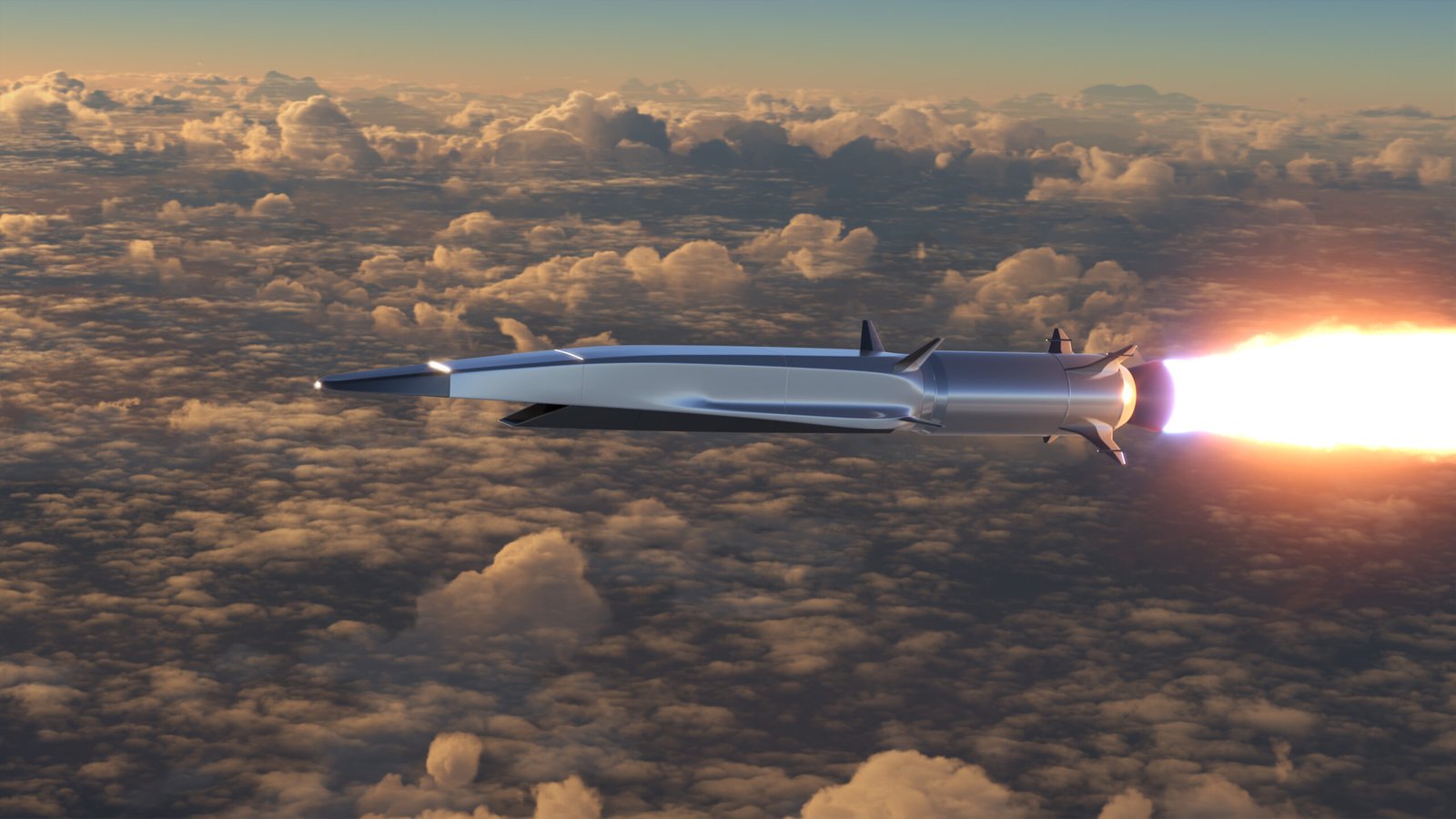
WASHINGTON — In a bid to evade increasingly sophisticated adversary air defenses, the Pentagon’s secretive research agency is seeking “radical” industry ideas that could pave the way for a new generation of hypersonic weapons, according to a government notice.
Through a request for information published Aug. 7, the Defense Advanced Research Projects Agency (DARPA) identified a need for a “revolutionary leap” in performance for traits like range, speed and altitude. The notice says DARPA’s goal is to eventually build and test a full-up demonstrator for what the agency calls the Next Generation Hypersonic Cruise Missile.
“This capability must maintain technological superiority, enabling the U.S. to promptly strike advanced threats in highly contested environments,” the notice says. “DARPA expects a Design for Manufacturing and Assembly (DFMA) philosophy to be embraced from the outset, demonstrating a realistic path from demonstration to affordable, high-rate production.”
There are broadly two types of hypersonic weapons, which are typically defined as systems that travel faster than Mach 5 and can maneuver on the way to their target. Some hypersonic missiles use a boost-glide system, where a glide vehicle exits and then reenters the atmosphere and separates from a rocket booster, skipping toward its target on descent. Others use an air-breathing propulsion system — meaning they have to operate within the atmosphere — and typically fly low to evade adversary sensors.
DARPA’s notice for a next-generation hypersonic cruise missile would fit with an air-breathing approach, similar to the Air Force’s Hypersonic Attack Cruise Missile. Air Force officials have previously pointed to air-breathing cruise missiles as possessing more operational flexibility, since they tend to be smaller than boost-glide systems. That means more types of aircraft, and potentially other platforms, can launch them. (The Air Force is also producing a boost-glide system called the Air-Launched Rapid Response Weapon that will be carried by bombers, while the Navy and Army share an overlapping boost-glide program.)
While the Pentagon has made progress in hypersonics research, it is still behind China and Russia in fielding the weapons, according to a recent Atlantic Council study. Further, DARPA’s notice says that prevailing hypersonic concepts using scramjet engines for air-breathing propulsion “often achieve predictable, incremental gains in isolated performance metrics, representing evolutionary improvements rather than the disruptive capabilities required for future conflicts.” Additionally, the notice says “legacy manufacturing processes” are often “too expensive and complex” to produce hypersonic weapons at scale.
The notice asks for input on three specific “focus areas.” One is centered on “architectural concepts and integration strategies” for a next-gen cruise missile, essentially evaluating the weapon at a system level and what advances it could offer. This would include how to employ the weapon and its size, with implications for how it could be launched. DARPA is casting a wide net, listing options like a large form factor for external carriage on bombers, a smaller form factor that could be carried internally, ground launch or even as a palletized munition.
A second is seeking “high-risk, high-reward technologies” that would underpin the weapon, including high energy density fuels, propulsion and high-temperature materials that can withstand the punishing conditions of hypersonic environments.
“This is not a modernization or incremental improvement effort,” the notice says. “DARPA seeks unconstrained, radical new subsystem concepts that can deliver a quantum leap in overall system performance and distinguish themselves completely from the current state-of-the-art.”
A third focuses on innovative testing and evaluation to accelerate development. The notice lists potential “revolutionary capabilities” like “autonomous telemetry, advanced data assimilation and novel range safety architectures” that can, in turn, “lead to a quantum leap in overall program execution efficiencies.”
DARPA often invests in demonstrating new technologies in partnership with the US military services, who could commit further funding and carry a system into production if promising designs emerge. The Air Force’s HACM, for example, was heavily influenced by a DARPA program called the Hypersonic Air-breathing Weapon Concept or HAWC.
The notice says that there may be a competitive solicitation, but also notes that the next-gen hypersonic cruise missile is a “potential new DARPA program.” Industry responses would likely inform whether such a program is viable.
DARPA is planning an industry day in September to brief interested vendors and is encouraging participation of non-traditional defense firms. Responses to the request for information are due Oct. 6.
