

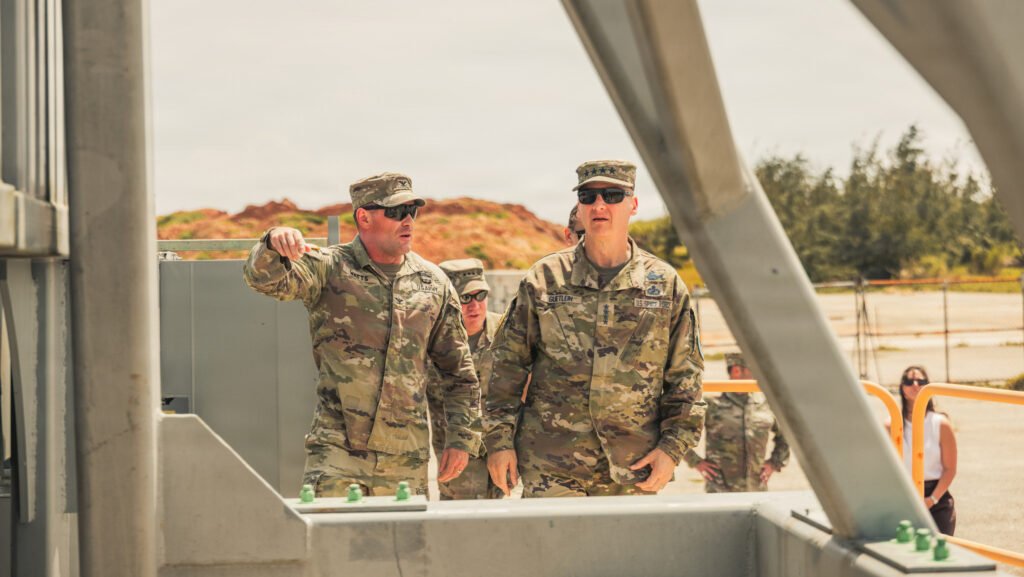
HUNTSVILLE, Ala. ― The Pentagon’s Golden Dome czar said that the 12 contenders for future space-based interceptor (SBI) development contracts have passed the first of four milestones in the Space Force’s demonstration effort.
“All of the providers that are part of the competition are progressing exceptionally well, and Gate 1 just came to a closure. I have not seen the results of Gate 1, but as I have heard back from Space Systems Command (SSC), all providers look positive and will continue into Gate 2,” Gen. Michael Guetlein told the annual Army Space and Missile Defense conference here on Tuesday.
He explained that there are four “gates,” or “tests,” under SSC’s unusual prized-based SBI competition. As first reported by Breaking Defense, the arrangement requires industry competitors to self-fund prototype development and demonstrations of space-based weapons that can neutralize enemy missiles, in hopes of winning relatively small pots of prize money along the way.
“Gate 1 is to get the design in place and do component level testing. Gate 2 is to build a capability that can go into outer space. Gate 3 is to prove that that capability works in outer space. Gate 4 is to prove that the capability actually works as part of the broader Golden Dome architecture,” Guetlein said.
“And once they get through all those four gates, four tests, if you will, in a prize-based competition, then we will make a decision: is it affordable, is it scalable?” he said.
Guetlein stressed that his Golden Dome office has not “put in any operational requests for production capabilities” and will not do so until after the contenders “prove through the prize-based competition that those capabilities … are effective, but more importantly, that they’re scalable and affordable.”
“At that point, we will then make a decision if we are going to move into production or not,” he added.
The four-star general has previously emphasized the lawmakers that the US may not pursue massive SBI constellations if it’s not financially feasible. But as it stands, all totaled, the Defense Department has slated $3.2 billion for the SBI development effort, which includes 20 contracts doled out to the 12 competing firms announced by the Space Force in April. The demonstration competition covers three flavors of SBIs for hitting adversary ballistic and hypersonic missiles, both nuclear and conventional:
- boost-phase endo-atmospheric interceptors for hitting incoming missiles within the Earth’s atmosphere shortly after launch;
- exo-atmospheric interceptors, to knock them down a little later after they have left the atmosphere; and,
- mid-course interceptors, designed to strike when the adversary missiles are partially through their flight path.
Guetlein said that the reason the demo effort was able to move so rapidly to contract is because of novel thinking by SSC’s portfolio acquisition executive (PAE), who “built a prize-based competition that did not exist before, and is changing the way we get after that capability.” Col. Bryon McClain currently serves as acting PAE Space Combat Power, which is managing the SBI effort.
Guetlein would not comment on the schedule for various SBI tests, nor on whether they would include shooting down a live or simulated targets. He referred reporters’ questions to SSC, which did not respond to a inquiry from Breaking Defense by press time.
However, according to an Aug. 7 report by Bloomberg, the first interceptor flight tests will take place next year and will continue into 2028.
The Space Force has said it intends to demonstrate an “initial capability” for SBIs in 2028, although the blueprint for the prize program said that actual intercept demonstrations are not slated to take place until June 2029.
