

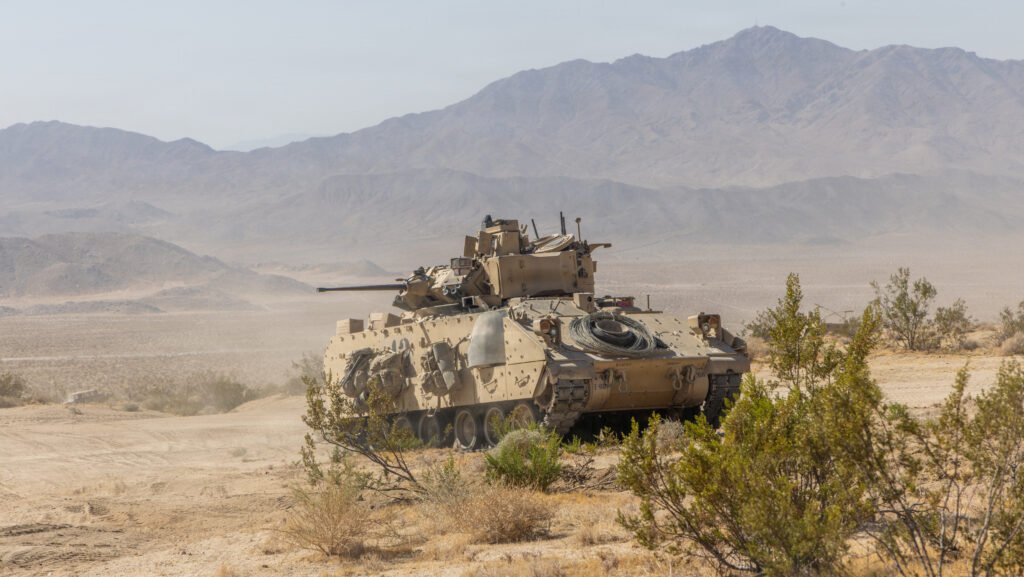
DETROIT — The Army is awaiting new fleets of M1E3 Abrams and XM30 Infantry Fighting Vehicles, but in the meantime, some of the legacy platforms its using face a “readiness crisis,” in part due to supply chain woes, a top official in the Army’s office responsible for managing the sustainment of its ground vehicle fleet told Breaking Defense.
“We have an aging fleet, and we have modernization on the horizon, but it’s not coming fast enough. We’re going to be maintaining some of these legacy platforms for decades, and so obsolescence issues that we have now, we have to live with for 20 or 30 years,” Brig. Gen. Beth Behn, commanding general of the Army’s Tank-Automotive and Armaments Command (TACOM), told Breaking Defense in an interview here at the GVSETS conference.
To help counter this crisis, TACOM is planning on holding more engagements with industry to help fix supply chain woes, Behn said, similar to the TIGER hackathon TACOM hosted last month. As Breaking Defense previously reported, the goal of that hackathon was to attempt to mend bottlenecks affecting subcomponents of the Abrams’ AGT1500 engine, nicknamed the Tiger, made by Honeywell Aerospace. (Despite its name, the event did not involve any hacking.)
According to Behn, the event, which brought together high level officials, Honeywell and over 40 other vendors, was successful in its three goals: finding second sources for the engine’s subcomponents; finding companies to utilize complex advanced manufacturing; and finding companies to provide raw materials for subcomponents.
With that, Behn said TACOM is “going to reap the benefits” from the exercise for not only the Tiger engine but other systems as well, noting that more exercises are to come.
“That approach to thinking differently about solving a problem, not just saying, ‘Ugh, gosh, we’re having a really hard time getting parts from, you know, this supplier. That supplier says that there’s nobody else that they can find to do it,’” she said.
“Well let’s cast a wider net. Let’s use both the OEM’s [original equipment manufacturer] network and whatever we can bring in through a broader network to see if there’s a different way to attack this problem.”
Behn declined to divulge specifics on what platforms are facing readiness issues, but said the problem spans “across the tactical wheel vehicle fleet and the tracked systems that we sustain,” adding that “we are looking at every lever we can pull to address those.”
Apart from hackathon-like events, Behn said curating a “closer” relationship between TACOM and the Defense Logistics Agency (DLA) will also help the readiness crisis as the DLA manages about 80 percent of the repair parts for TACOM’s platforms.
“Just more communication, more ensuring that we’re giving DLA a clear demand signal and sharing our data analytic tools that help us project and predict requirements, I think is an avenue,” Behn said. “More importantly, the communication, so that they’ve got clear visibility of our requirements. They know precisely where it is that we’d like greater investment, greater depth in the supply chain.”
Further, Behn said she’s “optimistic” that the Army’s sprawling reworking of its acquisition offices will help fill readiness gaps. She said with the new structure, one of the “most exciting things” is that sustainment is a part of the discussion earlier on in the acquisition life cycle.
For example, she said, she’s in the room when decisions are being made surrounding the development and acquisition for the M1E3 Abrams tank and the replacement the XM30, two vehicles that have yet to fielded.
“So there’s an accountability and inclusion of all of those supporting entities from the beginning. But I’m just optimistic. I mean, time will tell whether all of the promises come forth as we hope that it will,” Behn said.
