

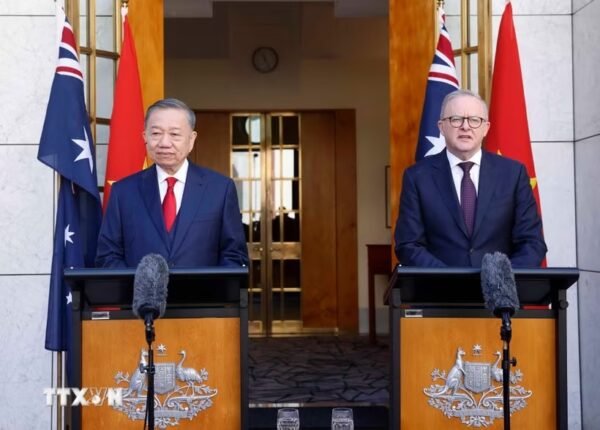
Vietnamese President To Lam’s visit to Australia this week highlighted the burgeoning relationship between the two countries. Given that much of Australia’s large Vietnamese diaspora remains suspicious of the Communist Party of Vietnam – and South Vietnam flags are often seen flying in suburbs with a concentration of Vietnamese Australians – there is a domestic balancing act that the Australian government needs to perform. However, the convergence of interests between the two countries is now proving the stronger pull.
The focus of Lam’s visit was on new economic and security agreements. The now dominant lens of Australia’s foreign policy perceives economic security as a central pillar of national security.
The economic angle is where the most movement is already happening. Since 2020, two-way trade has doubled, with Vietnam now approaching Australia’s list of top ten trading partners. The specific measures announced this week were mostly incremental: greater agricultural access (including kangaroo meat), and creating smoother services within e-commerce and banking sectors. The low-cost airline Vietjet confirmed it will fly into the new Western Sydney Airport, due to be opened later this year. These are not transformative arrangements, but things that push the relationship forward in important ways.
The major development was Vietnam approving a license for the Royal Melbourne Institute of Technology (RMIT) to open a campus in Hanoi. The university had already established a campus in Ho Chi Minh City in 2000, and has been keen to establish itself as a major driver of the bilateral relationship, including through the creation of the Australia Vietnam Policy Institute to facilitate building the relationship between the two countries. This is part of a broader push by the Australian university sector to embed itself in Southeast Asia, with four other universities operating in Malaysia and Indonesia.
Although starting from a low base, the two countries’ security relationship has begun to deepen. This is being driven primarily by shared concerns about China’s activity in the South China Sea. Within their updated Joint Vision Statement, Canberra and Hanoi identify a more challenging regional security environment, marked by strategic competition and military build-up in the Indo-Pacific, and express a shared commitment to a rules-based regional order. Although not mentioning China directly, the statement emphasizes a respect for sovereignty and international law, and the importance of peace and stability in the South China Sea, including freedom of navigation and overflight and adherence to UNCLOS.
To facilitate this vision, the countries have been institutionalizing dialogues through regular meetings between defense and foreign ministers. Yet there is now an attempt to create more practical and substantive cooperation through maritime security, defense intelligence and information sharing, cybersecurity, humanitarian assistance and disaster relief, counterterrorism, military medicine, and the defense industry. The two countries also intend to increase bilateral military education and training as well as multilateral exercises, and seek out paths to greater interoperability.
A key element to this is filtering cooperation through regional cooperation. The phrase “ASEAN centrality” has become something of a shibboleth repeated by the Australian government when seeking to enhance relations with Southeast Asian countries. It may have less than solid practical implications, but it is how the region wants to frames its diplomacy and engagement, and so it is necessary for Canberra to respect that.
Due to this, the Joint Vision Statement declared that Australia and Vietnam will work more closely through ASEAN-led mechanisms, particularly the ASEAN Defense Ministers’ Meeting-Plus – the annual platform established in 2010 that enables the 11 ASEAN member states to engage with external dialogue partners for regional defense cooperation. Such dialogues are important confidence building mechanisms for Australia and Southeast Asia.
Australia’s approach to Southeast Asia is based on the idea that no single tool is enough to protect and advance its interests. This means that greater agricultural access, digital economy agreements, and a new university campus in Vietnam are all complementary to securing greater defense cooperation. Each creates a web of intersecting ties that can prove resistant to any potential shocks or attempts at coercion.
In Vietnam, Australia has a receptive partner as its own diplomatic approach has a similar logic – diversify economic and security ties across as many partners as possible so that no single relationship, and no single power, gains leverage over Vietnamese decision-making. While some in the Vietnamese diaspora may be displeased with the To Lam’s visit, the foreign policy objectives of Australia will overwhelm their protests.
