

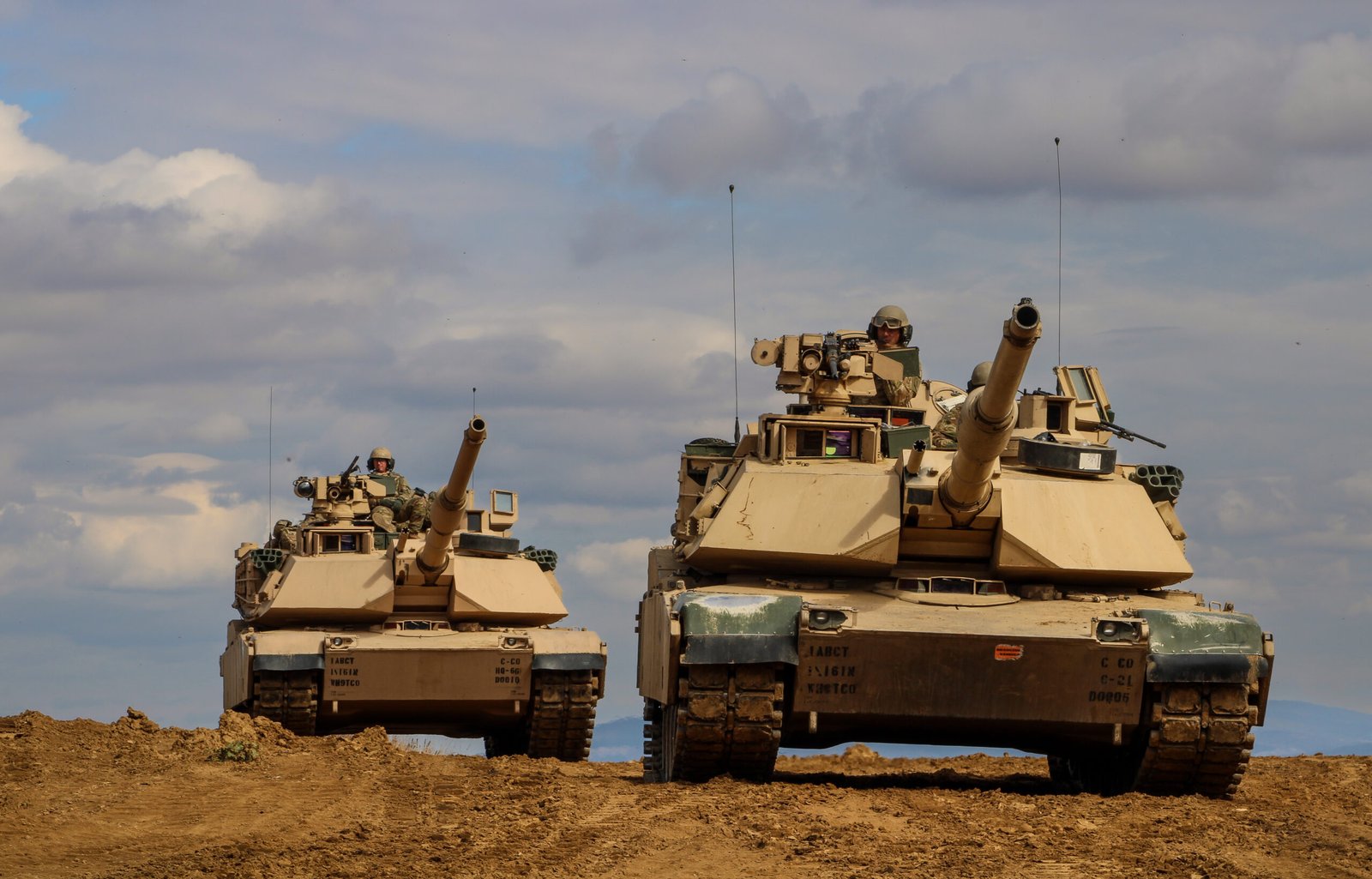
DETROIT — Army ground units don’t have enough exportable power on their vehicles to charge drones, communications systems or command posts, and the service is urging industry to find solutions quickly, as new, energy-intensive weapons roll out to the force.
“Every formation we have today is underpowered. Every single one of them, and more power requirements are coming,” Brig. Gen. Troy Denomy, program acquisition executive for maneuver, told an audience here at the GVSETS conference’s keynote address Thursday.
“New counter-UAS [unmanned aerial systems] are going to show up. Next [Generation C2] is going to show up. There are other programs that we have to be mindful of coming in. So, how do we solve our power problem across our formations? And it’s not by buying more generators,” he continued.
Legacy vehicles in the Army’s current fleet, like the M1A2 Abrams, Bradley Fighting Vehicles and those in the tactical wheeled family, were not built to generate the power needed to charge and run the current systems the Army is increasingly relying on — not only drone and counter-drone systems, but also increasingly complex command posts.
“When I talk to brigade commanders, sitting brigade commanders, their number one problem is how do they have and how do they plan for recharge cycles to keep their UASs in the air, and they don’t have enough ability to do it organically,” Denomy said. “So they’re having to meter how many UASs they can actually put in the air, not because of what the mission dictates, but because of how much power they have available.”
Though generators supply extra power to troops, the equipment is noisy and easy for adversaries to spot, Alex Miller, the Army’s chief technology officer, explained during the keynote with Denomy.
“Generators are loud. They create a lot of visual signature. They create a lot of thermal signature, and we have to get past that,” Miller said.
Simply acquiring more battery packs is also not a solution, Denomy said, as they put more burden on the soldier.
“Solutions that [are] presented to me [are] like, ‘Well, just give them another battery.’ You walk with five batteries in your pack for eight hours, and tell me how your feet feel,” Denomy said. “And you got to fight when you get there, right? So just adding batteries is not the solution.”
Though Denomy didn’t provide specific capabilities that could enhance power on legacy vehicles, he did mention that there are some new technologies that “are really encouraging with fuel cells.”
Denomy also pointed to the fact that some of the new vehicles, like the XM30, set to replace the Bradleys, and the M1E3 Abrams, set to replace the M1A2s, provide more exportable power. The heavy variants of the service’s Infantry Squad Vehicle are also being designed to generate more exportable power, as Breaking Defense previously reported. Similar technology outfitted on legacy vehicles would be ideal, Denomy said.
Further, the Army has been fielding some “next-gen” power management solutions, Miller said, though he didn’t get into the specifics. Miller said that, in addition to finding alternatives to batteries and generators, the Army is also looking to find alternatives for liquid fuel.
“We have got to change the fact that liquid fuel is still the most power dense, efficient way to move energy across the battlefield. We’ve got to change that,” Miller said. “Those are the types of things that we need your help, that I truly believe that only this crowd — because you’ve been doing it for literally since World War II — can help us solve those problems. So, please dig into those things.”
