

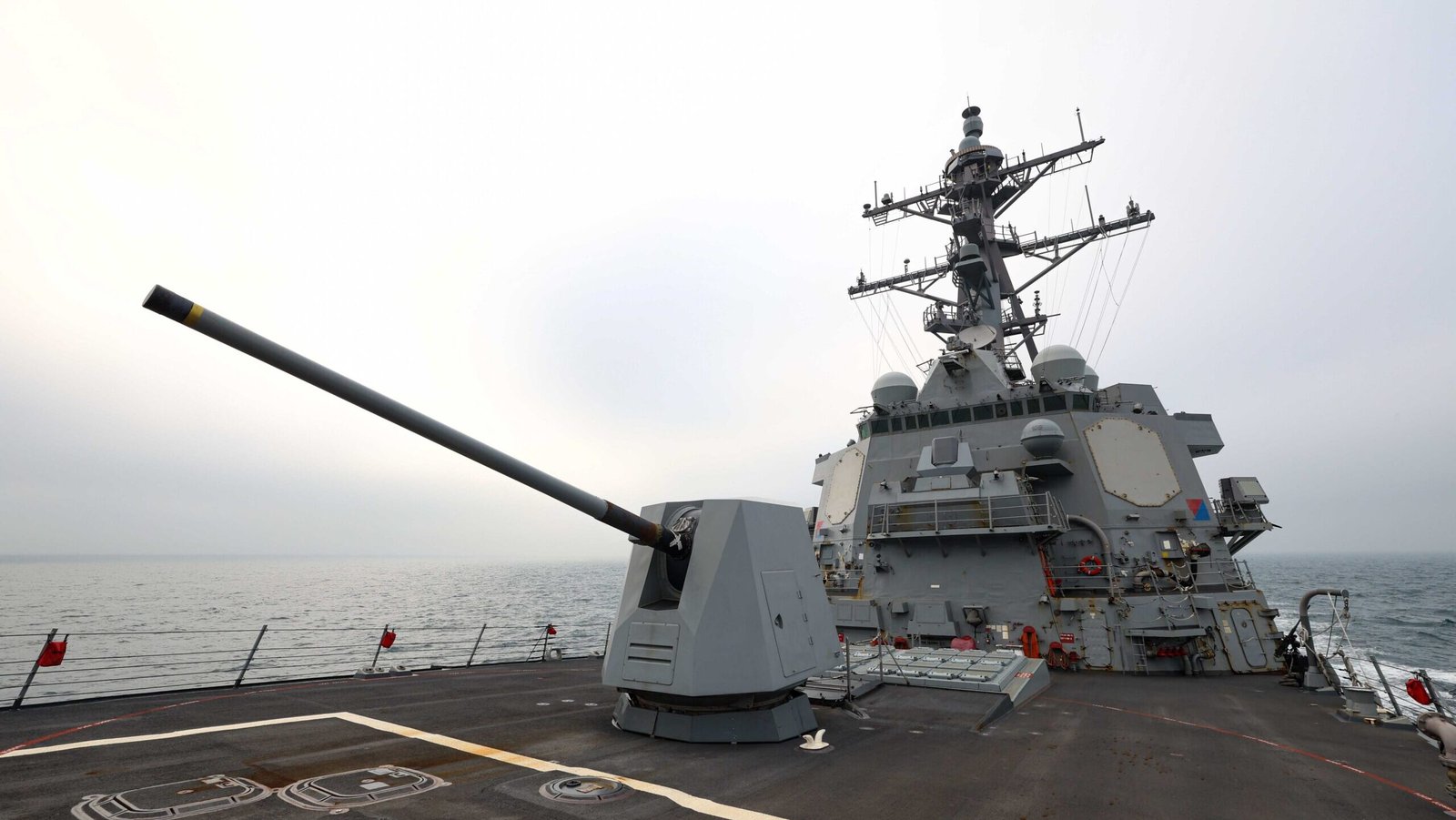
In December 2025, high-intensity Chinese military exercises around Taiwan featured, for the first time, a mock comprehensive air and naval blockade of the island. Weeks later, a pair of US naval vessels entered the Taiwan Strait to carry out the first naval transit of 2026.
While the transit provided reassurance to some regional capitals, especially Taipei, it remains the only publicly declared transit the US Navy has initiated in the Taiwan Strait this year, and one of only three since the start of the second Trump administration. That marks a substantial decrease from prior years, which — at a time when Chinese military coercion has intensified — raises some serious concerns.
Our analysis of Taiwan Strait transits — which draws data from official statements of both the US government and foreign governments, news reports, US naval press reports, and existing databases, including the Taiwan Security Monitor — tracked 28 naval transits under the first Trump administration and 32 under the Biden administration.
In contrast, current rates project only 14 publicly reported transits for the entirety of Trump 2.0 — in what would amount to a 50 percent decline from Trump 1.0 and a 56 percent decline from the Biden administration.
If America’s presence in one of the world’s most contested waterways is quietly fading, the strategic ramifications could be serious.
Rarely out of the headlines, the Taiwan Strait has long been a site of sporadic flare-ups caused by competing territorial assertions. China has declared the Strait to be its territorial waters, but virtually no other country, including the United States, recognizes that claim as lawful or legitimate. Military transits through the Strait have become an important tool in preventing the normalization of Beijing’s illegitimate claims. In the Strait, these operations deliberately challenge unlawful assertions by sailing through unilaterally declared zones to contest unrecognized authority.
More importantly, transits project American military presence at a time when Chinese warships and aircraft have become routine fixtures around Taiwan. Since 2022, when then-US Speaker of the House Nancy Pelosi visited Taiwan, Chinese air and naval presence has become alarmingly commonplace, with incursions into Taiwanese airspace and the island’s surrounding waters happening on a near-daily basis. On any given day, roughly five or six warships surround Taiwan at all times. China’s “daily activity around the island, near weekly joint combat patrols, and response exercises conducted during periods of heightened political tensions,” the US Department of Defense’s 2025 China Military Report assessed, have all set successive yearly highs.
The severing of undersea cables and lately the unlawful stops and inspections of Taiwanese vessels are part of Beijing’s “salami-slicing” tactics aimed at draining the vigilance of Taiwan’s government. Still, Beijing has held off on launching an all-out invasion of the island for now. The prospect of US involvement — a perception partly sustained by routine naval presence — threatens to complicate China’s effort to achieve the “strategic decisive victory” that Chinese President Xi Jinping envisions.
Transits give the US Navy practical experience navigating the Strait and if there is a prolonged decline in Taiwan Strait transits, Washington loses that operating experience and could possibly embolden Beijing to pursue coercive, illegal and destabilizing military activities with greater confidence.
Of course, some analysts disagree with the importance of these transits. Taiwan Strait transits “are just one aspect of U.S. military presence,” former Pentagon official Drew Thompson argued, “so they should be judged qualitatively, not quantitatively.”
While true, naval transits play an outsized role in signaling non-recognition of unlawful Chinese maritime claims precisely because of their visibility and regular occurrence. Following a joint passage of US and Canadian warships through the Strait in October 2024, for instance, Taiwan’s Ministry of Foreign Affairs lauded the transit as demonstrating “concrete actions to safeguard Taiwan Strait peace,” noting it was “the fourth joint transit in under two years.” These transits are among the clearest ways for the US to express its commitment to navigational rights in both word and deed.
Some observers posit that the dip since the start of Trump 2.0 is the result of the US Navy engaging in “silent transits,” in which the Pentagon declines to publicize passages to dampen tensions with Beijing. China has in the past publicly denounced Taiwan Strait transits and urged Washington to stop creating “public hype.” Taken together with President Donald Trump’s expanding receptivity to greater diplomatic and economic cooperation with Beijing in his second term, this explanation certainly seems plausible: The transit of the USS Higgins and HMS Richmond in September 2025 was not publicly advertised but later confirmed through a Pentagon official. No press release was provided by the US Navy.
While these “silent transits” are preferable to no activity at all, publicly declared naval operations send a broader signal to allies and the international community. A sudden drop in them can degrade perceptions of American priorities and credibility in both friendly and hostile capitals.
It’s also not the time for long-running demonstrations of US presence, commitment and deterrence to be decreasing. It’s not as if China’s maritime coercion has been shrinking in a cycle of mutual de-escalation; to the contrary, it has been accelerating.
Fewer public transits are taking place under Trump 2.0, at a time when Chinese maritime forces have grown more bellicose. While undeclared transits may be filling this gap, there is a real risk that American allies and partners—let alone Beijing—could misinterpret the Trump administration’s strategy as a retreat on American commitments. Perceptions of that kind, once formed, can become difficult to reverse.
The Pentagon, therefore, should return to the standard tempo of publicly announced routine transits established across the last two administrations.
Allen Zhang is a researcher in the Heritage Foundation’s Asian Studies Center, where he contributes to the Center’s research on Taiwan and China policy. Charity Ihrman is a member of Heritage’s Young Leaders Program.
