

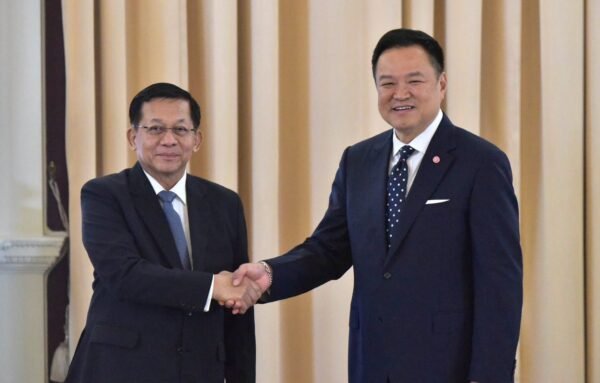
On August 6, Thailand’s Prime Minister Anutin Charnvirakul rolled out the red carpet for Myanmar’s military-appointed leader Min Aung Hlaing. During the two-day visit, Anutin pledged to work with Myanmar to eventually reintegrate the country into the Association of Southeast Asian Nations (ASEAN), which has excluded it from its summits since late 2021. The two countries also signed three memoranda of understanding in labor, water, and space cooperation during the visit. Min Aung Hlaing also visited the Thai parliament and invited Thai business leaders to invest in the war-torn country.
The invitation to Min Aung Hlaing was opposed by Thai civil societies and activist networks. Most notable is the protest by a Thai MP who shouted calls for peace and humanity during his appearance in the parliament. For the junta leader, the trip served as a major diplomatic win due to the relative diplomatic isolation that he has faced since the military coup of 2021.
Obviously, Thailand is the foreign country most directly impacted by Myanmar’s civil war, from massive inflow of legal and illegal migrants into the country to cross-border crime and scam networks. Thus, it is understandable that Thailand would want to work to reduce tensions within Myanmar, especially the Thai-Myanmar border, and to promote peace and stability.
What is significant and puzzling is its increasing divergence from ASEAN in addressing the crisis. By officially inviting Min Aung Hlaing to visit Thailand, the Thai government has arguably lent legitimacy to the junta leader without requiring any efforts at implementing ASEAN’s Five-Point Consensus. As Professor Thitinan Pongsudhirak from Chulalongkorn University recently argued, this not only diverges from the ASEAN approach to the conflict but also creates difficulties for the Philippines, the current ASEAN chair, and for Singapore, which will take ASEAN’s helm in 2027.
Why Thailand is adopting such a unilateral and divergent approach from its ASEAN counterparts is muddled. On one hand, Thailand is optimistic that what it refers to as “calibrated reengagement” towards Myanmar will eventually yield concessions and cooperation from Myanmar’s side. Citing detained leader Daw Aung San Suu Kyi’s recent meeting with a representative from the International Committee of the Red Cross, Anutin claimed that the situation in the country is moving in the right direction. Thai Foreign Minister Sihasak Phuangketkeow also stated that Myanmar would undertake further positive steps and allow ASEAN representatives to meet with Aung San Suu Kyi.
Thailand is thus trying to advocate a softer and more accommodative approach to Myanmar. In doing so, they claim that their approach is more effective or would yield positive results in the near future. This also reflects Thailand’s growing impatience with the ongoing situation in Myanmar and with ASEAN’s approach to the conflict. The Thai government’s move could be interpreted as a conclusion that ASEAN’s stance of excluding the junta leader and his government from the bloc’s summits made the latter increasingly uncooperative, limiting ASEAN’s ability to persuade it to make concessions, such as the release of Daw Aung San Suu Kyi and the resumption of inclusive political dialogue.
Thailand’s incongruent, if not contradictory, approach to Myanmar’s conflict with ASEAN has broader implications and consequences beyond its strong urge to resolve the crisis along its western border. Ultimately, it could undermine and challenge ASEAN’s collective approach to the crisis. Despite growing dissatisfaction towards ASEAN by both outsiders and the Burmese public in handling the crisis and the implementation of the Five-Point Consensus, ASEAN has taken several unprecedented steps, most notably the exclusion of the military leaders and political appointees from high-level summits and ministerial meetings.
According to some analysts, ASEAN has been undertaking some creative reinterpretations of its founding principle of non-interference, while simultaneously adhering to it. It has framed the Myanmar conflict as having “adversely impacted regional stability,” implying that the crisis is not merely an internal affair, while also acknowledging that the solutions must be “Myanmar-owned and Myanmar-led.” Successive ASEAN chairs have broadly held the same line, despite slight shifts in approaches from year to year, demonstrating consistency and consensus in the bloc’s position.
In this regard, even though Thailand claims to adhere to the Five-Point Consensus, its recent policy of calibrated reengagement with Myanmar’s military-appointed government, and its most recent invitation to Min Aung Hlaing onto Thai soil, without progress in the implementation of the Five-Point Consensus, is a direct challenge to ASEAN unity. Just recently, the ASEAN special envoy on Myanmar, Philippine Foreign Secretary Ma. Theresa Lazaro said that Myanmar’s readmission to ASEAN was still “far off” without significant progress in the implementation of the Five-Point Consensus. This explicitly contradicts Thailand’s pledge to reintegrate Myanmar into ASEAN. Meanwhile, Myanmar has shown no intention to make progress on the Consensus; indeed, it has openly criticized it. Thailand’s unilateral approach also undermines the bloc’s unified position on the crisis, as two observably different approaches are now running in parallel.
The effectiveness of Thailand’s approach will be tested over time, although there is little hope of achieving genuine peace and stability by accommodating the military-appointed government and by excluding various stakeholders, particularly the revolutionary groups and ethnic organizations, from engagement. At the same time, Thailand’s Myanmar gambit tests ASEAN’s consensus on the crisis and may, in the longer term, erode ASEAN’s role as a regional actor in promoting peace and stability.
