

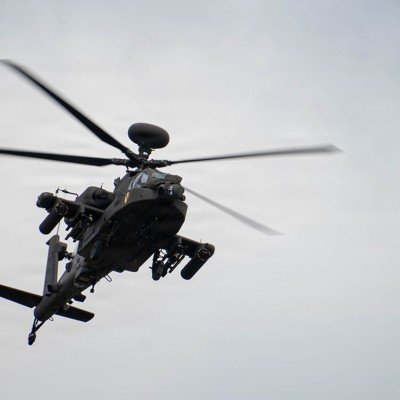
Army officials plan to resume Apache training flights in days, after the fleet was grounded following a crash that left two soldiers dead in Texas, according to an internal memo reviewed by Defense One.
The two soldiers, Chief Warrant Officer 2 Deontre T. Huey and Warrant Officer Seth L. Olmstead, died during a maintenance test flight out of Fort Hood on Aug. 12. On Friday, Army officials announced a stand down of AH64 Apache training flight operations and said in a news release it “will remain in effect until we have a better understanding of the root cause of the accident.”
However, a widely circulated internal Aug. 14 memo reviewed by Defense One said the grounding “concludes on midnight Tuesday,” with plans for “flight operations resuming on Wednesday 19 August.” The document acknowledges that from fiscal year 2023 through this year, the Army had nine fatalities from nineteen Class A mishaps, the term used for the service’s deadliest and costliest incidents.
“During the Army aviation AH-64 fleet safety stand down, commands will focus on aviation academics and safety related topics,” the memo states. “Senior commanders will be involved during the aviation safety stand down. Opening remarks shall be provided by general officers, who will articulate the importance of this event. Commanders will review, brief, and discuss an overview of current safety statistics and trends.”
Safety stand downs are common after military crashes, but the current Apache grounding marks the latest in a recent string of safety mishaps for the storied attack helicopter. Three months ago, Defense One exclusively revealed a transmission problem that could “result in loss of tail rotor thrust, electrical power, and hydraulics. Some of the AH-64 Echo models had to be grounded as a result. Prior to that investigation, there had been at least three Apache incidents—including one crash during a maintenance flight out of Fort Hood, according to photos and information from a pilot.
While investigations into the crash are ongoing, a U.S. official told Defense One the service was “able to eliminate the transmission as a causal factor.” The official confirmed the Apache fleet would resume training flights this week.
A Boeing executive told Defense One on the sidelines of the Farnborough International Air Show in the United Kingdom last month that they couldn’t share the progress on fixing those transmission problems.
“Boeing does have crews that are there working with the U.S. Army on some of those components,” said Mark Ballew, Boeing Defense, Space, and Security’s senior director of business development and strategy for vertical lift. “So our team’s been there, they’ve been working there for the last month-plus on that.”
A Boeing spokesman told Defense One on Sunday the company is still working with the Army on the transmission problem.
Apaches are being relied on heavily during the ongoing war in Iran, are part of major foreign military sales this year, and have been used for high-level transportation of Defense Department leaders and celebrities.
Officials wrote in Friday’s memo that “CENTCOM deployed formations are exempt from the safety stand down requirements.”
In June, an Apache went down near the coast of Oman while “patrolling international waters,” according to U.S. Central Command. After the helicopter was reportedly struck by an Iranian drone, the U.S. military deployed a Navy drone boat to rescue the downed crew.
