

A video clip of India’s Road Transport and Highways Minister Nitin Gadkari is going viral these days in which he claims that a Dubai prince once asked Prime Minister Narendra Modi to “export” him to Dubai for six months.
According to the minister, the Dubai royal was so impressed by India’s rapidly expanding road infrastructure that he wanted Gadkari to replicate it in Dubai.
Both Modi and Gadkari, while highlighting the success stories of India’s highway construction, claimed that India is now using space technology in road construction and that by 2024, India’s roads could be comparable with roads in the United States.
It is a good story. It is also an irresistible one for a politician who has spent more than a decade selling India’s highway construction as one of the great success stories of the Narendra Modi era.
There is no doubt that India has developed a vast network of roads connecting major cities and reducing travel time.
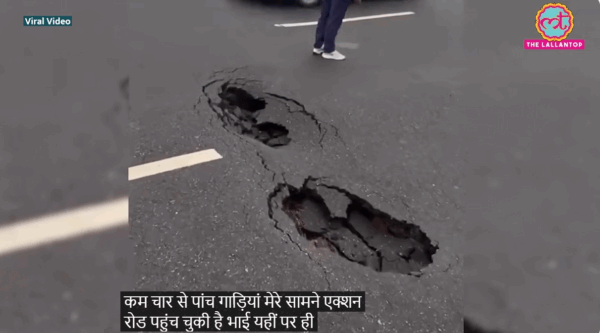
However, these much-hyped expressways have not withstood the stress test of even the season’s first rains.
India’s social media has been flooded with video clips showing how these expressways have developed potholes and cracks during the first spell of the monsoon this year.
The biggest story was the Delhi-Dehradun Expressway, inaugurated by Modi on April 14 at a reported cost of about $1.258 billion, which developed large potholes and cracks just three months after its opening.
The biggest ridicule was directed at the government when the Kanpur-Lucknow Expressway, barely weeks after its inauguration, caved in. To avoid embarrassment, the government launched repair works, but the sight of industrial electric fans lined up along a freshly built expressway to dry out waterlogged soil further dented the government’s claims.
Then came the Pune-Mumbai Expressway Missing Link, built at a cost of about $701.93 million. Pothole-like patches appeared on the newly inaugurated stretch after the first waves of monsoon rain.
The Delhi-Mumbai Expressway has not escaped the monsoon stress test. A contractor’s contract was terminated by the National Highways Authority of India (NHAI) after repeated failures to meet contractual requirements.
Indians are accustomed to navigating potholes during the monsoon season, but deep craters on high-speed expressways could be life-threatening for drivers.
The newly built expressways and national highways across and between major Indian cities have developed cracks, potholes or structural failures soon after opening, raising serious questions about construction quality, supervision and accountability.
Gadkari, who was already facing people’s outrage over adding ethanol to petrol, has disappeared from public life. One doesn’t know whether he attended the recently concluded monsoon session of Parliament.
The NHAI has initiated proceedings to declare PNC Infratech, the developer of the Lucknow-Kanpur Expressway, a non-performing contractor after glaring lapses emerged in the construction quality of the newly inaugurated corridor.
The Times of India, in its editorial titled “Pothole Nation,” said this characterizes recurring highway craters as systemic failures stemming from corruption and poor construction oversight.
In an article titled “It’s roads to ruin as Indians count cost of Modi, the motorway PM,” The London Times argued that Modi’s infrastructure boom is impressive in scale but increasingly marred by poor construction and failures. The newly built roads, bridges, airport roofs and underpasses have repeatedly developed serious problems.
It pointed to around 170 bridge collapses between 2021 and 2025, causing about 200 deaths, along with several airport and road failures.
The potholes and cracks will be repaired in due course, but no action can repair the damage to the Modi government’s image as a champion of a corruption-free India.
