

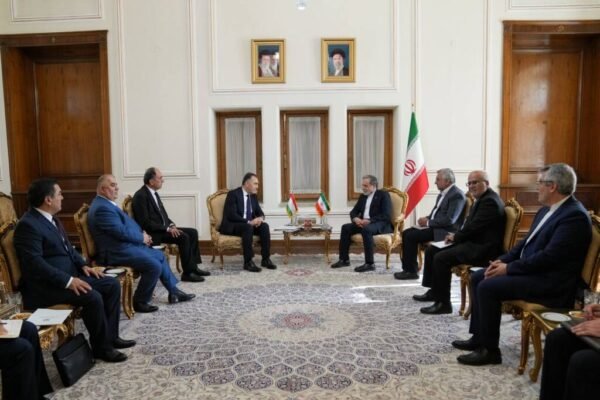
Tajikistan and Iran have reportedly finalized the framework of a long-term agreement for the export of Iranian oil to energy-starved Tajikistan. The announcement comes a month after the two sides signed an agreement to establish a logistics corridor through Afghanistan.
Russia supplies an estimated 90 percent of Tajikistan’s oil product imports. Given increased Ukrainian attacks on Russian oil infrastructure, all of Central Asia is feeling the fuel pinch. This comes also as the U.S. conflict with Iran continues past a 60-day deadline the two sides set for an agreement in June. Pressure on global energy markets abounds and Central Asian governments are scrambling to find alternative suppliers and routes. Tajikistan has turned to Iran, among others.
A high-level Tajik delegation led by Minister of Energy and Water Daler Juma met with his Iranian counterparts in Tehran on August 15. As reported by RFE/RL’s Tajik Service, Ozodi, Dushanbe says that the possibility of importing Iranian oil products to Tajikistan, including diesel fuel, jet fuel, and crude oil, were discussed. Iran’s semi-official news outlet, Mehr News Agency, specified that the two sides had finalized a framework and agreed to set up a working group, “to examine the technical and logistical details of the cooperation.”
The devil is always in the details.
What’s clear is the need on Tajikistan’s end. In July, Juma told Ozodi that Tajikistan had fuel reserves that would last for around 60 days. Meanwhile, prices across the country have escalated and some regions reported shortages of diesel fuel, lines at gas stations, and rationing. Even earlier, a World Food Program market update on Tajikistan in June noted that while food price rises had eased, fuel costs continued to escalate. As of June, diesel prices were 21.1 percent above the five-year average and petrol prices were 13.2 percent above average.
“The entire world is facing energy challenges these days, especially Tajikistan. We’re trying to increase fuel supplies from Iran while simultaneously addressing logistics issues,” Juma said in the wake of the recent talks, according to AsiaPlus, a Tajik news outlet..
In mid-July, following a meeting in the Iranian city of Mashhad, Tajikistan, Iran, and Afghanistan signed a transit agreement paving the way for overland shipments of Iranian commercial cargo through Afghanistan to Tajikistan. A trial shipment was being planned for August.
Tajikistan and Iran traded goods worth $119.6 million in the first three months of 2026, according to Tajik government statistics, an 8 percent increase compared to the same period last year. Trade between the two primarily transits the South Caucasus, Turkmenistan, and Uzbekistan. A route through Afghanistan makes logistical sense, but it may not be secure enough to form a practical link in the short term.
Afghanistan’s Badakhshan Province, which borders Tajikistan, has become a growing site of conflict, particularly with the emergence of a new resistance group – Sipahiyan-i-Mihan – which managed to briefly capture a district seat last month.
