

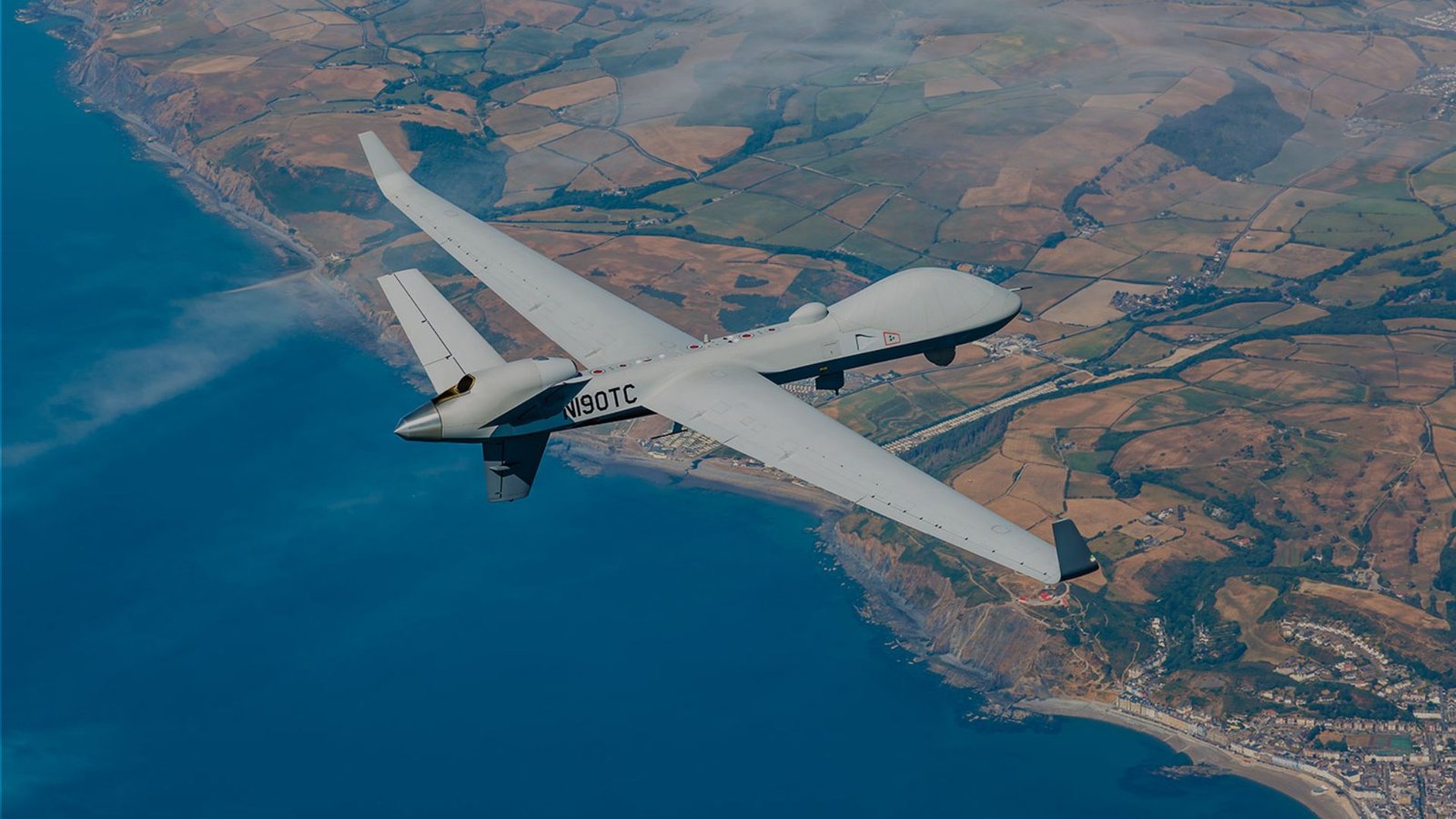
On 17 August 2026, the Government of India signed a USD $203 million deal with General Atomics Aeronautical Systems (GA-ASI) to lease two MQ-9B SeaGuardian high-altitude, long-endurance (HALE) unmanned aerial vehicles (UAVs) to the Indian Navy (IN) for 30 months.
Currently, the IN operates two leased MQ-9Bs under a contractor-owned, contractor-operated (COCO) arrangement dating to November 2020, and that contract will end in early 2027. The new pair keeps an orbit running until the 31 MQ-9Bs India ordered in 2024 start arriving.
Through the MQ-9B, the IN – alongside the Indian Air Force (IAF) and Indian Army (IA) – will reinforce three core capabilities. The first one is a wide-area intelligence, surveillance, target acquisition, and reconnaissance (ISTAR) net. This will be done through a 360-degree surface search radar alongside two electronic support measures (ESM) suites and a communications intelligence (COMINT) payload. The second capability is an extended anti-submarine warfare (ASW) search net through the AN/SSQ-62F directional command-activated sonobuoy system (DICASS), the AN/SSQ-53G directional frequency analysis and recording (DIFAR) sonobuoy, and the AN/SSQ-36 bathythermograph. And finally, the third capability is strike, namely using AGM-114R Hellfire air-to-ground missiles and GBU-39B/B Small Diameter Bombs (SDB).
It is also worth noting that the MQ-9B seamlessly integrates into the IN’s wider ISTAR ‘stack’, adding to the P-8I Neptune and the MH-60R Seahawk. Thus, when it comes to ISTAR, ASW, and anti-ship warfare (AShW), the IN will operate a fully networked and interoperable system cutting across large, long-range fixed-wing patrol aircraft, multi-mission rotary crafts, and, not least, advanced HALE drones.
