

Vietnam’s government on Friday expressed its opposition to “illegal” reclamation and construction activities in the Paracel Islands, after reports emerged of fresh Chinese construction activities in the contested South China Sea archipelago.
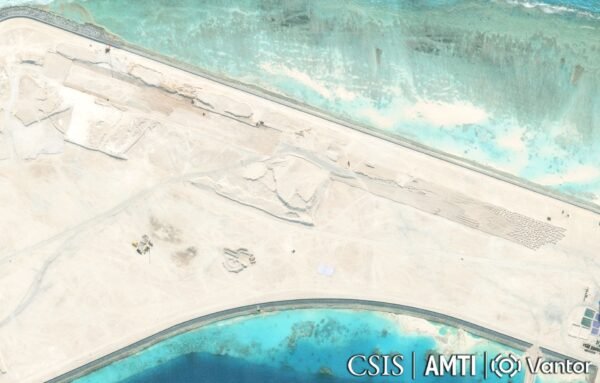
On August 14, the Asia Maritime Transparency Initiative (AMTI) reported that China had completed land reclamation at Antelope Reef in the Paracels, and appeared to be working on new infrastructure on the island.
AMTI, which is run by the Washington-based Center of Strategic and International Studies, said that “the first signs of major infrastructure at the new artificial island have emerged,” including a “likely airstrip.”
Reuters then reported on August 25 that new installations had been sighted on Yagong Reef, an islet close to Antelope Reef, citing photos taken by Vantor, a commercial provider of satellite images. While the purpose of the buildings was not certain, “several structures on Yagong Reef resemble other military radar/early warning facilities seen elsewhere in the South China Sea and are likely associated with the ultimate military functions of nearby Antelope Reef,” a Vantor spokesperson told the news agency.
Vietnam claims sovereignty over the Paracel Islands, which it refers to as Hoang Sa, but they have been under Chinese control since 1974, when China seized them following a battle with the then-teetering southern Republic of Vietnam.
When asked about the recent reports at a regular press briefing on Friday, Foreign Ministry Spokesperson Pham Thu Hang told the press that Vietnam “has full historical evidence and legal grounds to affirm its sovereignty over the archipelago, including Hai Sam reef and Ba Ba island, in accordance with international law,” using Hanoi’s preferred names for Antelope Reef and Yagong Reef.
Hang stated that all “foreign activities” in the Paracels, including the two sites in question, were “completely illegal and null and void,” and that Vietnam has lodged a strong diplomatic protest with China over the issue. “Vietnam demands the immediate cessation of such activities and that they not be repeated,” she added.
While Vietnam has no real power in the Paracels, in recent years it has undertaken a significant land reclamation at its features in the Spratly Islands, which lie to the south of the Paracels and are also contested by the Philippines, Malaysia, and Brunei. AMTI reported in May that Vietnam had reclaimed a total of 2,771 acres of land in the Spratlys and was beginning construction of extensive infrastructure on its features there, including harbors, munitions storage depots, and communications structures. AMTI has also previously reported that Vietnam is building an airstrip on Barque Canada Reef, its largest feature in the Spratlys.
The pro forma Vietnamese response to the reports of Chinese activities in the Paracel Islands is unsurprising. It probably does not foreshadow any significant tensions between Hanoi and Beijing. The Chinese government has been surprisingly sanguine about Vietnamese construction activities in the Spratly Islands, compared to its treatment of the Philippines, a U.S. treaty ally to whose minor perceived transgressions it has responded with considerable force.
Indeed, it could be that the construction activities at Antelope Reef and Yagong Island case are China’s way of responding to Vietnam’s South China Sea expansion by enlarging its own presence. As AMTI noted, Beijing’s “rapid expansion of Antelope Reef has cemented Beijing’s lead in island-building” after the rapid pace of reclamation by Vietnam had put it on track to surpass China’s island-building in the Spratlys.
Whether this equilibrium holds once both sides complete their infrastructure remains to be seen.
