

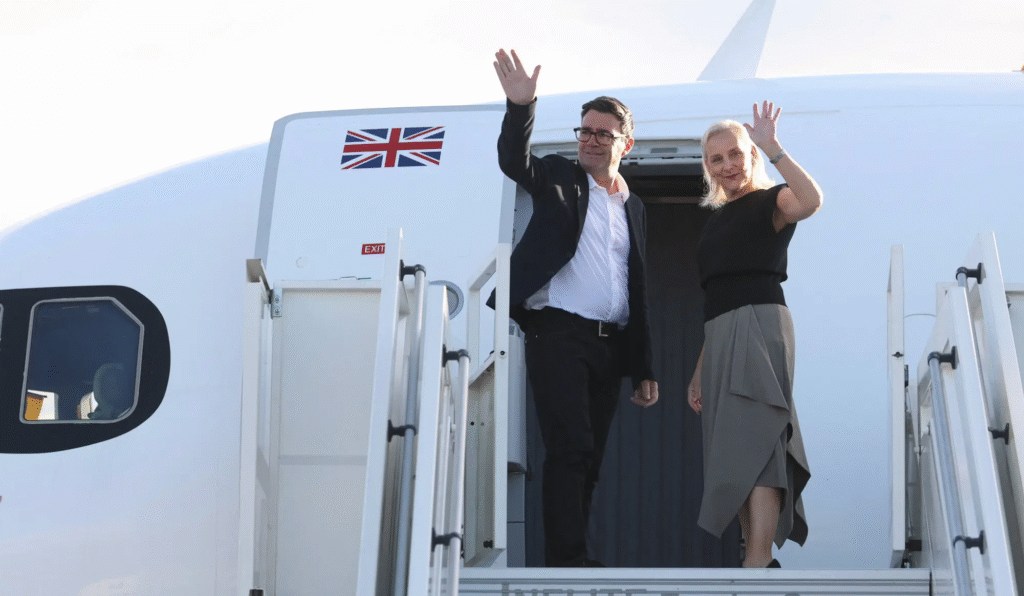
Britain will begin refuelling Saudi fighter jets defending the kingdom from Houthi attacks as Andy Burnham meets Donald Trump for talks on the widening conflict in the Middle East.
An RAF Voyager tanker will provide air-to-air refuelling for Saudi aircraft following a request for military assistance from Riyadh.
The deployment is expected to begin within days as Houthi forces intensify missile and drone attacks against Saudi Arabia.
Burnham is due to meet Trump in New York on Tuesday during the UN General Assembly, where the conflict and efforts to reduce tensions with Iran are expected to feature in discussions.
The Prime Minister said he approved the Saudi request after receiving advice from Defence Secretary Wes Streeting and Foreign Secretary Ed Miliband.
Burnham said: “We have received a request from Saudi Arabia for military support and … I agreed to that request for defensive air-to-air refuelling.”
He linked the decision to protecting British economic interests as disruption in the Gulf and Red Sea puts pressure on global energy supplies.
Burnham said: “I go back to the point I made about the cost of living pressures and acting to secure the interests of Britain and the wider region.”
He added: “Because of course Saudi Arabia has been experiencing attack, is looking at potential further disruption and we need to keep those alleyways open, and hence our agreement to the request.”
The agreement is expected to last several weeks but will remain under review.
British officials say the Voyager will support Saudi aircraft conducting defensive missions rather than strikes against Houthi positions.
The Ministry of Defence said the aircraft would “support Saudi defensive activity in support of the legitimate government of Yemen”.
It said: “The Houthis are a dangerous threat to regional stability in the Middle East, and it is in the UK’s national economic and security interest that they do not succeed.”
The UK has already deployed air defence equipment and personnel to help protect Saudi Arabia against missile and drone attacks.
The latest commitment has raised questions over the extent of Britain’s involvement if the conflict continues to expand.
It comes as Washington has resisted Saudi requests for sustained US military action against the Houthis while continuing to provide weapons and intelligence to Riyadh.
Trump has sought to avoid opening another front while the United States remains involved in its confrontation with Iran.
Burnham said he would use his talks with Trump to push for an end to the wider conflict.
He said: “Of course the message is that we want to see an end to the conflict as quickly as possible and we stand ready to play our part.”
The deployment follows a renewed Houthi offensive in Yemen and attacks on Saudi territory.
Saudi forces intercepted a ballistic missile targeting Riyadh on Saturday, while the Houthis said they had also targeted other sites in the kingdom.
The group has advanced along Yemen’s Red Sea coast and seized the port city of Mocha and strategically important islands near the Bab al-Mandab Strait.
The waterway connects the Red Sea with the Gulf of Aden and normally carries about 12 per cent of global trade.
Disruption around the Strait of Hormuz has also forced Saudi Arabia to rely more heavily on alternative routes for energy exports.
The Ministry of Defence said: “We unequivocally condemn the Houthi attacks on Saudi Arabia and are clear that the Kingdom of Saudi Arabia and the Republic of Yemen have the right to defend themselves.”
Britain has previously taken direct military action against the Houthis. RAF Typhoon aircraft joined US forces in strikes against Houthi positions in Yemen during operations to protect commercial shipping in the Red Sea.
The latest deployment stops short of British aircraft conducting strikes themselves.
It comes as Saudi Arabia seeks greater assistance from regional allies. Turkey has said it is prepared to meet Saudi military needs under the recently signed Mecca Joint Defence Agreement with Riyadh and Pakistan.
Britain says its latest deployment remains limited to defensive support while diplomatic efforts continue to end the wider conflict.
