

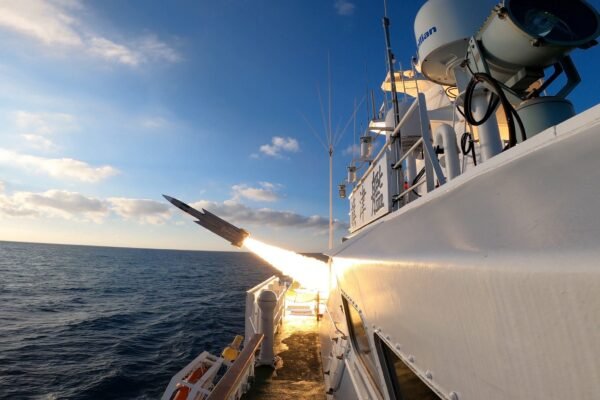
Since July, China has begun conducting more regularized coast guard patrols in waters east of Taiwan. These operations are, of course, partly connected to recent maritime developments involving Japan and the Philippines. Yet a broader trend is also becoming increasingly visible: the People’s Liberation Army (PLA) has stepped up both the scale and intensity of its activities in the airspace and waters east of Taiwan.
In addition to continuing its joint combat readiness patrols across the Taiwan Strait median line and into Taiwan’s southwestern airspace, the PLA has noticeably increased reconnaissance and surveillance operations to Taiwan’s east and southeast. On September 5, the PLA deployed J-11 fighters, Su-30s, H-6 bombers, Y-8 electronic warfare aircraft, KJ-500 airborne early warning and control aircraft, and other platforms, with some entering Taiwan’s southeastern airspace. During another joint combat readiness patrol on September 9, PLA aircraft operated in Taiwan’s northern, central, and eastern airspace, further demonstrating that Chinese military activity is no longer concentrated primarily west of the island.
According to data released by Taiwan’s Ministry of National Defense, PLA aircraft repeatedly operated east of Taiwan in September, including on September 5-6, September 9-10, September 14-16, and September 18-19. During the September 9 patrol, the PLA also deployed combat aircraft, support aircraft, and unmanned aerial vehicles (UAVs), with activities extending into Taiwan’s eastern airspace.
Compared with manned aircraft, UAVs offer longer endurance, lower operating costs, and greater suitability for sustained intelligence, surveillance, and reconnaissance missions. The PLA’s growing use of drones east of Taiwan therefore serves not only as a form of military pressure, but also as a means of systematically collecting battlefield intelligence on Taiwan’s force posture.
Potential targets of such surveillance include air base activities in Hualien and Taitung, aircraft takeoffs, landings, and dispersal patterns, the operation of radar and air defense systems, movements of naval and air forces, and possible external reinforcement routes through waters and airspace east of Taiwan.
Cutting Taiwan’s Sea Lines of Communication
For Taiwan, the strategic importance of its eastern coastline becomes particularly apparent in a wartime scenario. In the event of a PLA attack, airports and ports along Taiwan’s western coast could be subjected to sustained strikes or interdiction by long-range rocket artillery and Dong Feng-series ballistic missiles. Eastern ports would therefore become critical rear-area logistics hubs and potential lifelines for sustaining Taiwan’s war effort.
This concept was reflected in Taiwan’s Han Kuang 42 live-fire exercise earlier this year. On August 13, Taiwan’s navy and coast guard jointly conducted blockade-breaking escort and strategic logistics transfer drills. A combined naval and coast guard formation escorted the ROCS Yushan, which was acting as a simulated merchant vessel, into Hualien Port. Civilian vehicle convoys were then used to transfer supplies inland. The exercise was intended to test Taiwan’s ability to break a maritime blockade and maintain strategic supply lines during wartime.
This is precisely the kind of contingency the PLA is likely seeking to counter.
Since July, China has used maritime law enforcement vessels to increase its presence in waters east of Taiwan. Even before that, PLA Navy warships had regularly conducted patrols and surveillance in the area. In the past, however, such activity was often reactive, particularly when Chinese vessels encountered Taiwanese surveillance ships operating in waters east of the island. Since June, Beijing appears to have increased the intensity of such patrols and begun integrating UAVs more systematically into operations east of Taiwan.
Expanding Intelligence Collection and Close-In Reconnaissance
The deeper significance of the PLA’s expanding presence east of Taiwan lies in its ability to build a more comprehensive intelligence picture of Taiwan’s eastern military infrastructure.
Under Taiwan’s longstanding defense planning, the eastern side of the island could become a critical sanctuary in wartime. Air bases, naval facilities, and other military infrastructure in eastern Taiwan may be used to disperse aircraft and warships, conduct repairs and resupply, regenerate combat power, and support possible external intervention by the United States, Japan, or other partners.
Unmanned systems can do more than conduct reconnaissance or launch direct strikes. They can also provide targeting data for long-range precision weapons, including Dong Feng-series missiles, helping the PLA build a more integrated sensor-to-shooter architecture. This reflects the PLA’s broader emphasis on integrating reconnaissance and strike capabilities into a single operational system.
If the PLA can systematically monitor patterns of military activity during peacetime — including radar activation cycles, force movements, dispersal routes, and the operating rhythms of key bases — it can improve the effectiveness of wartime joint strikes and blockade operations by the PLA Rocket Force, Air Force, and Navy.
Future indicators should therefore include the duration of PLA UAV operations east of Taiwan, the frequency of appearances by Chinese electronic intelligence and reconnaissance aircraft, and the degree of coordination between PLA aircraft and naval vessels operating east of the island.
This trend has become particularly important as Taiwan itself expands military activity in the Western Pacific. Recent developments include testing of the MQ-9B unmanned aerial system, military deployments to Orchid Island during the Han Kuang exercise, and tri-service precision munitions drills conducted in the waters east of Taiwan, including the sinking exercise involving the decommissioned frigate ROCS Lan Yang.
These activities provide the PLA with strong incentives to increase intelligence collection east of Taiwan. Through close-in reconnaissance, Beijing can seek to gather technical and operational data on Taiwan’s emerging capabilities, including new unmanned systems, missile deployments, force movements, and joint operational procedures.
Conclusion: The Battle for Taiwan’s East
For Taiwan, recent PLA activity suggests that the eastern side of the island can no longer be treated simply as a protected rear area.
Taiwan’s deployments during this year’s Han Kuang exercise already indicate a response to the PLA’s growing operational focus on the region. In addition to increasing naval and air patrols east of the island, Taiwan has begun deploying missile units to Orchid Island.
Orchid Island is located relatively close to the Philippines’ Batanes Islands, creating potential space for closer Philippines-Taiwan security cooperation. If combined with Japan’s southwestern islands — particularly Ishigaki and Yonaguni to Taiwan’s northeast — these locations could form important nodes in a broader defensive network along the First Island Chain. Such a network would not necessarily depend on the large-scale forward deployment of naval forces. Instead, it could emphasize an “anti-sea from land” approach, using distributed land-based missiles, sensors, UAVs, and intelligence networks deployed across strategically located islands.
The objective would be to turn geography into an operational advantage. By integrating Taiwan, the Batanes, and Japan’s southwestern islands into a more resilient surveillance and strike architecture, Taiwan and its partners could complicate PLA naval operations in the waters east of the island and partially offset China’s numerical superiority at sea.
The strategic competition over Taiwan is therefore increasingly extending beyond the Taiwan Strait itself. The waters east of Taiwan – linking the First Island Chain to the broader Western Pacific – are becoming an increasingly important operational theater. For Taiwan, the next major challenge may not be defending its western coastline, but ensuring that its eastern flank remains open, survivable, and connected to the wider Western Pacific.
