

By Andre Pienaar
A quiet meeting ten blocks from the UN
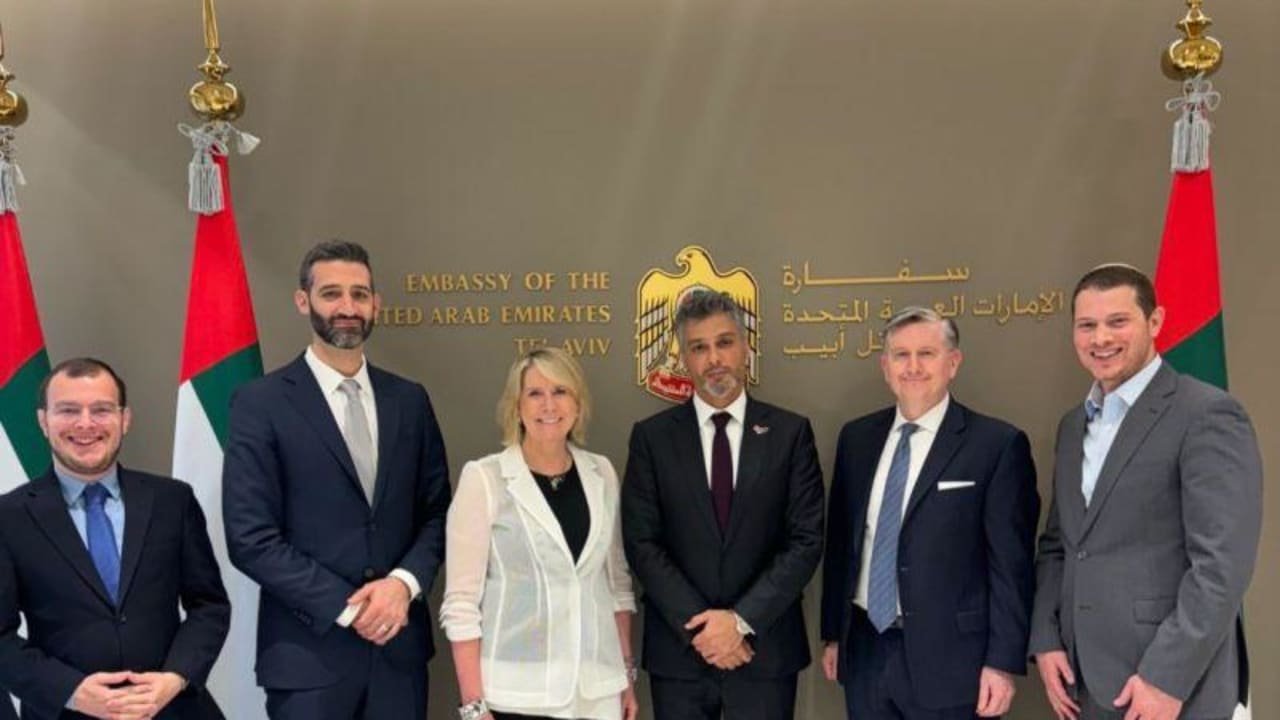
On 24 September, on the 43rd floor of a Manhattan office tower, officials from the United States, Israel, the United Arab Emirates, Bahrain, Morocco and Kazakhstan sat down together for the first time since January 2023. Ten blocks away the UN General Assembly was busy with its annual theatre of resolutions and walkouts. The Abraham Accords countries had chosen a quieter room.
The gathering was hosted by the N7 Foundation, the philanthropic vehicle of the hedge fund manager Jeffrey Talpins, with Under Secretary of State Allison Hooker leading the American delegation. “Nearly three years after October 7, the Abraham Accords countries are back together,” Hooker said. Two facts about the table deserve attention. Kazakhstan sat at it for the first time. Sudan, a founding signatory, was not there as the current repressive regime now chose to buy arms from Iran.
Those two details tell the story of where the Accords stand six years after they were signed on the South Lawn of the White House: durable and resilient enough to bring together the original founders surviving three wars, strong enough to draw a new member from beyond the Middle East in Kazakhstan, and parting ways with a member whose state collapsed into the arms of Tehran.
What three wars could not destroy
The Accords were supposed to die on 7 October 2023. That was one of the strategic purpose of the attack: Hamas and its patrons in Tehran understood that a Saudi-Israeli normalisation could be imminent, and that once Riyadh signed, the Sunni Arab order would have made its peace with the Jewish state. The massacre was designed to make that impossible. At a tactical level there was some damage. Saudi accession stalled, and the wars that followed in Gaza, Lebanon and Iran froze the multilateral track for nearly three years.
But the Abraham Accords themselves did not collapse. Not one of the Gulf signatories withdrew its ambassador. The UAE was the first Arab state to condemn the attack, and Netanyahu’s first call with an Arab leader afterwards was to Mohammed bin Zayed. Bahrain and the UAE absorbed destructive air attacks from Iran and persevered. Trade, defence procurement and intelligence liaison continued through a Gaza war, a Hezbollah war and a war waged by Iran in which Gulf airspace was itself a battlefield.
That resilience tells us something about what the Accords actually are. They were never a peace treaty in the Camp David sense, resolving a territorial dispute between belligerents. They were a security architecture built by states that had already concluded, privately and for a decade, that Iran’s aggression and terrorism are a threat to regional and international security. October 7 did not change that calculation. If anything, the Iranian missile barrages of 2025 and 2026 confirmed it. A framework built on shared threat perception survives shocks that would shatter one built on sentiment.
The last multilateral meeting before the one last Thursday was the Negev Forum in Abu Dhabi in January 2023. Egypt and Jordan, who sat in that room as observers were absent from the meeting last week in New York. The Board of Peace and the Gaza reconstruction agenda now occupy the space where a Saudi normalization track once stood. And the State Department has, for now, ceded the convening role to a private foundation. Although there is change, the Accords led by President Trump during his First Term endured and will continue to be part of his legacy.
Kazakhstan and the geography of the Accords
Kazakhstan’s accession, announced by President Trump on 6 November 2025 during the C5+1 summit with Central Asian leaders at the White House, was dismissed by some as purely symbolic. Astana has had full diplomatic relations with Israel since 1992.
That misreads what accession to the Abraham Accords mean. The Accords stopped being a bilateral normalisation instrument the moment the Negev Forum was created in 2022. The accords convene countries that share the Abrahamic faiths, and the value lies in who is in it and what they do together. Kazakhstan is the largest economy in Central Asia, the world’s leading uranium producer and a major exporter of oil and critical minerals. Its president endorsed the American peace plan for Gaza in September 2025, then walked into the Accords two months later alongside a package of American investment that exceeds $17 billion and involves Nvidia, Boeing and OpenAI.
The strategic logic runs in both directions. For Washington, bringing Astana into the tent extends the Accords from a Middle Eastern framework into a Eurasian one, linking Central Asian resource wealth and trade corridors with Gulf capital and Israeli technology and innovation. The Gulf states have already poured billions into Kazakh, Uzbek and Azerbaijani infrastructure and energy. Organising those flows under a single political umbrella gives the United States influence in a region where Russia still dominates the security file and China the economic one. For the Gulf and Israel, it adds a Muslim-majority, secular, resource-rich partner that sits on the far side of Iran and shares its assessment of Tehran as a source of aggression and instability.
Azerbaijan, already Israel’s closest partner in the Muslim world and a critical energy supplier, is the obvious next candidate, and Baku’s presence would close a ring around Iran’s northern frontier. Uzbekistan and Kyrgyzstan sat in the room when Kazakhstan’s accession was announced. If the Accords are becoming a Eurasian architecture rather than just a Levantine one, Thursday’s meeting shaped the future.
The empty chair: Sudan’s road to perdition with Tehran
Sudan was the Accords’ most ambitious bet and is now the clearest failure. When Khartoum declared its intention to normalise in October 2020, it was less than a year out from the revolution that had ended three decades of Omar al-Bashir’s Islamist rule. Sudan had spent those decades as a transit hub for Iranian weapons to Hamas and Hezbollah, and as a sanctuary for jihadist networks. The bargain was straightforward: removal from the US list of state sponsors of terrorism, a path back to the World Bank, and Israeli investment, in exchange for a civilian government turning the country away from Tehran. Sudan signed the Abraham Accords Declaration in January 2021. The bilateral treaty with Israel was never concluded.
The October 2021 coup ended Sudan’s civilian transition. The war that broke out in April 2023 between General Abdel Fattah al-Burhan’s army and the Rapid Support Forces (RSF) plunged the country in a civil war with competing visions for the future of Sudan with Burhan supporting the restoration of an Islamist state on the repressive Muslim Brotherhood model and Hemmadi promising a new secular constitution that will protect Sudan’s minorities. Burhan needed weapons, and Tehran sold them. In July 2024 Sudan restored diplomatic relations with Iran and exchanged ambassadors, ending an eight-year rupture. By December 2024 Iranian drones were being deployed by the Sudanese Armed Forces (SAF) in the civil war.
What has followed goes well beyond arms purchases. Sudan’s military-industrial complex, a billion-dollar enterprise producing munitions, missiles and drones, is now substantially Iranian-built and Iranian-staffed, with Iranian experts operating from a base on the Red Sea coast. The security apparatus has been rebuilt on the model of the Islamic Revolutionary Guard Corp (IRGC), including a unit patterned on the Quds Force. Muslim Brotherhood cadres hold key ambassadorial posts, including the embassy in Tehran. The Islamist al-Baraa bin Malik Brigade fighting alongside the army declared solidarity with Iran during this year’s war. Washington responded by designating the Sudanese Muslim Brotherhood a terrorist organisation, with the listing taking effect on 16 March 2026 and citing IRGC training and support.
The gravest development is maritime. Iran is working to link Sudan’s military infrastructure to the Houthis across the Red Sea, creating a continuous operational corridor on both shores of the waterway that carries Suez-bound shipping. The Houthis alone forced the world’s carriers around the Cape of Good Hope. A Houthi-Sudanese axis with Iranian engineers on the African shore would place that threat far closer to Israel and to the canal itself. Sudan, which was meant to be the Accords’ bridgehead in Africa, has become Tehran’s second bridge head on the Red Sea.
The Accords did not destabilise Sudan. On the contrary a Muslim Brotherhood-penetrated SAF did. The civilians who signed the declaration in 2021 are still there, waiting for the civil war to end.
What the next phase requires
The lesson of Kazakhstan and Sudan, read together, is that the Accords are strongest where they build on shared values and an alignment that already exists and weakest where they are leveraged to create these. Astana joined because its interests had already moved. Khartoum left because its state had already been captured. The signatures were the least in both cases.
That should shape the next phase. The task now is turning diplomatic ties into practical cooperation. It means an Accords security dimension with real content: shared air and missile defence in the Gulf, which the Iranian barrages made unavoidable; a Red Sea maritime surveillance and interdiction architecture that treats the Sudanese and Yemeni shores as one problem; and a critical minerals and energy compact that gives Kazakhstan, and in time Azerbaijan, incentives to build relations.
Six years after the South Lawn, the Abraham Accords have survived the worst that their enemies could do. That is an extraordinary achievement, and one that few predicted in the autumn of 2023. The meeting in New York had a new member at the table and an empty chair for a member lost for now. Whether the next meeting adds to the first or the second, will depend on whether the Accords’ signatories are prepared to build and defend the values and networks that hold the framework together.
