

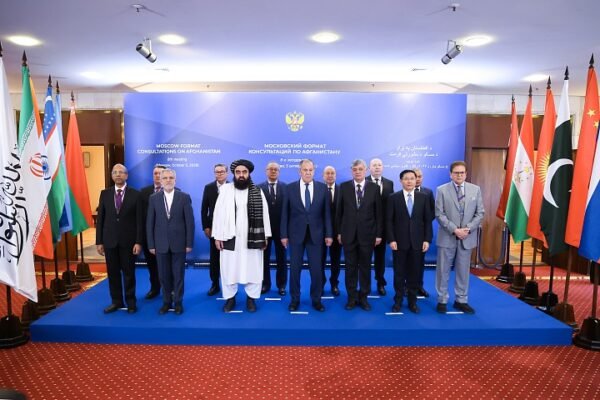
On October 5, Moscow hosted the eighth meeting of the special representatives and senior officials from regional countries for the Moscow Format to discuss political and economic relations with Afghanistan and counterterrorism and counter-narcotics cooperation. The Moscow Format includes Afghanistan, China, India, Iran, Kazakhstan, Kyrgyzstan, Pakistan, Russia, Tajikistan, and Uzbekistan.
But the meeting failed to adopt a joint statement because the Pakistani and Afghan delegates disagreed over the language on terrorism. The Taliban objected to the frequent mention of terrorism in reference to Afghanistan.
Russia’s special envoy for Afghanistan, Zamir Kabulov, said the Afghan delegates accepted similar language last year. He believed that the changed relations between Pakistan and Afghanistan might have caused Kabul’s objection this time.
The meeting was held only a week after the most recent confrontation between Islamabad and Kabul. On September 18 and 26, Pakistan suffered deadly terrorist attacks in its northwestern province, Khyber Pakhtunkhwa, that together killed about 44 people and injured about 138. Pakistan responded with airstrikes on different targets in Afghanistan that it believes were the training camps and hideouts of the Tehreek-e-Taliban Pakistan (TTP) and its associated factions responsible for the cross-border attacks.
At the Moscow summit, Pakistan’s delegation said the Taliban were complicit in those attacks in Pakistan because the terrorist groups were operating on Afghan soil with impunity. The Taliban said Pakistan was using military aggression in violation of international law for an issue that could be resolved through political negotiations.
The Moscow Format meeting failed to bridge these differences enough to allow for a joint communique. What’s noteworthy is that other countries that share borders with Afghanistan – such as China, Tajikistan, and Uzbekistan – did not use their diplomatic capital to reach an understanding on language that included everyone’s concerns.
Afghanistan’s neighbors have different levels of concern about militancy there. Their strategies, especially on counterterrorism, are a function of the nature of their border with Afghanistan, the extent of the threat from militant groups on Afghan soil, and the Taliban’s scale of cooperation regarding those groups. From their perspective, military force is not the most effective solution to address the issue.
China shares a border of only about 92 kilometers with Afghanistan, high in the Wakhan Corridor, marked by rough terrain and the nearly 5,000-meter high Wakhjir Pass. In terms of a terrorist presence in Afghanistan, Beijing considers the East Turkestan Islamic Movement (ETIM) its main concern and has pressed the Taliban to act against the group. The Taliban have reportedly relocated ETIM fighters away from the border, and they now have a dispersed presence. Therefore, the immediate cross-border threat to China is smaller, and any movement across the pass is easy to detect.
Uzbekistan similarly shares a short border of 144 kilometers with Afghanistan, almost entirely along the Amu Darya. Regular cross-border movement is concentrated at the closely guarded Termez-Hairatan road and rail crossing. But the militant groups in Afghanistan that concern Tashkent have shown only a limited capacity for cross-border attacks. There was one incident in 2022 of rockets being fired toward Termez, which didn’t cause any casualties. Therefore, the immediate cross-border threat is relatively small and easier to contain.
Tajikistan’s case is closer to Pakistan’s in terms of the long border and threat. Dushanbe shares about 1,374 kilometers of border with Afghanistan, much of which runs along the Panj River and passes through remote and mountainous territory and is difficult to monitor consistently. The cross-border threat therefore needs more immediate attention. In November 2025, two cross-border attacks from Afghanistan’s Badakhshan province killed five Chinese workers in Tajikistan.
As for Taliban cooperation, Kabul has offered these countries help in investigations and has arrested suspects after cross-border attacks.
Pakistan’s case is of a different magnitude on all these counts.
Pakistan shares 2,640 kilometers of border with Afghanistan, where Pashtun and Baloch communities live on both sides. Afghanistan has never recognized the border since Pakistan’s founding. Islamabad has been fencing it since 2017, but militants continue to cross it. A disputed frontier with kinship networks on both sides gives militants far more routes and tricks to enter Pakistan than Afghanistan’s northern borders offer.
Pakistan also faces a much larger threat. Its key concerns are the TTP, the Balochistan Liberation Army (BLA), and the Islamic State Khorasan Province (ISKP). Islamabad charges that all three groups have a presence in Afghanistan, especially the TTP. U.N. monitors estimate the TTP, which has carried out the most frequent and lethal attacks in Pakistan, has about 6,000 fighters in Afghanistan.
By September 2026, Pakistan’s terrorism situation had worsened sharply, with 1,232 militant attacks in nine months, already 169 attacks above those recorded in all of 2025. Consistent attacks on this scale raise domestic pressure to take firm action.
Moreover, the Taliban have shown limited willingness to cooperate with Pakistan on the issue of militant groups. The Taliban leadership describes TTP members as Pakistani refugees and refuses to classify them as militants. U.N. monitors report that the group enjoys greater liberty and support from Taliban authorities. Kabul has offered to relocate the TTP fighters away from the Pakistani border, but that step cannot stop the militant movement through the long and porous border with Pakistan.
Pakistan has, therefore, asked for written guarantees that the militants would not use Afghan soil as a base for attacks in Pakistan. The Taliban have rejected this demand, which was why the Istanbul talks failed in November 2025.
Pakistan has said its operations will continue until the Taliban take verifiable action against militant groups on Afghan soil. Yet none of Afghanistan’s neighbors has publicly supported Pakistan’s airstrikes. China, Russia, and Iran have called for restraint and offered to mediate, and Uzbekistan urged a diplomatic resolution. China hosted informal talks in Urumqi in April but those ended without agreement.
Whether in Urumqi or more recently in Moscow, repeated efforts at finding common ground have fallen flat. While none of Afghanistan’s neighbors is comfortable with the idea of cross-border terrorism, none of them has sanctioned Pakistan’s military retaliation, either.
