

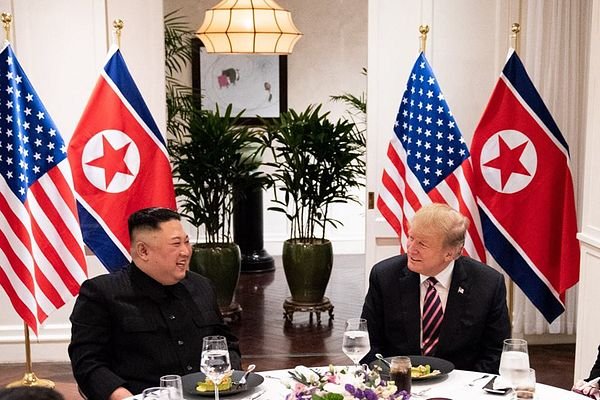
U.S. President Donald Trump’s push for a fourth summit with Kim Jong Un has so far been rejected by the North Korean leader, who may be playing hard to get. However, based on our decades analyzing North Korea, participation in countless face-to-face meetings with North Koreans – official and unofficial – and numerous visits to North Korea, we think that some in Pyongyang may believe their country could benefit greatly from a fourth summit, though not in terms of what Washington may think.
In view of North Korea and Kim’s experience, especially his three summits during Trump’s first term in office, and Pyongyang’s analysis of the president’s current foreign policy, the North Korean Foreign Ministry would emphasize the following points that lay out a strong case with Kim Jong Un for a fourth summit.
First, it would point out that because of Kim’s policies in the military and economic fields, taking advantage of shifts in international geopolitics, especially Pyongyang’s close relationship with Russia and China, North Korea is in a position of strength for a summit, should the chairman choose to proceed.
The United States and Trump, on the other hand, are in a much weaker position than before. The president’s overconfidence and erratic personality will almost certainly result in missteps that further weaken the U.S. position. And he doesn’t grasp that another summit will greatly benefit North Korea, which is now working in opposition to Washington.
The ministry would add that, as Kim has said many times, the past – the previous summits in Singapore, Hanoi, and at the Demilitarized Zone – is gone. Back then, the chairman focused on improving relations with Washington in return for putting his nuclear program on the table and creating space for North Korea to modernize its economy.
But today, another summit would improve North Korea’s global position by supporting its friends – China and especially Russia – undermining Washington’s influence abroad, and, hopefully, nudging Trump to accept Pyongyang’s growing nuclear arsenal. The ministry would also observe that, more than ever, Trump’s missteps have made the situation ripe for creating tensions in the already fraying South Korea-U.S. alliance.
Time Is on Pyongyang’s Side
Just as in the past, should Kim decide to proceed, the timing and venue of a new summit will be the subject of considerable back and forth with the Americans. In this instance, the North Koreans may believe the result of a summit could be more consequential because of Trump’s personality and his growing domestic political weakness.
The ministry would applaud Kim Jong Un’s policy of delaying a summit decision to take advantage of Trump’s eagerness to meet and extract unilateral concessions has already resulted in victories. The president has shortened one South Korea-U.S. exercise and left a cloud hanging over the rest.
Trump has also inched away from Washington’s long-standing pursuit of denuclearization and toward accepting North Korea as a nuclear power. That appears to have had the added benefit of setting off an internal debate. The State Department continues to back denuclearization, contradicting Trump’s position and sending confusing signals to U.S. allies.
Looking ahead, the North Korean Foreign Ministry would predict that if the Republicans lose the upcoming November congressional elections, as expected, nothing will save Trump from a greatly weakened situation. As a result, he may be anxious to make even more concessions to paint any outcome – even simply holding a meeting with Kim – as a personal victory.
North Korea’s Real Assessment of President Trump
While North Korea’s media have avoided direct criticism of Trump and continued to note Kim’s personal relationship with him, in private, foreign ministry analysts probably believe that his worst personality traits, evident in 2018 and 2019, have only become worse. These, in turn, will provide openings to reach agreements that further support Pyongyang’s strategy.
They would emphasize seven traits that will affect Trump’s performance at a North Korea-U.S. summit. First, at 80, he is seven years older than when the last summit was held and has declined physically and mentally. As the aged typically do, he has good days and bad days. Second, he reacts well to flattery, more so than ever. Third, Trump has a higher opinion of himself and his negotiating ability than in the past, even in the face of repeated failures. Fourth since he is more likely to rely on his gut feelings rather than expert advice, Trump will act impulsively. Fifth, he is losing his grip on reality. American media often laugh at many of his claims. Sixth, Trump has rolled out the red carpet at summits with presidents Vladimir Putin of Russia and Xi Jinping of China, despite their opposition to Washington’s global interests. He mistakenly believes that flattery can overcome policy differences.
Perhaps even more important, Kim’s advisors will point out that Trump does not understand strategic thinking. Past summits with North Korea have demonstrated that he has no grasp of the wider picture; the U.S. war with Iran again underlined his short sightedness. It is doubtful he will understand that the North’s new objectives are different from the past and inimical to U.S. interests.
The American Negotiating Position
Given this analysis of Trump, North Korea’s Foreign Ministry would conclude that he will either repeat standard U.S. positions or come up with his own on the spur of the moment without expert advice from his staff.
Trump knows denuclearization is not in the cards. Instead, he may float the idea of a nuclear freeze. If he does bring it up, the chairman could simply repeat his insistence that Pyongyang needs a strong deterrent. From his perspective, that deterrent is not just to maintain North Korea’s security but an absolute requirement for regional balance, especially given the growing danger of Japanese militarism.
The president may also repeat his proposal made at the 2019 Hanoi summit for a moratorium on further testing of intercontinental-range ballistic missiles (ICBMs) that can reach the United States. South Korean President Lee Jae-myung advanced the same idea at the recent United Nations General Assembly session. The proposal wouldn’t include the shorter-range missiles that target Seoul and Tokyo. As a result, it will prove controversial in South Korea and could create new tensions in U.S. relations with Japan.
The ministry would suggest that Kim could easily parry such a proposal by insisting that any moratorium on ICBM launches must include other countries with those missiles. That would be consistent his position that North Korea is now a global power and cannot be expected to make concessions other nuclear powers will not. And, of course, neither the United States nor the others will be open to that idea,
Trump is likely to dangle sanctions relief for North Korea – a centerpiece of past summits – in return for concessions. The ministry would note, however, Pyongyang’s success in avoiding those restrictions with assistance from Moscow and Beijing, as well as the billions of dollars North Korea earns from illicit cyber activities. As a result, Kim should not see sanctions as the card that Washington once imagined them to be. Still, lifting them could have some secondary political value for North Korea, enhancing its international standing and further normalizing its status.
Moreover, a proposal to lift sanctions could backfire and cause problems for the United States. It could stir up trouble in the Western bloc in the United Nations Security Council since lifting restrictions would face stiff resistance from Britain and France. On the domestic front, fiddling with sanctions would spark criticism from both Trump’s own party and political opponents. While he will not care, such policy turmoil further weakens the United States.
Just as in the past, the president will probably showcase grandiose, even far-fetched, and unachievable schemes to modernize North Korea’s economy. He has done that more recently with a proposal to turn Gaza into a modern coastal metropolis. Pyongyang’s position is quite clear – foreign aid is poisoned candy and should be rejected out of hand unless the chairman decides otherwise.
Finally, Trump can be expected to try to interfere with North Korea’s strong support for Russia in its war with Ukraine. However, the ministry’s America watchers would note that Washington has consistently underestimated the chairman’s commitment to the new relationship with Moscow. Presumably, few if any in the White House read Kim’s last letter to Putin expressing continued full support for Russian operations in Ukraine. Just how hard Trump will push is an open question given his zigzagging approach to the war and his hopes for a better relationship with Putin.
A Potential North Korean Strategy
The Foreign Ministry will argue that a Trump-Kim meeting represents a golden opportunity to secure important objectives while only taking tactical steps that appear to be concessions. It will also open doors to significant strategic gains. It would recommend the following steps.
Kim’s overall summit approach should showcase his statements over the past year that North Korea is seeking “peaceful coexistence.” That theme has mesmerized the Americans. However, meaningless formulations used before by nuclear weapons states, such as “a nuclear war cannot be won and must never be fought,” would cloak the North’s real objectives. So would any pledge to “work for peaceful resolution of outstanding differences.”
All of this will appeal to Trump who is determined to declare peace in his time and secure the Nobel Prize. In reality, highlighting “peaceful coexistence” would put North Korea in a position to protest virtually any steps the United States takes in the region as contradicting Washington’s assertions of a desire for peace.
While Trump’s aides are sure to warn him ahead of time, the ministry would recommend that Kim press the president to go beyond his random public statements on the North’s nuclear capabilities to put it in writing, perhaps in a summit declaration. Any acknowledgment of North Korea’s nuclear arsenal coming out of the meeting, even only verbal, will create turmoil in Seoul and Tokyo.
The chairman should certainly encourage Trump to reduce the U.S. military commitment to South Korea. He will be pushing on an open door. Trump has made it clear in the past that he is willing to further limit U.S. military activity in and around the Korean Peninsula. One possibility is ending joint South Korea-U.S. military exercises. The ministry would caution that it is unclear how far the president will go. But its experts would point out that he has also been consistently looking to draw down U.S. forces in the South for years.
Finally, North Korea’s diplomats would recommend that Kim seriously consider accepting any offer Trump makes to recognize the Democratic People’s Republic of Korea as a sovereign state. Embassies in each capital could serve as a formal line of communication after decades of hostility. In theory, they can be framed as a step to reduce tensions and avoid accidental war. In practice, they will do neither.
If diplomatic recognition occurs, Trump will claim credit for taking another step to build peace. However, this measure will reinforce North Korea’s goal of demonstrating that it is a global player to be reckoned with and further its objective of gaining international acceptance as a nuclear power.
The Bottom Line
The Foreign Ministry is likely to conclude that a fourth summit will advance Kim Jong Un’s goals, especially in view of Trump’s poor foreign policy performance and personality flaws.
Even if there is no concrete outcome, the ministry would argue that the optics will be important in positioning North Korea for the future. Just having a summit will strengthen Kim’s standing abroad. Should an impatient Trump walk out again as he did in Hanoi, rather than an embarrassment to the chairman, it will emphasize Washington’s negative image and cause problems with Seoul and Tokyo.
No matter the outcome, it will also be possible to exploit Trump’s post-summit behavior to advance Pyongyang’s objectives. He will continue to insist he has a good personal relationship with Kim. That will be useful as a shield providing time for North Korea to continue to build up militarily for the remainder of the president’s term in office.
Finally, if the past is any guide, the Foreign Ministry will conclude that the chances are an erratic Trump will never stick to what he says. As a result, any agreement may not survive more than a few months. Then North Korea will be able to take tougher steps. For example, after the 2019 Panmunjom summit, Trump went back on his promise to cancel an upcoming joint South Korea-U.S. military exercise. As a result, Pyongyang stonewalled the U.S. in subsequent negotiations and ended its missile test moratorium.
