

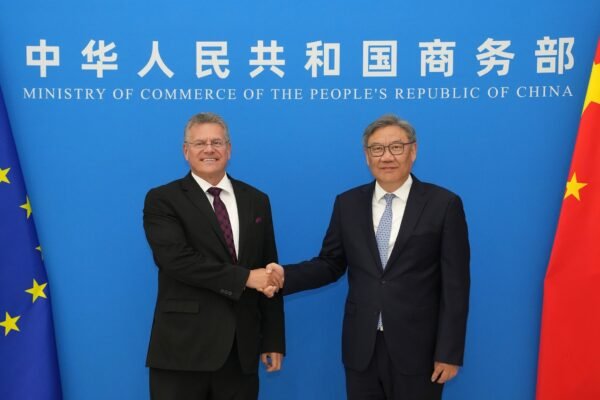
Like last month’s summit between the U.S. and Chinese presidents, the China-EU Trade and Investment Consultations in Beijing were primarily about stabilization rather than a breakthrough. EU Trade Commissioner Maros Sefcovic and Chinese Commerce Minister Wang Wentao closed a handful of agreements and confirmed that neither side wants a trade war. However, the structural issues remain unresolved. What both sides gained is time.
For the European Union, the choice is increasingly difficult: secure real concessions from Beijing to address structural trade imbalances or deploy stronger unilateral measures to protect its industrial base. Compounding this dilemma is Europe’s risk of becoming an adjustment variable in the China-U.S. strategic competition, absorbing diverted Chinese exports when tensions escalate while losing market opportunities and negotiating leverage when Washington and Beijing strike bilateral deals. Washington holds the technology lever, while Beijing controls critical minerals and key nodes of global supply chains. Europe depends on both.
The most concrete outcome of the talks concerns the automotive sector. Under a preliminary deal, Chinese exports of hybrid and plug-in hybrid vehicles to the EU could be curbed more than half against projected levels over the next four years. The stakes are high. In 2025, the EU imported more than 1 million Chinese-made cars, worth $15.5 billion (13.7 billion euros) and up 30 percent in volume on 2024. Hybrids tell the story best: 659 Chinese hybrids sold in the EU in 2022, versus more than 160,000 in the first seven months of 2026, plus almost 218,000 plug-in hybrids.
Chinese brands now hold almost 12 percent of Europe’s new-car market, up from 1 percent five years ago, and roughly a third of plug-in hybrid sales. In the United States, Chinese cars are absent. Washington has effectively shut Chinese electric vehicles out of its market through 100 percent tariffs, while Europe remains far more exposed to Chinese automotive imports. The U.S., a market of 16.2 million new vehicles, bought fewer than 90,000 China-made vehicles in 2024, almost all of them Western brands built in China.
The rapid expansion of Chinese carmakers has intensified competitive pressures on European manufacturers, particularly in Germany and France, which had pushed for tougher trade measures. The proposed 50 percent reduction in Chinese hybrid exports is a step forward, but it is measured against projected growth, not current volumes.
China’s hybrid expansion accelerated after the EU imposed tariffs on Chinese battery-electric vehicles in 2024. Manufacturers shifted toward hybrids, which were exempt from those duties. While Washington imposed steep barriers to Chinese electric vehicles, Brussels left a significant loophole. The hybrid cars deal is therefore less a breakthrough than an attempt to correct a weakness in Europe’s trade policy.
As for whether the deal will work, much will depend on enforcement. Effective restrictions could give European automakers time to adjust. Weak implementation would allow Chinese exports to expand further, forcing Brussels to consider tougher measures and risking retaliation that could disrupt supply chains and investment on both sides. Meanwhile, Chinese automakers are increasingly moving from exports to manufacturing inside Europe. The strategic question is no longer simply how many Chinese cars are imported in the European market, but where industrial value is created, who controls the technology, and where the jobs are located.
The second result concerns market access and trade rebalancing. Brussels and Beijing agreed to cut tariffs on a range of EU products to the most-favored-nation (MFN) rates set under WTO rules. The goods covered, from car parts to olive oil and footwear, account for nearly $4.7 billion in exports. If implemented, the measure would save European exporters at least $260 million in duties.
Set against the trade figures, however, it is a small gain. In her State of the Union speech, European Commission President Ursula von der Leyen called the EU’s deficit with China “unsustainable.” It now runs at more than 1 billion euros a day. The goods deficit rose from 306 billion euros in 2024 to 360 billion euros in 2025 and could reach 400 billion euros ($470 billion) this year, according to Eurostat.
The United States, meanwhile, moved in the opposite direction. In 2025, its goods deficit with China fell by almost a third to $202 billion, the lowest in two decades, as imports from China dropped 30 percent. China’s share of U.S. imports fell to about 9 percent, the lowest since it joined the WTO in 2001. The EU’s goods deficit with China is now twice America’s. What Washington kept out with tariffs, Europe increasingly absorbs.
Sefcovic defended the new deal with China as the result of an intense negotiation, noting that Washington had needed far more rounds to get its own deal. But he warned against complacency.
The third result concerns critical raw materials, above all rare earths and permanent magnets. This is where Europe depends on China most – 98 percent of EU demand for rare earth magnets is met by Chinese imports. Beijing will ease export licensing for European companies through a green channel. That matters for carmakers, renewables, and defense. But Beijing keeps control of the licenses, and with it the power to turn supplies on and off.
Washington got more. At the Busan summit in October 2025, the United States secured a one-year suspension of China’s new export restrictions and general licenses for its companies. The White House summit in September 2026 extended that suspension until January 10, 2027. Brussels obtained faster procedures for licenses that remain individual and revocable. Washington negotiated with tariffs and semiconductor controls on the table. Europe only trade-defense tools it has yet to use.
The industrial strategies differ as well. The United States has stepped up directly, with the Pentagon taking a stake in MP Materials and Washington forging minerals deals with Australia and Japan. Europe is relying on the Critical Raw Materials Act and RESourceEU, a sound framework but slower and less funded. Faster licenses make Europe’s supplies more predictable, but they do not make it less dependent.
That’s not to say Europe has no leverage. Four days before the talks, France and Germany jointly called for stronger trade defense instruments against Chinese overcapacity, subsidies, and market distortions. Beijing got the message. In response, official Beijing urged Paris and Berlin not to push the EU toward protectionist tools. Germany’s position carried the most weight. The European Commission went to Beijing with more leverage than before.
EU leaders will discuss the deal at the European Council on October 15–16. They will find a difficult balance in it. The hybrid agreement limits Chinese exports that hurt European carmakers. The rare earth agreement eases Chinese exports that the same carmakers rely on. Europe wants fewer of some Chinese goods and a steady supply of others, and on both counts the decision rests with Beijing. The recent truce calms the relationship but leaves the imbalances in place.
What Europe does with the next few months will matter more than the deal itself. If it invests in competitiveness, innovation and economic security, it can negotiate from strength next time. If it doesn’t, it will remain the adjustment variable in a rivalry it does not control.
