

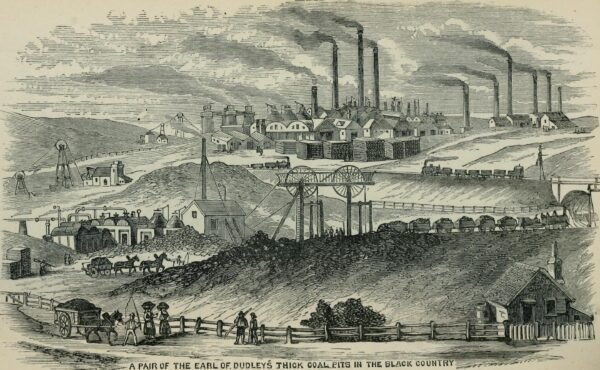
Historians often ask why the Industrial Revolution began in Europe and not elsewhere.
The classical framing of this question is the Needham Problem. Writing in 1969, the British historian of science, Joseph Needham, asked: “Why did modern science, the mathematization of hypotheses about Nature, with all its implications for advanced technology, take its meteoric rise only in the West…[and] had not developed in Chinese civilization?” After all, Needham noted, “between the first century BC and the fifteenth century AD, Chinese civilization was much more efficient than occidental in applying human natural knowledge to practical human needs.”
The Industrial Revolution refers to the transformation from agrarian, handicraft economies to machine- and factory-based industrial economies. It began in the 18th century and was the harbinger of the modern world, enabling Western dominance over most of the rest of the world, either through outright colonization, as in much of India and Africa, or by means of indirect control, as in China and Iran. The Industrial Revolution built on the preceding Scientific Revolution in Europe, which emphasized the acquisition of knowledge through reason and empirical research.
Needham sought to answer the question of why the Industrial Revolution did not begin outside Europe by examining the evolution of science in China.
But the issue ought not to be seen as merely a dichotomy between Western and Chinese civilization. In fact, India and the Islamic world would arguably have been better candidates than China for the emergence of industrial civilization. As in Europe, large swathes of India and the Islamic world engaged in long-distance trade, patronized universities, and were divided into competing kingdoms fighting against each other and against pastoralist peoples from the neighboring steppes and deserts. The Islamic world and Europe, especially, had to compensate for a lack of abundant labor. Incessant warfare led to the adaptation of gunpowder, while trade spread innovations such as the compass and paper beyond the region.
In India, there are two periods that stand out as optimal times for an industrial revolution to occur there. The first is in the 6ht century CE, when the Gupta Empire had disintegrated into a plethora of kingdoms and a shared elite culture across polities emerged. India thus experienced both political competition and was home to a pan-India culture. An exchange of ideas happened at a number of universities, such as Nalanda. These conditions were similar to those in early modern Europe. Some of India’s greatest advances in the arts, philosophy, and mathematics occurred in the centuries following the end of the Gupta Empire, with figures like mathematician Brahmagupta and philosopher Shankara living during this period.
A second period would have been in the Deccan peninsula during the early modern era. The topography and location of this region favored the persistence of several rival kingdoms seeking to gain an advantage over each other. They all had access to ocean-going trade and had a history of trade guilds, which allowed the easy flow of goods and ideas. In the early 16th century, the Deccan sultanates were some of the earliest innovators in cannon technology and military architecture. In the 18th century, the Kingdom of Mysore invented sophisticated rockets and other weaponry, whilst the Marathas established ordnance factories where skilled metalworkers created cannon and firearms adapted to local Indian conditions.
While it should be noted that the engine behind 18th-century Deccani manufacturing were skilled craftsmen rather than mechanization, the region had many of the right ingredients to commence industrialization around the same time as in Europe. The British conquest halted these initial local moves in that direction.
However, there were many other reasons the Industrial Revolution began in northwest Europe — and not elsewhere, such as in India — in the 18th century.
Industrialization is not inevitable. It is not the default outcome of human civilization. It takes certain institutions and worldviews as prerequisites and particular economic and geopolitical conditions — many of which came together by chance — to spark the process.
A great many factors must align, not least intense international rivalry in the state’s vicinity. For example, a polity ought to have enough labor to man its factories, but not too much labor — as China did — so as to make investment in industry more expensive than utilizing manual labor. A polity would ideally be sedentary rather than nomadic, stable enough internally to guarantee the continuity of institutions such as universities, companies, and land ownership, and home to a flexible labor market: the masses of peasants in many states were not permitted to move freely and offer their services anywhere. The polity must be strong enough to guarantee the rule of law, but not so bureaucratic so as to stifle private enterprise and innovation.
The historian Kyle Harper, speaking about the Roman Empire, noted that: “there [were] tinkerers and engineers, but they [were not] talking to the mathematicians and the physicists. If you were from on high to design self-sustaining innovation, I think you would want to bring those elements into proximity.” Harper argues that industrialization took off in early modern Europe because states funded scientific research and married the findings to the work of engineers and builders. Both groups seeded each other’s minds with ideas.
This process requires a state — or well-endowed institutions, such as corporations and universities — to facilitate scientific discoveries and its practical applications. This is a time- and capital-intensive process that was undertaken — more often than not — to improve the finances and security of the state through gains in efficiency and production. The benefits had to have been more than the costs.
On top of that, the state must overcome tradition and inertia: not an easy task. For example, after the victory of the Vijayanagara Empire against the Sultanate of Bijapur in 1520 at the Battle of Raichur, the two sides drew different conclusions on the efficiency of gunpowder.
Writing about the emperor of Vijayanagara, Krishadevaraya, historian Richard Eaton notes:
Though impressed with the matchlocks used by his Portuguese mercenaries, [Krishnadevaraya] failed to see firearms as the way of the future…there is no evidence that he followed up his victories by establishing an arsenal or a matchlock foundry in Vijayanagara. Nor did he or his successors ever mount cannon on the walls of their capital or provincial forts, or in other ways adapt their defensive systems to accommodate gunpowder technology…Bijapur, by contrast, responded quite differently to the battle’s outcome…[and] therefore launched an accelerated drive to pioneer new gunpowder technologies…from the small swivel guns that the Portuguese had placed on the gunwales of their ships, they took the idea of mounting a much larger cannon on a cubic block of granite set on an iron pin, enabling the gun to move horizontally.
Inertia is difficult to overcome. Research has found that in many parts of India, even when women are offered high-paying jobs in factories or offices, they decline due to family pressure and tradition that looks down on women working outside of the home. And for cultural reasons related to status, many Indians dream of becoming government bureaucrats or white-collar workers in the information technology industry, rather than seeking to work in factories or engaging in commerce or sales. These factors inhabit industrialization, development, and the spread of rational socioeconomic organization deriving from individualism.
For these reasons, for much of human history, it has been more efficient for most states — and most elites — to simply exploit land and people harder and harder. The Romans had a copious number of slaves and empires as diverse as the Ottomans and Mughals engaged in tax farming: the practice of a government contracting tax collection to private individuals, individuals who would often take a cut for themselves after fleecing peasants and merchants.
Many scholars have speculated that in India, mathematicians, artisans, scientists and builders were not often in the business of exchanging ideas, belonging to different endogamous jatis, or castes. According to economic historian Tirthankar Roy, “technology existed as tacit knowledge of artisan communities, and the evidence of partnership between diverse skills was rare. Scientific knowledge was often documented, but remained restricted within scholastic circles.”
Contrary to a widespread but incorrect belief, literacy was widespread amongst a number of castes, and was not restricted to just Brahmins. But different communities still interacted with and circulated texts mostly within their social milieu, and sometimes different jatis even used different writing systems. For example, in parts of North India, merchants used the Mahajani alphabet, scribes (Kayasthas) used the Kaithi alphabet, and Brahmins used Devanagari.
Another factor that may have inhibited industrialization in pre-modern India was its abundant quantity of specialized and cheap labor, which dampens the need for mechanization and labor-saving devices. China, too, had abundant labor, and thus, less incentive to mechanize in pre-modern times. The first Mughal Emperor Babur famously observed this phenomenon in his diary, the Baburnameh:
Another good thing in Hindustan is that it has unnumbered and endless workmen of every kind. There is a fixed caste (jam’i) for every sort of work and for every thing, which has done that work or that thing from father to son till now…680 men worked daily on my buildings in Agra and of Agra stone-cutters only; while 1491 stone-cutters worked daily on my buildings in Agra, Sikri, Biana, Dulpur, Gwalior, and Kuil. In the same way there are numberless artisans and workmen of every sort in Hindustan.
In fact, it was arguably not in the interests of a state to create a large number of unemployed people by introducing industry. Even today, if one were to observe construction in much of India, one would see a large number of individuals carrying and laying bricks with their bare hands instead of using machines or complex tools.
The historian Ada Palmer has noted that industrialization was less likely to begin in richer regions with more developed artisanal industries and vibrant trade, such as Italy. In fact, as per Palmer, even though Italians during the Renaissance had the technology for industrial looms, they did not want to pivot away from producing artisanal fabrics, which brought them wealth.
The parallels with India are striking. Due to its abundant labor, its social structure, and the inertia of an economic system that worked well enough, there was little incentive to initiate mechanization and the Industrial Revolution in India. The parts of India that came closest to industrialization — such as states in the early modern Deccan — did so when geopolitical conditions highly incentivized such an outcome. Survival trumped inaction in those cases. But more often than not, it was too late, or unnecessary, as the Industrial Revolution arrived fully formed from Europe in India.
