

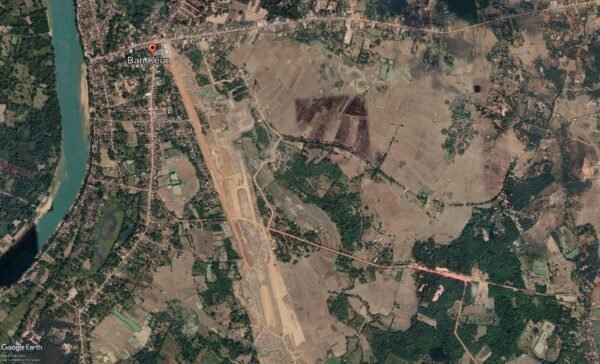
China’s recent announcement of the opening of a new Joint Logistics and Training Center to train air force pilots in Ban Keun, Laos, has caused much concern about China’s intentions and capabilities. The new center, together with the China-Cambodia Joint Support and Training Center at Ream Naval Base in Cambodia, gives China’s military the ability to cover inland airspace over Indochina and out toward the Gulf of Thailand.
Vietnam has not commented on the new base at Ban Keun, but Prime Minister Le Minh Hung just concluded a visit to Laos and Cambodia. Laos was Hung’s first official visit since assuming the prime ministerial post in April. Hung and Thongloun Sisoulith, the president of Laos and general secretary of the Lao People’s Revolutionary Party, affirmed the “great friendship, special solidarity, comprehensive cooperation, and strategic cohesion” between the two nations. Both countries will celebrate the 50th anniversary of the signing of the 1977 Vietnam-Laos Treaty of Friendship and Cooperation next year.
China’s new base in Laos signals one of the major developments in Indochinese affairs since 1991. The 1991 Paris Peace Agreements ended the Third Indochina War and laid the basis for how China and Vietnam would handle Indochinese affairs to avoid a repetition of the polarization and arms race that contributed to Vietnam’s invasion of Cambodia in December 1978 and China’s retaliatory invasion of Vietnam in February 1979.
The Agreements demanded the withdrawal of foreign forces and their equipment from Cambodia, thereby ending the direct Vietnamese and Chinese interference in Cambodian affairs. This agreement came two years after China and Laos had normalized ties and three years after Vietnam began to withdraw its troops from Laos. China and Vietnam normalized ties in November 1991, the month after the Paris Peace Agreements. One of the key conditions of normalization is that neither country would seek hegemony in Indochina, which was the main reason China and Vietnam fought in 1979. After 1991, neither Vietnam nor China has had a permanent military base in Laos or Cambodia.
The post-1991 status quo is now enduring a stress test with the opening of China’s joint training centers in Ream and Ban Keun. From Vietnam’s perspective, what matters is not just the current capability but China’s future intentions. Although these centers are of limited military utility, China’s military presence could polarize Indochina if Laos and Cambodia come under pressure to host more Chinese military personnel or equipment, grant China exclusive access to these centers, or give China the right to use them during wartime. If Laos and Cambodia sided with China, it would completely expose Vietnam’s western flank to a hostile foreign power.
However, Vietnam will stick to its non-aligned foreign policy (no military alliances, no siding with one country against another, no foreign military bases, and no use of force or threats to use force in international relations) to maintain its goal of keeping Laos and Cambodia neutral.
If the Third Indochina War taught Vietnam any lessons, it is that allying with a great power to keep Laos and Cambodia in its orbit is not a viable policy option. In 1977, after the Khmer Rouge attacked Vietnam with tacit Chinese support, Vietnam began to side with the Soviet Union to counter Chinese influence in Cambodia.
However, Hanoi’s decision elevated what was a local issue between China and Vietnam into a great-power rivalry between China and the Soviet Union. China could not accommodate Vietnam’s interest in Cambodia and Laos and mediate the Khmer Rouge’s conflict with Vietnam when it perceived that Vietnam was ushering a great power into China’s backyard. Such an involvement made China determined to rid Indochina of any interference by linking Vietnam’s Indochinese ambitions with Soviet “socialist imperialism.”
Beijing accused Hanoi of colonizing its western neighbors and rallied world opinion against Vietnam. Vietnam’s alliance with the Soviet Union could not help it maintain its grip on Laos and Cambodia despite Moscow bankrolling the endeavor because Chinese military and economic punishments were too severe. After the Soviet retrenchment from Indochina in 1991, the neutralization of Laos and Cambodia was inevitable.
If Vietnam hosted a foreign military base on its soil to counter China’s bases in Laos and Cambodia, this would only make China double down on its presence. The Soviet presence at Cam Ranh Bay did not end China’s support for anti-Vietnam insurgents in Laos and Cambodia. There are simply no countries that can help Vietnam compete with China over Laos and Cambodia to the degree the Soviet Union could. The United States is not a continental power in mainland Asia. As such, Hanoi cannot abandon its stance of non-alignment.
It would also not be viable for Vietnam to threaten to attack China’s bases in Laos and Cambodia. This is not the first time China set up a joint training center in either Laos or Cambodia. In 1977, China helped the Khmer Rouge construct the 2,400-meter-long Krang Leav airfield in Kampong Chhnang, which at the time would allow China to station short-range bombers to carry out raids in southern Vietnam. China trained Khmer Rouge pilots and pledged to donate fifty-six aircraft to Cambodia. China also stationed engineering troops to construct roads in northern Laos beginning in 1962.
When Vietnam invaded Cambodia in December 1978, it quickly captured the unfinished Krang Leav airfield, thereby ending the Chinese threat from the southwestern front. Hanoi also captured Kampong Som (Sihanoukville), Cambodia’s only major seaport, through which it received Chinese war material. Although China did not send troops to Cambodia, Vietnam’s use of force against Cambodia gave Beijing the pretext to launch a retaliatory attack in February 1979. Laos subsequently ceased all cooperation with China, ending China’s military presence in Laos, but it did not restrain Beijing’s military punishment of Vietnam along the China-Vietnam land border and in the South China Sea.
It is not hard to imagine that Vietnam’s decision to use force against Ban Keun and Ream in the future would result in another Chinese attack. Vietnam can use long-range missiles to attack Chinese bases in Laos and Cambodia, which can spare the country of an invasion and limit escalation. However, there is no guarantee that China would not launch missiles against Vietnam’s bases or maritime outposts.
Because Vietnam can neither arms race nor side with a great power against China, Vietnam’s best option to keep Laos and Cambodia neutral is to resist further Chinese presence by political means. Vietnam’s friendship treaty with Laos should provide some degree of consultation between the two countries, as the treaty commits both countries to come to the defense of the other. Laos being transparent with Vietnam over the extent of Chinese presence and any future expansion plans would allay Hanoi’s fear to some degree. Vietnam’s affirmation of the 1991 Paris Peace Agreements and Cambodia’s constitutional clauses barring foreign bases from Cambodian soil remain vital. Like Laos’ case, Vietnam should press for more transparency over China’s presence at Ream. Vietnam should also highlight the continued trilateral cooperation framework among the three Indochinese countries to lock in the economic and political benefits of them cooperating with rather than siding against Vietnam.
Besides direct approaches toward its western neighbors, Vietnam can dilute the significance of Chinese centers by supporting more foreign presences there. The Ream Naval Base is a case in point. Although China funded the renovation and expansion of the base, Cambodia has invited foreign warships from Vietnam, Japan, the United States, Australia, India, and others to visit the base. If China’s center in Ban Keun is not directed against any third party, foreign countries should seek regular access to the center to refuel aircraft or exchange technical expertise with the Lao People’s Liberation Army Air Force. Vietnam’s diversified foreign policy means that it doesn’t matter which country visits the center, just that no countries are excluded from stopping at Ban Keun. This is how Vietnam’s foreign partners can help it achieve its objectives in western Indochina without alarming China.
Finally, Vietnam keeping its relationship with China amicable is the best method of keeping Laos and Cambodia neutral. Some observers have argued that the new bases in Laos and Cambodia signal a failure of Hanoi’s China policy. Despite Vietnam joining China’s “Community of Common Destiny” in 2023, these analysts claim, China is continuing the “encirclement” of Vietnam. However, this assessment downplays China’s largely non-confrontational stance toward Vietnam’s land reclamation campaign at sea. It is also worth noting that China calls the two facilities joint centers and not exclusive military bases, which signals a desire on Beijing’s part not to provoke Hanoi. Importantly, it is China’s air force and the navy that are at those bases and not the army, which would be more threatening to Vietnam. China has an interest in keeping its undisputed southern border with Vietnam stable while it focuses on Taiwan. In exchange, Vietnam must continue assuring China that it has no intention of siding with another great power against it. Such an assurance deprives China of any rationale to turn Laos and Cambodia against Vietnam.
The post-1991 Indochina order is now being tested, but many facets of that order are worth preserving. Vietnam’s and China’s reciprocal commitment not to establish permanent foreign bases in Laos and Cambodia and not to seek hegemony over Indochina will prevent the peninsula from being plunged into another China-Vietnam conflict or a conflict between China and Vietnam’s great power ally. So long as China’s presence in Laos and Cambodia does not result in them turning against Vietnam, Vietnam will continue honoring the post-1991 order.
