

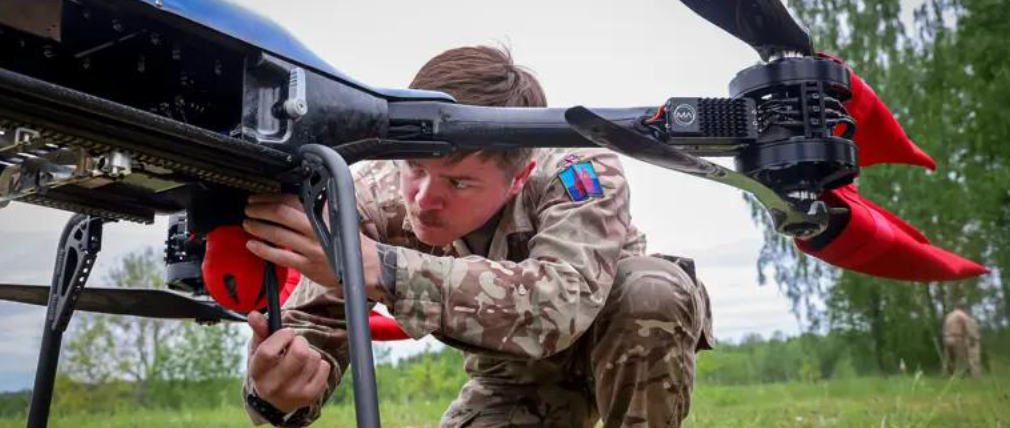
Britain is spending £25 million on new drones and electronic warfare equipment to strengthen its frontline troops.
The investment will provide British forces in Estonia with hundreds of attack drones, improved surveillance equipment and systems to detect and disrupt enemy aircraft.
Announced by the Ministry of Defence, the funding will strengthen troops deployed on NATO’s eastern flank as part of efforts to deter a Russian attack.
The package includes one-way attack drones, which destroy targets by crashing into them, and first-person view drones, which operators guide using live video feeds.
The number of intelligence, surveillance and reconnaissance drones will also be doubled, allowing troops to locate enemy positions and monitor movements more quickly.
The investment reflects lessons from the war in Ukraine, where both sides have used drones to identify targets, direct artillery fire and attack military vehicles.
Defence Secretary Wes Streeting said: “This investment will increase our deterrence on NATO’s front line, with our troops in Estonia being kitted out with the latest drones and capabilities. It will mean our Army can move faster, be more agile and strike the enemy harder. And it shows how we’re investing today to step up our deterrence and readiness for tomorrow.”
The new counter-drone equipment includes electronic warfare systems carried by soldiers and mounted on military vehicles.
The systems will scan for electronic signals, helping troops detect and disrupt hostile drones before they can pose a threat.
Additional shotguns will provide protection against drones at close range when electronic interference is ineffective.
The war in Ukraine however has demonstrated the limitations of relying entirely on electronic jamming.
Russian forces have increasingly used fibre-optic-controlled drones, which remain connected to their operators through thin cables rather than radio links. These aircraft cannot be disrupted by conventional radio-frequency jamming.
The Ministry of Defence has not specified whether the new equipment can counter fibre-optic-controlled drones or other aircraft designed to operate without conventional radio communications.
British troops will also receive multi-spectral camouflage designed to conceal soldiers and equipment from surveillance systems, including thermal imaging sensors.
Additional lightweight four-wheel-drive vehicles will allow troops to move quickly in smaller, dispersed groups, making them harder to locate and target.
The investment will support the Army’s developing reconnaissance-strike approach, which combines surveillance, intelligence and precision weapons to reduce the time between identifying and attacking enemy positions.
General Sir Roly Walker, Chief of the General Staff, said: “Ukraine has shown that the side which can see first, strike first and protect itself best has a significant advantage in modern war. We are acting on those lessons now.”

He added: “This investment delivers more drones, more electronic warfare capability and better protection for our soldiers, making the British Army harder to find, harder to defeat and more lethal when it matters most. That’s what it takes to be ready to fight and win alongside our NATO Allies.”
The investment follows a wider agreement between Britain and Estonia in July to modernise the British military presence and strengthen NATO’s defences in the Baltic region.
Under the agreement, British forces will move towards a more mobile formation supported by improved surveillance and precision weapons.
The Ministry of Defence said the changes would increase the number of British personnel in Estonia to around 1,200, while maintaining a brigade in the United Kingdom ready to reinforce the country during a crisis.
The latest equipment will be supplied to the 4th Light Brigade, a high-readiness formation responsible for reinforcing NATO’s eastern flank, by April 2027.
The Ministry of Defence has not disclosed the precise number of attack drones being purchased, their manufacturers or the existing number of reconnaissance drones available to the troops concerned.
The £25 million package forms part of a wider £50 million allocation under Project RAPSTONE, an Army programme intended to introduce new battlefield technology more quickly.
