

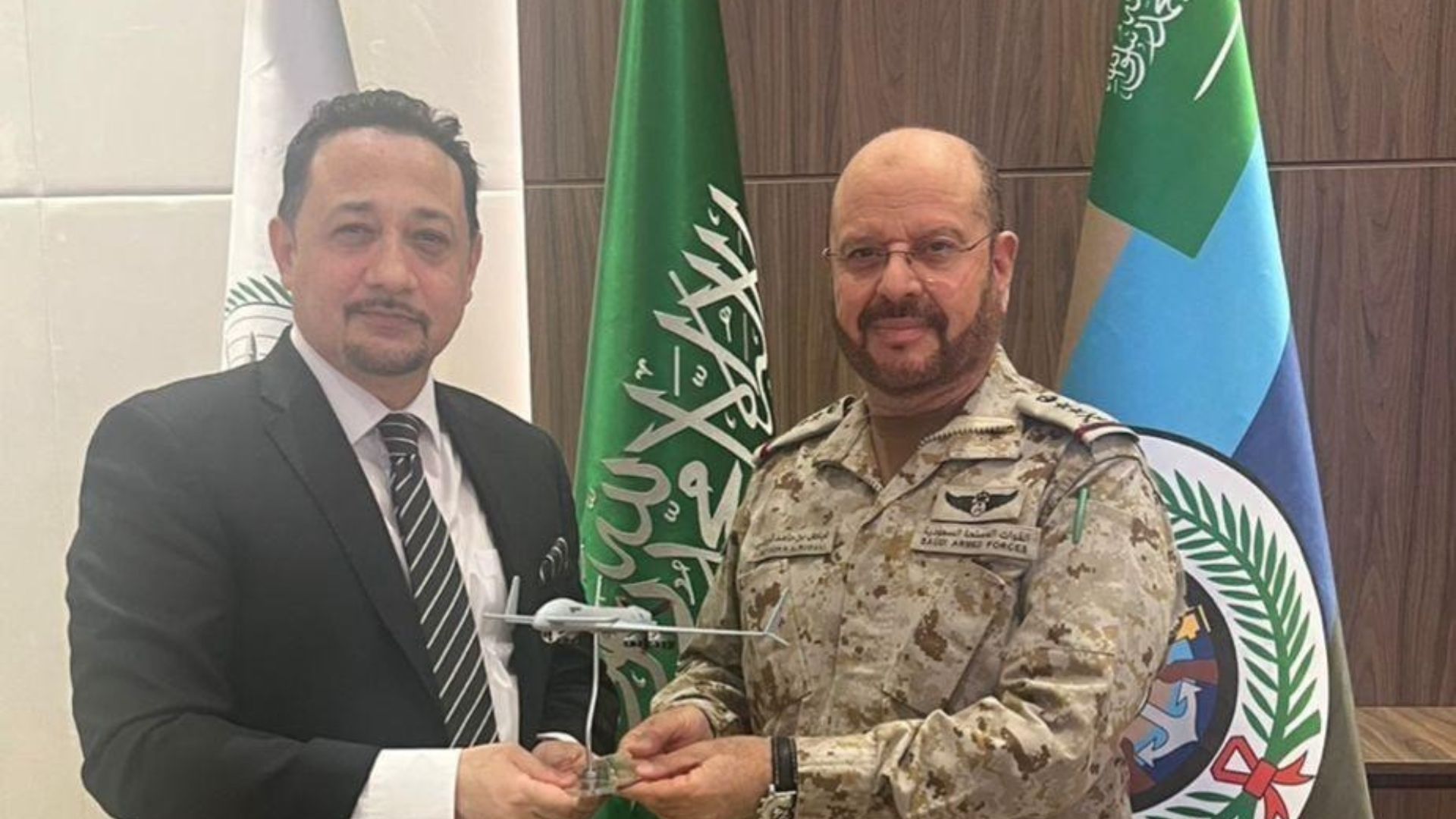
Global Industrial & Defence Solutions (GIDS) came to the 2026 World Defense Show (WDS) in Riyadh with a clear message: Pakistan provides a mature munitions and drone portfolio, it is ready to transfer production to friendly countries, and Saudi Arabia is a critical market.
GIDS’ CEO, Asad Kamal, said as much at the exhibition, telling Aviation Week Saudi Arabia is the company’s “biggest market” and that the state-owned conglomerate is fully “willing to transfer technologies or transfer production to fulfill the aims of Saudi Vision 2030.”
For a company that has spent the past five years in transformation its brand outlook in the international market– i.e., IDEAS 2024 in Karachi, LAAD 2025 in Rio de Janeiro, IDEF 2025 in Istanbul and EDEX-2025, Egypt – WDS 2026, KSA was the culmination of a deliberate market-entry campaign.
GIDS stands today at a game-changing moment in its evolution by engaging and hosting highest level visits and demonstration of equipment for King Jordan, Indonesian President, Uzbekistan President and Azeri Defence Minister at GIDS HQs during the last six months.
The timing is favorable. Saudi Arabia allocated $78 billion to defence in its 2025 budget.
The General Authority for Military Industries (GAMI) has raised defence spending localization from 4% in 2018 to 24.89% by the end of 2024, and is targeting 50% by 2030. GAMI has signed over 53 industrial cooperation agreements worth approximately $9.32 billion with local and international companies, and the number of licensed military-industrial facilities in the Kingdom has grown from five in 2019 to 296 by late 2024. WDS 2026 itself closed with more than $8.8 billion in deals across 220 agreements.
The demand for new suppliers (especially those willing to localize) is real and promising. GIDS is positioning itself to feed that demand across three tracks – i.e., a growing munitions and drone portfolio, a willingness to forge local partnerships, and a broader pitch about why Pakistan is a structurally suitable defence industry partner for the Kingdom.
Growing its Munitions & Drones Portfolio
GIDS has spent the past four years sharpening its munitions and unmanned systems portfolio into a coherent export offering. At IDEAS 2024, Quwa noted that the company showcased a range of guided weapons, including the Rasoob 250 and AZB-81LR, as part of a deliberate strategy to lead with munitions rather than complete platforms.
The logic was that munitions have lower barriers to entry than complete platforms like the JF-17, generate recurring revenue, and position Pakistan within a niche assortment of key suppliers capable of producing advanced standoff weapons and cruise missiles.
That portfolio expanded at LAAD-2025, where GIDS displayed the Fatah-I and Fatah-II precision-guided rockets, the Taimur air-launched cruise missile, the Harbah NG anti-ship cruise missile, the AZB-series precision-guided bombs, the al-Battaar laser-guided bomb, and the YALGHAR-series loitering munitions.
The appearance in Latin America was significant in itself. GIDS was actively prospecting new regions beyond its traditional markets in the Middle East, Africa and Asia.
By 2026, the portfolio had further matured.
GIDS test-fired the Taimur air-launched cruise missile on January 3, 2026 (deployed from a Pakistan Air Force Mirage III), demonstrating an export-ready weapon with a 295-km range, INS/GNSS guidance, and low-altitude flight capability designed to evade air defences.
The company also formally unveiled the SMASH anti-ship ballistic missile, derived from the Fatah-II guided rocket, offering a 290-km range with an active radar seeker for both anti-ship and land-attack missions. Both systems are backed by demonstrated capability.
The Taimur has been flight-tested; the Fatah-II, from which SMASH is derived, is in service with the Pakistan Army.
On the unmanned side, GIDS displayed seven UAVs at WDS 2026, including the Shahpar-II Block-2 (operating at 25,000 ft with a payload of over 1,100 kg), Shahpar-III (reaching 35,000 ft with a payload capacity of 400 kg) & VTOLs.
New additions included the Yalghar-200 loitering munition – i.e., a 50-kg system with a 200-km range and 90–120 minutes of loiter time – along with the YALGHAR 200 and YALGHAR 400 air-launched loitering munitions (with ranges of 200 km and 400 km respectively).
The Safrah-III handheld drone jammer, with a 1,500-metre range, was also shown for the first time.
Returning goods included the Safarosh, a 175-kg turbojet-powered kamikaze munition with a 1,000-km range designed for high-value target engagement.
GIDS’ choice to present a diverse portfolio was a prudent choice as Riyadh is looking to populate an emerging domestic defence-industrial base with a range of capabilities, from guided rockets and cruise missiles to loitering munitions and MALE drones.
GIDS, with over 250 products in its catalogue, can offer variety at a scale that few mid-tier defence exporters can match.
Forging Local Partnerships
GAMI’s localization mandate means foreign suppliers must bring production, technology, and jobs into the Kingdom. GIDS has signaled that it understands this.
At IDEF 2025, GIDS signed a cooperation agreement with Turkiye’s MKE (Mechanical and Chemical Industry Corporation) focused on the development and production of aerospace munitions.
Kamal noted at the time that collaboration between the Turkish and Pakistani defence industries “has much more potential than where it is today.”
That agreement is relevant to the Saudi context because it demonstrates GIDS is willing to enter joint development and co-production arrangements, the exact model Saudi Arabia is seeking from its suppliers.
A company that co-develops munitions with Turkiye’s state-owned enterprise can credibly offer to do the same with Saudi partners.
Speaking with Quwa after WDS 2026, Kamal made the localization pitch explicit, stating that many companies were interested in localizing GIDS products. As CEO, he also expressed his vision to evolve GIDS into a top revenue generator and a flag bearer of Pakistan defence industry amongst the Top 100 exporters of South Asia by 2030.
The variety of the GIDS stand – spanning cruise missiles, guided rockets, loitering munitions, MALE drones, and counter-drone systems – was itself a signal.
Each product category represents a potential localization stream: a licensed production line, a maintenance hub, a joint venture, or a supply-chain integration opportunity.
Saudi Arabia’s Vision 2030 target requires not one large offset deal, but dozens of distributed industrial partnerships that collectively push localization from 24.89% toward 50%. GIDS is presenting itself as a company that can contribute across multiple areas.
Showing Why Pakistan is the Right Defence Industry Partner
GIDS is making a structural argument about why Pakistan, specifically, suits Saudi Arabia’s defence-industrial ambitions.
The first layer is cost.
Pakistan’s munitions and drones are priced below Western equivalents.
For a country spending $78 billion on defence annually and trying to localize half of that, cost matters. Every dollar saved on a guided munition is a dollar that can be reinvested into domestic facility buildout, workforce training, or additional procurement volume.
Pakistan’s defence exports (currently estimated between $300-$500 million annually, with deals worth several billion reportedly inked across the globe in 2025) are growing because buyers see value in the pricing.
The second layer is accessibility.
Pakistan does not impose the same end-use restrictions, congressional oversight, or re-export controls that complicate procurement from Western suppliers.
For Saudi Arabia, which has faced periodic political friction over arms transfers from the United States and Europe, a supplier that offers fewer strings is structurally attractive.
Pakistan’s products fill the gap between what Western suppliers are willing to sell and what the Kingdom needs to build domestically.
The third layer is the co-production and technology-transfer model.
As Quwa has noted in previous coverage, Pakistan’s defence industry faces its own structural constraints, including dependency on imported semiconductors, inertial navigation systems, and precision manufacturing equipment.
These constraints push Pakistani firms toward collaborative production models by default.
GIDS does not have the option of insisting on turnkey exports the way a Lockheed Martin or MBDA might. Its natural posture is partnership, which happens to align precisely with what Saudi Arabia is seeking under Vision 2030.
Supporting Pakistani Defence Needs
The Saudi market is attractive to GIDS for the obvious commercial reasons – e..g, volume, revenue, and a recurring customer. But there are also structural benefits from Pakistan, not least by gaining another funding source to help support defence development programs.
Heavy Industries Taxila (HIT) is developing the P251, a 155mm/52-calibre truck-mounted artillery gun system, as prime contractor for Saudi Arabian Military Industries (SAMI).
The system is being built to NATO-grade European alloy specifications – i.e., 40NiCrMoV15 and 35NiCrMoV15Mod – positioning it as a next-generation NATO-standard platform.
This is the model that matters for GIDS. When a Saudi partner funds the co-development of a weapon system, the R&D overhead moves off the Pakistani military’s budget.
Pakistan’s armed forces operate under persistent fiscal pressure. Every rupee allocated to R&D for a new munition or drone is a rupee diverted from immediate procurement, from spare parts, training, or operational readiness. With special reference to the upcoming IDEAS-2026, Kamal updated that biggest ever GIDS participation is planned since its inception where a number of new defence items will be showcased in the complete GIDS Hall covering a space of more than 3,000 SQM.
Saudi-funded co-development breaks that trade-off, freeing the Pakistani military to continue procuring what it needs today while its domestic defence industry builds the next generation of products on a partner’s development budget.
The benefits compound. A cruise missile or loitering munition co-developed with Saudi funding does not stay exclusive to the Saudi customer.
Once the product is mature and proven, Pakistan can offer it to other buyers – e.g., in the Middle East, Southeast Asia, Africa, or Latin America – at a lower marginal cost because the R&D has already been amortized.
For GIDS, replicating this model across its munitions and drone portfolio would be transformative.
If Saudi partners fund the co-production of the Taimur cruise missile, the YALGHAR loitering munition, or the YALGHAR-series air-launched systems, GIDS can accelerate product maturation without forcing the Pakistani military to choose between funding R&D and funding readiness.
The Saudi market becomes an engine for Pakistani defence-industrial development, i.e., a funding source that lifts the R&D burden and frees the military to focus on procurement.
