

The United States has deployed two aircraft carrier strike groups to the Middle East as part of Operation Epic Fury – its ongoing air and naval campaign against Iran – with a third carrier preparing to sail.
Total US naval presence in the region now exceeds 30 warships, according to US Central Command (CENTCOM).
CENTCOM Commander Admiral Brad Cooper stated that US and allied forces achieved total air and sea dominance over Iran within six days of the campaign’s launch. According to Cooper, US forces sank over 30 Iranian vessels – including what CENTCOM describes as a drone carrier comparable in size to a World War II-era aircraft carrier – and struck nearly 200 targets inside Iranian territory during the initial phase.
Subsequent reporting indicates the total number of Iranian ships hit has risen to at least 43, while the overall target count across the campaign has exceeded 3,000 as of early March 2026.
Carrier Strike Group Deployments
The USS Abraham Lincoln (CVN-72), operating with Carrier Air Wing 9 (CVW-9), has been stationed in the Arabian Sea since January 2026.
The Lincoln strike group is accompanied by at least eight Arleigh Burke-class guided-missile destroyers distributed across the Arabian Sea, Eastern Mediterranean, and Red Sea.
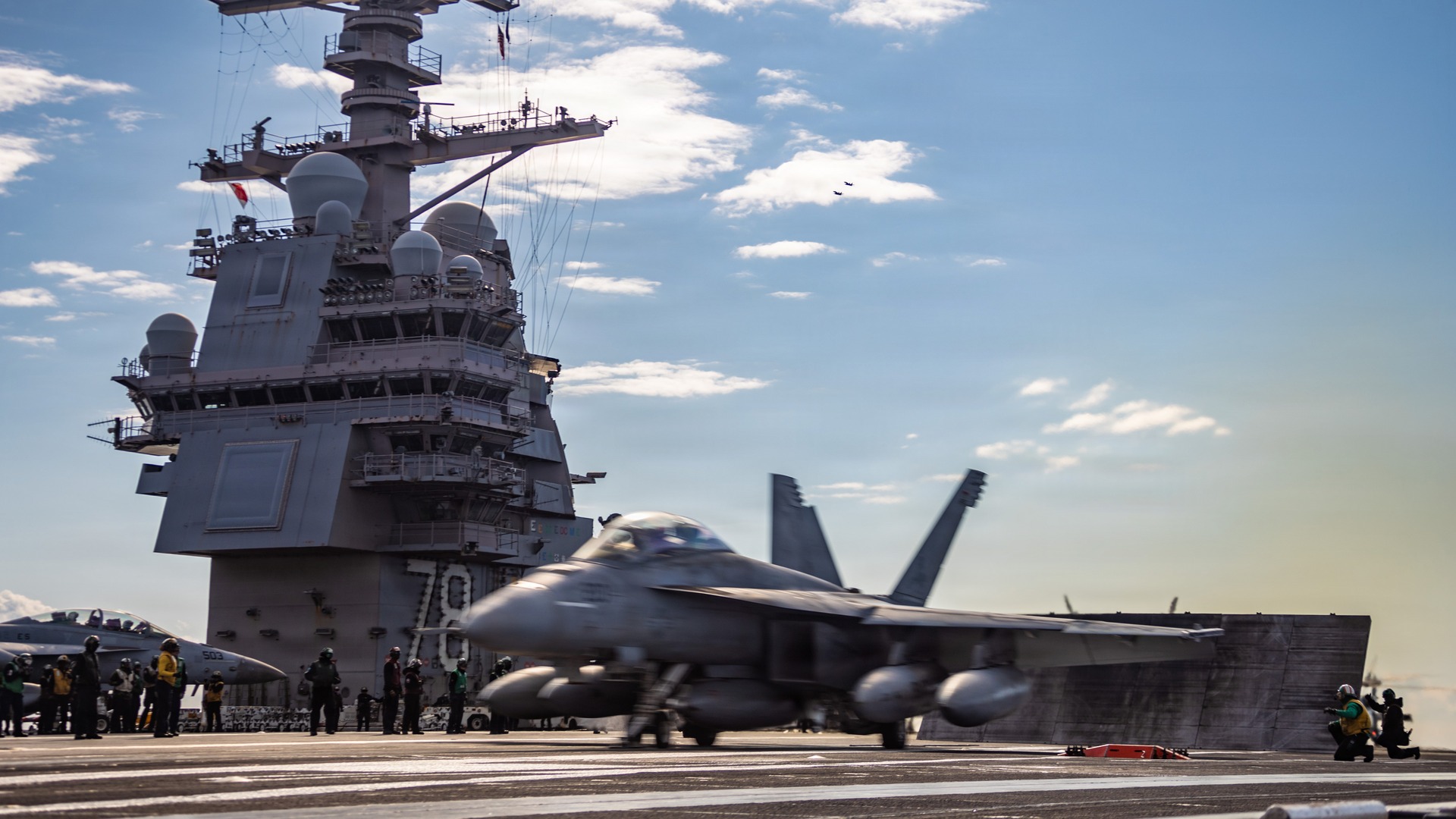
The USS Gerald R. Ford (CVN-78) – the US Navy’s newest supercarrier – transited the Suez Canal on 5 March and is now operating in the Red Sea as the second carrier strike group committed to the campaign.
A third carrier, the USS George H.W. Bush (CVN-77), completed pre-deployment exercises (COMPTUEX) on 6 March and is expected to deploy shortly.
However, the Bush has not yet entered the theatre – transit to the Eastern Mediterranean would take an estimated 10 to 12 days.
US Secretary of Defence Pete Hegseth stated that incoming US and Israeli forces represent “multiples” of current deployments, signalling further force build-up in the weeks ahead.
Iranian Claims and Conflicting Narratives
Iran’s Islamic Revolutionary Guard Corps (IRGC) claims to have struck the USS Abraham Lincoln with ballistic missiles, asserting that the carrier was forced to retreat from the Gulf of Oman. US officials have denied any hits, releasing photographs showing the Lincoln operating normally.
The IRGC also claims to have launched anti-ship missile and drone attacks against the Lincoln strike group. CENTCOM has not acknowledged any damage to US vessels from these engagements.
The conflicting claims remain unverifiable from open sources, though US forces continue to operate in the Arabian Sea without any reported repositioning consistent with combat damage.
International Responses
Spain has denied the US military access to its bases at Rota and Morón, prompting trade threats from President Trump. Spanish Prime Minister Pedro Sánchez has called for an immediate ceasefire, stating “No to war.”
No other allied naval deployments to the region have been confirmed in reporting from the past week.
Notes & Comments
The scale of the US naval build-up in the Middle East is considerable, but the details warrant careful parsing.
Two carrier strike groups are now active in the theatre – Lincoln in the Arabian Sea and Ford in the Red Sea – while the Bush is preparing to deploy but has not yet arrived. Reports describing “three active carriers” are premature; one could see the Bush entering the theatre within two weeks, but it is not there yet.
Admiral Cooper’s claim of air and sea dominance within six days appears plausible given the asymmetry in naval capability between the US and Iran.
The Iranian navy and IRGC naval forces were never designed to contest US surface dominance in a conventional sense – their strategy has historically centred on asymmetric threats: fast attack craft, anti-ship missiles, mines, and more recently, one-way attack drones.
In this vein, the sinking of over 30 Iranian vessels (rising to 43 per subsequent reporting) likely reflects the destruction of Iran’s fast attack craft, missile boats, and support vessels rather than any fleet engagement in the traditional sense.
The drone carrier described by Cooper – if confirmed – would represent a more significant capability loss, suggesting Iran had developed a dedicated platform for launching Shahed-type drones at range.
The escalation from 200 initial targets to over 3,000 in the campaign’s first week signals a shift from targeted strikes against launch sites and naval assets to a broader suppression campaign.
One can see CENTCOM moving from an initial ‘decapitation’ phase – targeting immediate threats – to a sustained degradation campaign aimed at Iran’s capacity to reconstitute its military infrastructure.
That said, the Iranian narrative deserves attention, even if its claims of striking the Lincoln are likely exaggerated. The IRGC’s assertion that it launched ballistic missiles at a carrier strike group – regardless of whether they hit – indicates a willingness to escalate.
If Iran retains sufficient ballistic missile stocks to target US capital ships, the risk calculus for operating carriers within range of Iranian strikes becomes a factor, even if current defences have proven effective.
The Spanish refusal to grant base access at Rota and Morón is a notable political signal, though its operational impact appears limited given that US forces in the region operate primarily from Gulf state bases and at-sea platforms.
However, it reflects growing European discomfort with the campaign’s scope and could complicate logistics if the conflict extends into the Mediterranean.
One could see the next phase of this conflict defined less by the naval engagements – which the US has effectively won – and more by the air campaign’s ability to degrade Iran’s missile and drone production capacity before stocks are reconstituted.
The arrival of the Bush strike group, alongside the Ford and Lincoln, would give CENTCOM three carrier air wings for sustained operations – a concentration of naval aviation not seen in the region since the 2003 invasion of Iraq.
