

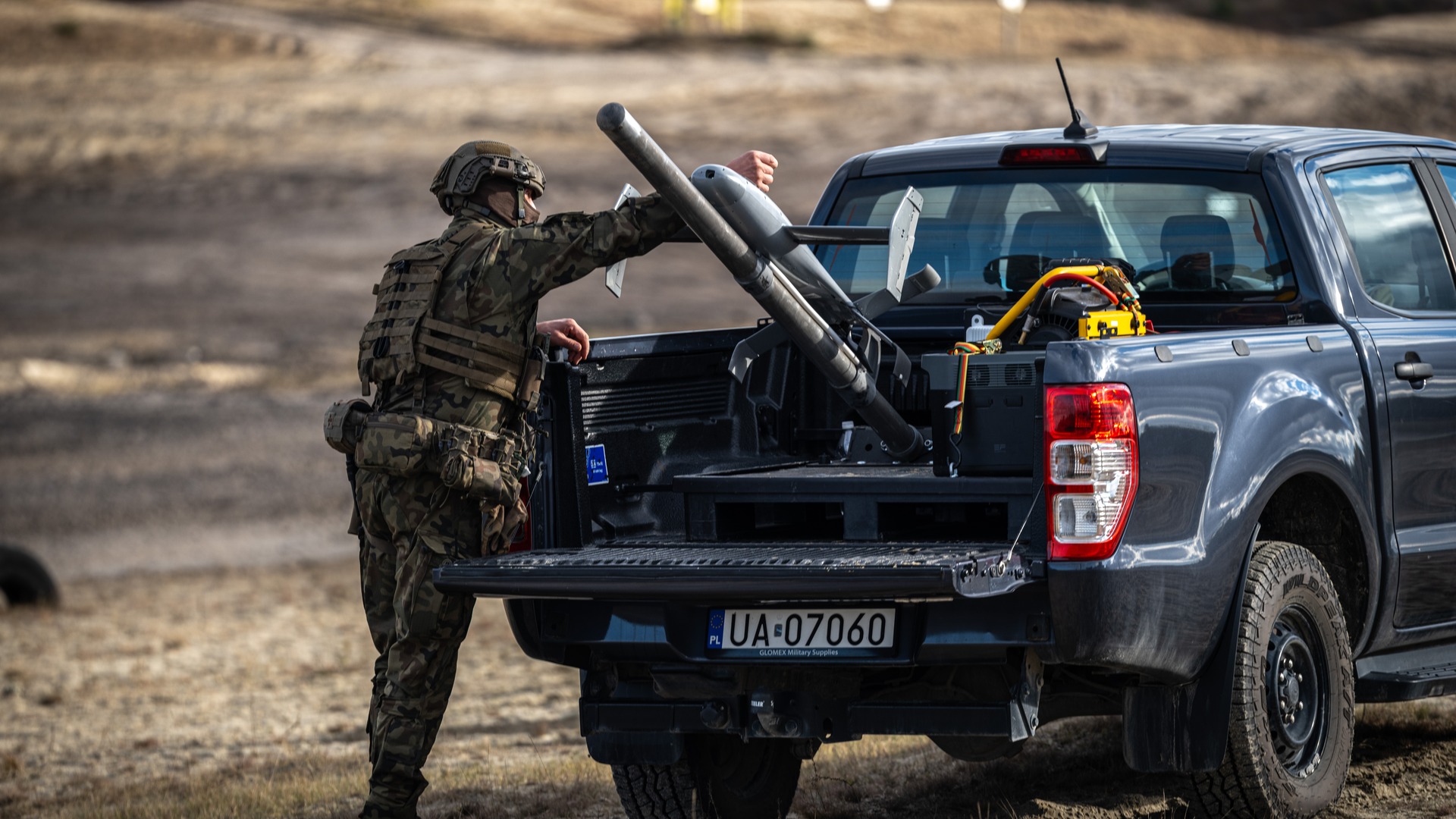
The United States and its Gulf allies are reportedly negotiating the procurement of interceptor drones and accelerating the deployment of directed-energy weapons to counter Iranian Shahed-136 drone swarms, amid what US officials describe as a cost-exchange problem created by Iran’s use of low-cost unmanned systems against high-value air defence assets.
According to US defence officials, the US military has been relying on Patriot PAC-3 missiles – each reportedly costing $13.5 million – to intercept Shahed-136 drones that cost an estimated $30,000 per unit. The disparity has prompted an urgent search for cheaper countermeasures, with Ukrainian-tested and American-developed systems emerging as leading candidates.
Interceptor Drones: Ukrainian and American Programmes
US and Gulf state officials are reportedly pursuing two distinct interceptor drone programmes to address the Shahed threat. The first is Ukraine’s Wild Hornets ‘Sting’ quadcopter, a Ukrainian-made system designed to kinetically engage Shahed-type targets at close range.
According to available specifications, the Sting quadcopter reportedly reaches speeds of 315 km/h with a range of 25 km and can deploy within 15 minutes from flat surfaces. Ukrainian officials claim the system has achieved high interception rates against Shahed-136 drones in the ongoing Russo-Ukrainian war, though specific figures have not been independently verified.
The second programme is Merops, a fixed-wing interceptor drone developed under Project Eagle – a US initiative led by former Google Chief Executive Officer (CEO) Eric Schmidt. The Merops system has been battle-tested in Ukraine since mid-2024 against Shahed-136 drones, with reports indicating hit rates as high as 95% and a unit cost of approximately $15,000.
The procurement rationale, according to US officials, centres on preserving Patriot stocks for higher-tier ballistic missile threats rather than expending them on expendable drones.
Directed-Energy Weapons and Ongoing Strikes
The US Navy is reportedly deploying shipborne laser systems to engage Iranian drones as part of a broader counter-unmanned aerial system (C-UAS) effort integrated into ongoing operations in the Gulf.
These deployments coincide with what US Central Command (CENTCOM) describes as a significant reduction in Iranian drone activity. CENTCOM claims drone attacks have fallen 83% and ballistic missile launches 90% since the start of Operation Epic Fury – the US-led air campaign targeting IRGC infrastructure, drone production facilities, and launch systems across Iran.
Among the strikes, CENTCOM reports the sinking of a large Iranian vessel described as a drone carrier comparable in size to a World War II-era aircraft carrier, though independent confirmation of the vessel’s class and role has not been available.
US officials say Operation Epic Fury is now transitioning from suppression of Iranian offensive capabilities to degradation of Iran’s capacity to reconstitute its drone and missile programmes.
Ongoing Incidents
Despite the claimed reductions, reporting from the past week indicates continued Iranian drone strikes on coalition and allied positions. Incidents reportedly include drone attacks on a hotel in Erbil, oil field infrastructure in Basra – including sites associated with Halliburton and KBR – and US military installations in Iraq. Coalition officials say these attacks were intercepted by air defence systems, though damage assessments have not been publicly detailed.
The Shahed-136’s reported 2,500 km range continues to place US bases, Gulf energy infrastructure, and allied positions within its operational envelope, sustaining the threat even as overall launch rates decline.
US leadership has asserted that forces in the region face no munitions shortages and maintain air superiority over Iran.
Notes & Comments
The cost-exchange problem at the centre of this reporting is not new, but the scale of Iran’s Shahed-136 campaign appears to be forcing a faster reckoning than the US defence establishment had anticipated. A $13.5 million Patriot PAC-3 intercepting a $30,000 drone is a 450-to-1 cost ratio – and in a swarm scenario involving dozens or hundreds of Shaheds, the arithmetic becomes untenable regardless of how many Patriot batteries the US deploys.
In this vein, the interest in interceptor drones is instructive. Ukraine has spent over two years developing layered C-UAS defences against exactly this class of threat – Shahed-136 one-way attack drones launched in volume against distributed targets. The Ukrainian model combines interceptor drones, electronic warfare (EW) jamming, and mobile rapid-reaction squads, reportedly achieving intercept rates above 80% against Shahed waves.
The convergence of Ukrainian combat experience and American engineering is notable. Wild Hornets’ Sting represents the Ukrainian organic approach – rapidly developed, field-tested, and iteratively refined under combat pressure. Project Eagle’s Merops represents the US technology sector’s entry into the counter-drone space, leveraging Silicon Valley engineering and Ukrainian battlefield data to produce a fixed-wing interceptor optimised for longer-range engagements. If both systems can replicate their reported results in the Gulf theatre, the US would gain a low-cost attrition layer that preserves its Patriot and Terminal High Altitude Area Defence (THAAD) stocks for the ballistic threats they were designed to counter.
That said, the Gulf operating environment differs from Ukraine in ways that matter. Ukraine’s C-UAS success relies heavily on dense EW coverage, early-warning networks built over years of operational learning, and a population mobilised for air defence. The Gulf states and US Central Command are attempting to replicate these layered defences in a compressed timeframe and across a much wider geographic area – from Erbil to Basra to installations across Kuwait, Qatar, and Bahrain.
The directed-energy track is the longer-term play. Laser weapons offer near-zero marginal cost per engagement and theoretically unlimited magazines, which makes them the ideal counter to swarm tactics. However, current shipborne laser systems remain limited in power output and are generally effective only at short range and against slower targets. One can see the current deployments as operational testing under combat conditions rather than a scaled capability – a step toward a future C-UAS architecture rather than a solution to the present one.
The CENTCOM claim of 83% and 90% reductions in drone and ballistic missile activity respectively is worth treating with caution. These figures likely reflect the combined effect of Operation Epic Fury’s strikes on production facilities and launch infrastructure rather than the performance of defensive systems alone. The continued incidents at Erbil, Basra, and Iraqi bases suggest that Iran retains sufficient residual capacity – and possibly pre-positioned stocks – to sustain a low-rate campaign even as its reconstitution capacity degrades.
One could see the next phase of this conflict hinging less on air superiority, which the US has effectively established, and more on the counter-drone layer beneath it. The procurement of Ukrainian and American interceptors alongside the deployment of laser systems signal that Washington recognises this gap. Whether these systems arrive and integrate fast enough to matter before Iran’s remaining Shahed stocks are expended – or replenished – will be a defining variable in the weeks ahead.
