

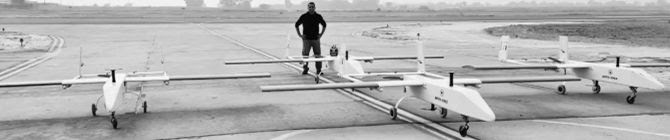
Bhopal-based Aryavart Technologies Development Pvt Ltd has emerged as one of India’s most promising private players in the unmanned systems domain with its long-endurance ARYA family of tactical unmanned aerial vehicles, now being evolved into a loitering strike–capable platform.
The company’s work on ARYA reflects a broader shift in India’s defence ecosystem, where regional innovation hubs and start-ups are taking on roles traditionally dominated by large public sector enterprises, particularly in domains such as surveillance drones, loitering munitions, and autonomous systems.
Founded in Bhopal, Madhya Pradesh, Aryavart Technologies has steadily built a niche in indigenous UAV design, development, and manufacturing, aligning closely with the Atmanirbhar Bharat vision of reducing external dependence in critical defence technologies.
Rather than remaining a generic drone manufacturer, the firm has chosen to focus on tactically relevant, mission-ready systems tailored to Indian operational conditions, including high-altitude regions, contested electromagnetic environments, and austere forward bases.
The ARYA platform, represented in its current fielded configuration as the ARYA-5001 tactical UAV, has already crossed an important credibility threshold with induction by the Indian Air Force (IAF).
Delivery of the first lot of ARYA UAVs to the IAF marks a rare achievement for a relatively young private company from outside the traditional defence-industrial centres of Bengaluru and Hyderabad, and signals growing trust in start-up-driven air systems within frontline combat and surveillance roles.
In its present form, the ARYA UAV is positioned as a high-performance, multi-role tactical system capable of supporting a range of missions from intelligence, surveillance and reconnaissance (ISR) to specialist payload carriage.
Publicly available performance data indicates an endurance of up to four hours, a cruise speed of around 180 km/h, and a payload capacity of up to 20 kg, giving it enough span to support electro‑optical/infrared (EO/IR) turrets, communications relays, electronic support payloads, or modular effects for strike roles.
A defining design feature of ARYA is its ability to operate effectively in GPS‑denied and electronic warfare (EW) environments, an increasingly critical requirement as regional adversaries invest in jamming and spoofing capabilities.
By emphasising robust navigation, resilient datalinks, and fail‑safe autonomous modes, Aryavart is clearly targeting the higher end of the tactical UAV spectrum, where survivability in contested domains is as important as raw performance figures.
The evolution of ARYA towards a long-endurance loitering strike platform builds naturally on these core strengths. While the currently fielded ARYA-5001 is optimised around ISR and tactical support, the same airframe class, endurance band, and payload architecture are well suited to hosting loitering munitions, warhead modules, or dispensers for smaller effectors.
As India’s armed forces induct systems such as Nagastra-1 loitering munitions and explore larger, longer‑range loitering UAVs, the availability of an indigenous, airworthy, already‑operational tactical UAV like ARYA provides a ready platform for iterative weaponisation and strike integration.
Conceptually, a long-endurance loitering strike variant of ARYA would combine the persistence of a tactical UAV with the terminal effects of a precision munition, allowing it to remain on station, build situational awareness, and then prosecute targets of opportunity.
This is particularly relevant in a South Asian context where high‑value targets may be fleeting, mobile, and located in complex terrain ranging from mountains to dense urban environments. In such scenarios, a loitering ARYA system could function as both sensor and shooter, shrinking the sensor-to-shooter loop and reducing dependence on manned aviation or large, satellite‑dependent UAVs.
The operational value of a loiter-capable ARYA becomes even more apparent when examined against India’s evolving doctrine on unmanned and autonomous systems. Indian services are moving from viewing drones merely as ISR assets to treating them as integral components of distributed, networked kill‑chains that blend surveillance, electronic attack, and precision engagement.
A Bhopal‑designed platform capable of operating in EW‑rich environments, while delivering both persistent surveillance and precision effects, fits neatly into this doctrinal trajectory and helps diversify the supplier base beyond a handful of state-linked entities.
From an industrial standpoint, Aryavart Technologies’ rise underlines the maturation of India’s private UAV ecosystem. The successful design, development and delivery of ARYA-5001 to the IAF demonstrate that regional companies can meet stringent airworthiness, safety, and reliability benchmarks expected by frontline services.
This also reflects improvements in the wider supply chain, including structures, avionics, propulsion, ground control systems, and software, which are increasingly sourced domestically rather than being imported as complete foreign solutions.
Leadership has played a key role in shaping ARYA as a mission-focused platform. The programme is led by Sqn Ldr Mahesh Kumar Pundhir (Retd.), who combines over a decade of helicopter flying experience, including with the Sarang helicopter display team, with a strong engineering background.
This blend of operational understanding and technical competence helps ensure that the UAV’s design decisions – from payload integration to human–machine interface of the ground control station – are tightly aligned with real-world battlefield requirements rather than purely theoretical specifications.
Looking ahead, there is significant scope for ARYA’s further evolution into a sophisticated loitering strike system. Global trends in unmanned warfare point towards greater integration of AI‑driven autonomy, collaborative swarm behaviour, and multi‑domain networking, including seamless links with ground forces, artillery, and manned aircraft.
The ARYA family, already positioned as an indigenous tactical platform with robust endurance and payload margins, offers a natural testbed for such enhancements, including AI‑assisted target recognition, autonomous route planning, and coordinated multi‑UAV operations in support of deep‑strike and suppression missions.
In the broader strategic context, systems like ARYA help strengthen India’s asymmetric warfare posture by providing persistent eyes and precision reach at relatively low cost compared with manned aircraft or large strategic UAVs.
Their indigenous origin also reduces vulnerability to sanctions, export controls, and foreign supply chain disruptions, while enabling secure customisation of datalinks, encryption, and mission software according to national security requirements.
For a country that must plan for protracted, high‑intensity contingencies along two active land borders and an expansive maritime domain, such assets are increasingly central to maintaining credible deterrence and rapid response options.
Ultimately, Bhopal-based Aryavart Technologies and its ARYA UAV line illustrate how India’s drone revolution is no longer confined to a few metropolitan hubs or technology giants.
By combining indigenous engineering, operationally informed design, and a clear trajectory towards loitering strike capabilities, the company is positioning ARYA not just as another surveillance drone, but as a versatile tactical tool for the next generation of Indian air operations across land and maritime theatres.
IDN (With Agency Inputs)
