

WASHINGTON — Two top military commanders have praised what they said was the critical role of space operations in the early days of Operation Epic Fury, but they were loathe to say what, exactly, the US military was doing in the highest, at times most secretive domain.
“A note about the Space Force. Our space superiority has been a critical enabler to this fight. Unseen by the world, the Space Force is doing two things. First, they’re degrading Iranian capability and second, they’re helping to protect American forces, and I’ll have to leave it right there,” Adm. Brad Cooper, commander of US Central Command (CENTCOM), said Wednesday in a short video address on X.
Cooper’s remarks followed those in a similar vein made by Chairman of the Joint Chiefs of Staff Gen. Dan Caine regarding the important role of US Space and Cyber Commands in the early hours of the war. “The first movers were US CYBERCOM and US SPACECOM layering non-kinetic effects, disrupting and degrading and blinding Iran’s ability to see, communicate and respond,” he told reporters on March 2.
But like Cooper, Caine left it there. And service spokespeople mostly followed suit. When queried for this report, a Space Force spokesperson referred all questions to CENTCOM and/or the Pentagon; spokespersons from SPACECOM and CENTCOM declined to go into details citing “operational security” concerns.
“[H]owever,” the SPACECOM spokesperson said, “Gen. Caine’s remarks underscore the importance of achieving and maintaining space superiority — not only to safeguard the systems necessary for precision strike capability, missile warning and tracking, and secure communications that connect globally dispersed organizations, but also to provide overwatch for terrestrial forces in harm’s way.”
While officials remain tightlipped, a bevy of experts including former Pentagon and military officials, told Breaking Defense that Cooper and Caine were almost certainly referring to the jamming of Iranian satellite communications along with other electronic warfare activities, as well as more traditional support activities such as missile warning. They’re missions for which the Space Force and SPACECOM have been preparing publicly for years.
“Establishing ‘space superiority’ in this case generally means jamming SATCOM systems that the Iranians might be using,” said one former Pentagon space official. That likely means interfering with Iranian communications as they make their way to and from ground stations.
“The Iranians do not have any other indigenous space capabilities of note although they do get imagery support from the Russian and Chinese, [but] we have not degraded those,” the ex-official said.
According to the American Enterprise Institute’s Space Data Navigator satellite tracking web tool, the Iranian government and commercial operators own 17 satellites, although only one, the Khayyam high-resolution Earth observation satellite launched in 2022, is deemed a military satellite.
Todd Harrison, AEI senior fellow and creator of the tool, noted that radio frequency (RF) jamming and spoofing (i.e. sending false signals to confuse a satellite) “would be the most direct way for the Space Force to degrade Iranian capability.”
Secure World Foundation’s Victoria Samson said that Cooper’s statement “clearly” was referring to “jamming, spoofing, and cyber” operations.
“Electronic warfare means that Iranian military units are having trouble or cannot communicate with each other, which impedes their ability to fight,” she said. “Cyber may be taking down electronic systems that the Iranians may be depending upon for organization, communication, imagery processing, etc. Spoofing may affect their ability to know where their mobile units are, or it may prevent them from know[ing] where our units [are]. They probably are having trouble getting imagery for targeting, battle damage assessment, and so forth.”
Lt. Gen. Dennis Bythewood, commander of Space Forces-Space, the Space Forces component serving SPACECOM, told the Mitchell Institute today that, in general, “space capabilities tend to be used first in any conflict … when we look at electronic warfare, being able to preclude any adversary from using their space systems the same way we would want to use ours.”
SPACECOM And Space Force: Vive La Différence
While both SPACECOM and the Space Force have roles in combat operations and the two organizations work hand-in glove, those roles are different.
SPACECOM operates US military satellite constellations — although the Space Force provides the Guardians that do those operations. Those constellations include the Global Positioning System used by troops to find their way in the world and to guide weapons to targets, classified communications birds, and missile warning/tracking constellations.
SPACECOM also provides the joint force space-based information necessary to, say, pinpoint Iranian counter-space systems, such as GPS and SATCOM jammers, so they can be targeted.
Although, at the moment, the Defense Department does not acknowledge owning and/or operating any kind of offensive space-based weapons including jammers, it is SPACECOM that would be responsible for using such weapons if called to attack adversary satellites. It also will be responsible in the future for operating the space-based missile defense interceptors being pursued under the Trump administration’s ambitious Golden Dome initiative to create a comprehensive air- and missile-defense shield over the United States.
The SPACECOM spokesperson added that the command “executes offensive and defensive space operations to set favorable conditions for our Joint warfighters,” noting that as Defense Secretary Pete Hegseth said on Feb. 23, “space is ultimate high ground, and we must deliver supporting fires from our position of advantage to cover our maneuver forces.”
The Space Force, as a military service, is responsible for organizing, training and equipping all US military combatant commands, not just SPACECOM. This includes embedding Guardians in those commands as Space Force “component commands.”
Space Forces-Central, headed by Brig. Gen. Todd Benson and activated in 2022, is assigned to CENTCOM. These components are responsible for operating the ground-based EW systems aimed at adversary satellites.
The Space Force spokesperson referred questions about the number of Space Forces-Central personnel assigned to Operation Epic Freedom to CENTCOM. The CENTCOM spokesperson declined to comment. However, at the time of its activation, the component numbered about 30 personnel.
Electronic warfare, including SATCOM jamming and spoofing, is a specifically acknowledged Space Force counterspace mission area under the responsibility of Combat Forces Command Mission Delta 3. Combat Forces Command “generates and presents combat-ready intelligence, cyber, space and combat support forces” to US combatant commands for deployment, according to the service’s website.
Space Force Counterspace Capabilities
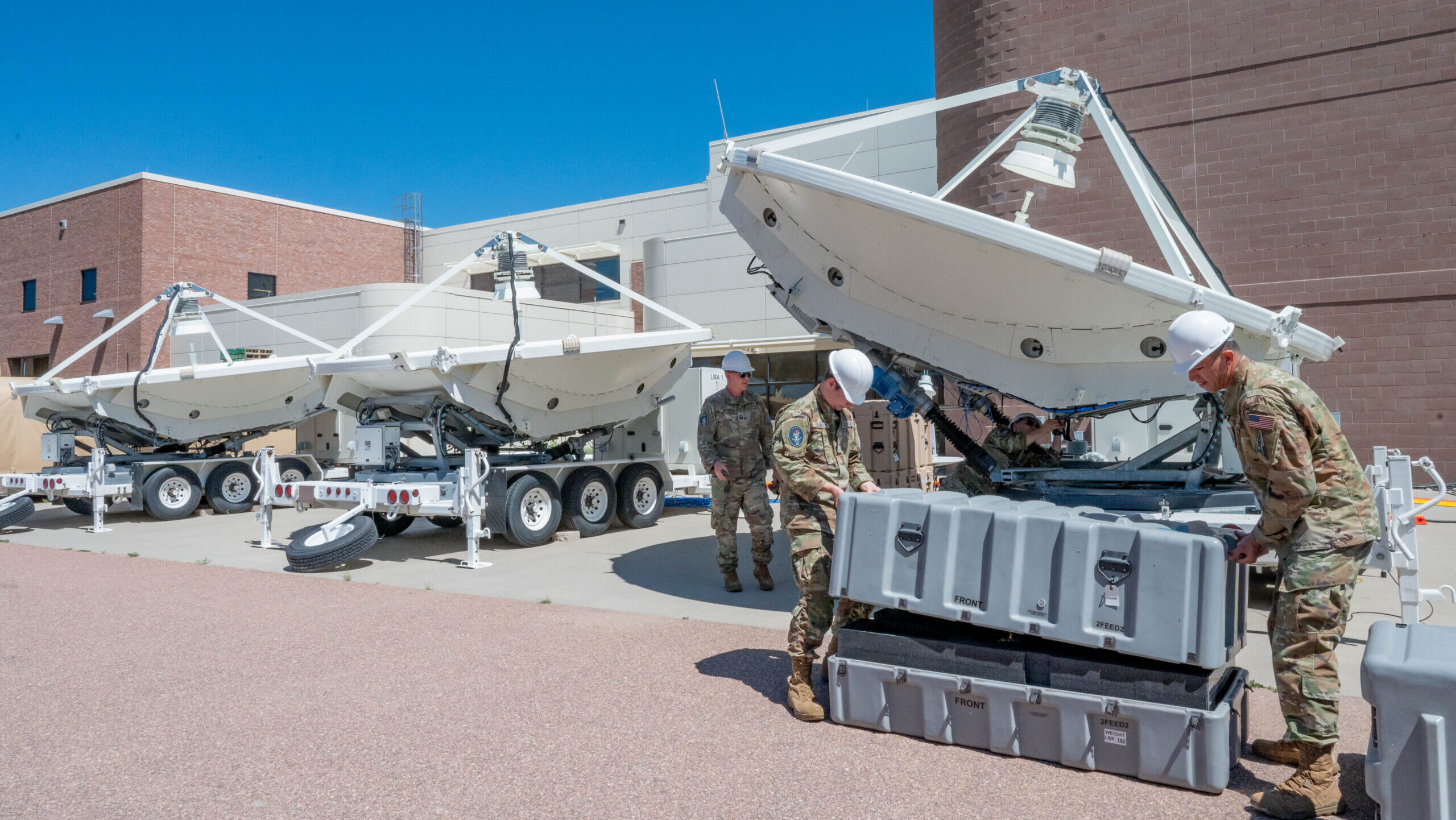
The service has at least three different SATCOM jamming systems in various stages of development and deployment. All of them work by jamming SATCOM uplinks — that is, blocking signals emanating from ground stations and providing operating instructions and other data to the satellites.
“Space Superiority jamming is … uplink jamming. This can be brute force (just radiate more power than either a valid transmitter or completely overpower the receiver on the satellite), or it can very exquisite jamming that picks out certain channels, waveforms, transponders, or even specific user channels,” the former Pentagon space official explained.
The first jamming system ever acknowledged by the Space Force, the Counter Communications System (CCS), was originally deployed in 2004. The latest update, called CCS 10.2, was completed in March 2020 by prime contractor L3Harris. There are 16 operational units, deployed with US European Command, US Africa Command and CENTCOM.
“I can only speculate on [Operation Epic Fury], but if Counter Communications Systems were employed, that could degrade Iran’s ability to command forces, coordinate missions, and share/transmit kill chain data. Again, I don’t know if those things necessarily occurred,” said the Mitchell Institute’s Kyle Pumroy, who formerly led Space Training and Readiness Command’s Delta 11, which serves as a “red team” in training Guardians on EW tactics.
A CCS follow-on, called Meadowlands and also developed by L3Harris, has been in operational testing with the Space Force since 2025. Meadowlands is billed as lighter, more mobile and capable of jamming across multiple frequencies including S-band and X-band. And unlike CCS, it can be operated remotely — meaning it does not have to be accompanied by a vulnerable crewed command post.
A Nov. 4 report by Bloomberg stated that the service intends to buy as many 32 units. For this report, a Space Force spokesperson declined to provide any information on Meadowlands aquisition plans, the number of units currently undergoing operational testing and where those are stationed.
Finally, the Space Rapid Capabilities Office (SpRCO) transitioned its miniature Remote Modular Terminal (RMT) jamming system to Space Force Combat Forces Command for operational testing in December 2024, a Space Force spokesperson told Breaking Defense.
Kelly Hammett, director of SpRCO, told reporters at the December 2024 Spacepower Conference in Orlando, Fla., that the RMTs are designed not just to jam SATCOM birds, but also block adversary “kill chains” and “targeting links.”
“That’s what these systems are intended to do: to block reception going either from, say, sensors that are that are looking at our joint forces and reporting up to a satellite and back to a battle management node, or vice versa,” he said.
The Space Force spokesperson said, “RMTs are operated by electromagnetic warfare Guardians from Combat Forces Command’s Mission Delta 3 – Space Electromagnetic Warfare, under the authority of the combatant commanders by which they are tasked.”
“RMTs are in a limited early use phase, which means they can be operationally employed while undergoing development and testing,” the spokesperson added. However, the spokesperson declined to say how many are deployed where, and refused to “speculate on a time frame for the operational acceptance.”
Back in 2024, Hammett said that some 24 RMTs had been delivered to the Space Force, and that a total of 160 had been funded.
To hear Hegseth tell it, if Space Force or SPACECOM are involved in space-related EW or cyber operations, it appears to be working against Iranian forces.
“They can barely communicate, let alone coordinate. They are confused; we know it,” he said in a morning briefing.
