

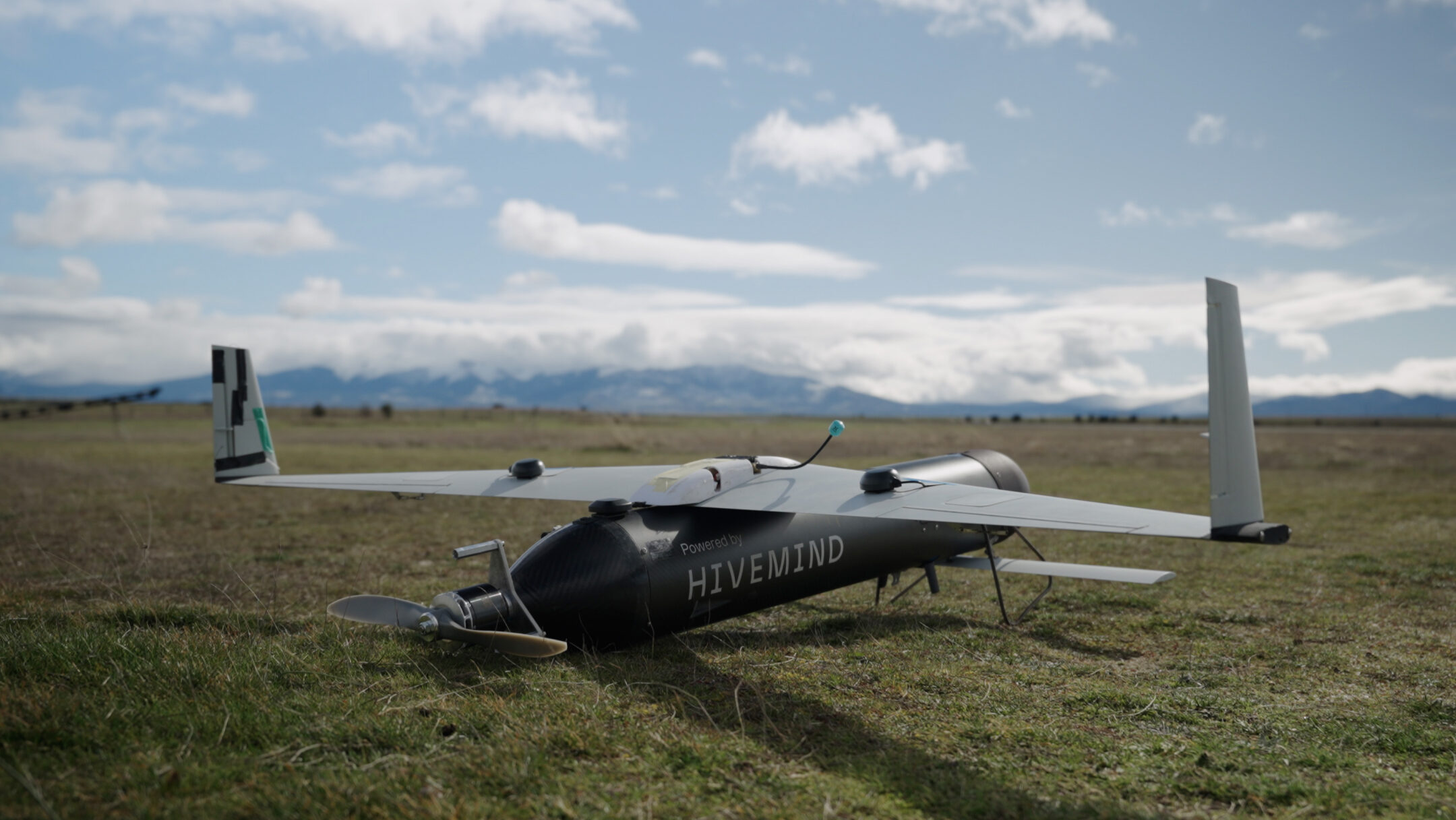
BELFAST — Swiss defense startup Destinus and California-based Shield AI have completed a two-month autonomy integration and flight test campaign in Segovia, Spain in which the companies said they successfully flew the European supplier’s Hornet drone interceptor with the US firm’s Hivemind software.
In announcing the test today, Shield AI said that Hivemind “autonomously adapted” Hornet’s flight paths in real time, including updated routing away from geofenced locations that were altered while airborne. The Hornet is a counter-unmanned aerial systems (c-UAS) air defense system, meant to take out other, threatening unmanned systems.
“The tests demonstrated the ability to rapidly integrate advanced autonomy into an operational platform while maintaining mission continuity without manual reprogramming,” added the American defense technology start-up.
A Shield AI spokesperson told Breaking Defense in a separate statement that the test campaign was financed through internal R&D funding from both the company itself and Destinus. He added that neither existing or potential customers were part of the test phase.
But the companies are hoping that the demonstration could tempt European air forces looking for cUAS solutions that can reduce reliance on crewed aircraft. Shield AI says the mission autonomy software operates on board an aircraft unlike other solutions that typically run off a ground control station. It can also function in Global Navigation Satellite Systems (GNSS) denied or communication degraded environments.
Christian Gutierrez, vice president of Hivemind Solutions at Shield AI, noted in the Segovia test campaign statement that the partnership with Destinus “shows that Hivemind can be deployed rapidly to support emerging operational needs.”
The Spanish trial is the first phase of a wider effort to integrate autonomy across several Destinus platform families, with the Hornet considered an initial baseline system, according to Shield AI.
“Future testing phases will expand the autonomy envelope to include advanced mission planning, terrain-aware flight profiles, and coordinated multi- platform behaviors,” added the statement.
Designed mainly for counter-drone and strike operations, including loitering munition interceptions, Hornet can also cover reconnaissance, data relay, and security operations. Additionally, Destinus says it can be deployed as part of a layered air-defense architecture, rolled out to protect high-value assets and critical infrastructure.
Hivemind tech has aleady been in use through integration on the V-BAT Intelligence, Surveillance and Reconnaissance (ISR) and strike drone, which has been deployed operationally in Ukraine, logging over 130 sorties as of April 2025.
“V-BAT operations are continuing in Ukraine, where the V-BAT is regularly facing considerable hostile electronic warfare and jamming, but continuing to deliver operational results and successes for the Ukrainian military,” the Shield AI spokesperson told Breaking Defense.
He said other European militaries have registered interest in V-BAT, especially in the Balkans and Eastern Europe.
After a testing phase, the Netherlands Ministry of Defense ordered 12 of the aircraft last week. Set to support naval operations, V-BAT control equipment will be fitted on eight Dutch ships as part of the acquisition plan, according to a statement.
Shield AI’s newer X-BAT stealthy loyal wingman drone “is continuing to be shown to potential operators and industry in Europe, where it is receiving considerable attention,” noted the company spokesperson.
