

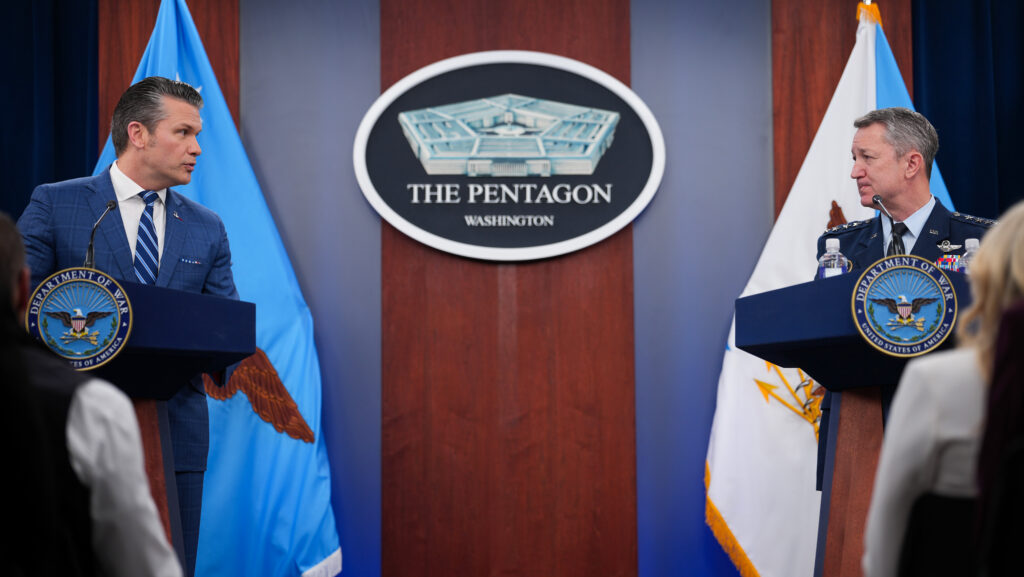
WASHINGTON — As Iran and the US embark on a two-week ceasefire, Pentagon leaders are touting military success, saying the broad swath of Tehran’s defense production capacity is crippled.
“What has been agreed to, what’s been stated, is the Strait [of Hormuz] is open,” Defense Secretary Pete Hegseth told reporters this morning. “Our military is watching. Sure their military is watching. But commerce will flow. And that’s what you saw the markets react to.”
Regardless of whether Tehran and Washington sustain this ceasefire and hammer out a long-term agreement, Hegseth said a host of US military objections have been accomplished over the past five-and-a-half weeks, calling it a “decisive military victory.”
“America’s military achieved every single objective, on plan, on schedule, exactly as laid out from day one. Iran’s Navy is at the bottom of the sea,” Hegseth told reporters this morning.
“Iran’s Air Force has been wiped out,” he later added. “Iran no longer has … any sort of a comprehensive air defense system. We own their skies. Their missile program is functionally destroyed. Launchers, production facilities and existing stockpiles depleted and decimated and almost completely ineffective.”
Chairman of the Joints Chiefs of Staff Gen. Dan Caine provided additional context on just what damage the Pentagon believes it has inflicted on Iran’s defenses. Internal analysis, the four-star general explained, estimated during Operation Epic Fury the US struck 13,000 targets and 1,700 ballistic missiles were intercepted by US forces and Gulf partners. Approximately 80 percent of Iran’s air defense systems were destroyed, he added, along with 90 percent of the “regular” fleet of maritime vessels (not the Islamic Revolutionary Guard Corps) and 95 percent of their naval mines.
And when it comes to Tehran’s defense industrial base, Caine said, the Pentagon believes that it has either damaged or destroyed 20 naval production and fabrication, nearly 80 percent of Iran’s nuclear industrial base, and 80 percent of their missile facilities.
“We’ve destroyed Iran’s defense industrial base, their ability to reconstitute those capabilities for years to come,” he told reporters. “We attacked, along with our partners, approximately 90 percent of their weapons factories. Every factory that produced Shahed one-way attack drones was struck. Every factory that produces the guidance systems that go into those drones was struck. Their missile defense industrial base is shattered.”
Despite US claims of military success, Iran has continued to have the ability to strike targets across the region including a petrochemical complex in Saudi Arabia this week, and an F-15E fighter last week.
Regardless, Hegseth’s comments about the delicate ceasefire between Washington and Tehran followed a tense weekend and start to this week after President Donald Trump vowed total destruction of Iran’s bridges and power plants if Iran did not reopen the Strait of Hormuz by 8 p.m. Eastern on Tuesday and present other acceptable terms.
“A whole civilization will die tonight, never to be brought back again,” Trump posted on Truth Social Tuesday morning. “I don’t want that to happen, but it probably will. However, now that we have Complete and Total Regime Change, where different, smarter, and less radicalized minds prevail, maybe something revolutionarily wonderful can happen, WHO KNOWS?”
But shortly before that US imposed deadline lapsed, Trump lifted the threat, instead announcing a new two-week “double sided” ceasefire during which the two sides would continue negotiations centered around a previously disclosed Iranian 10-point proposal. That proposal reportedly allows Iranian control over the Strait of Hormuz, ends US military attacks on Iran, requires US withdrawal from the Middle East and grants Tehran permission to enrich uranium.
However, the two-week ceasefire does not extend to all ongoing military operations in the region and Israel is continuing to strike Hezbollah inside Lebanon.
