

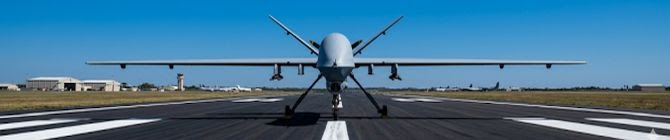
An Indian Air Force Medium Altitude Long Endurance (MALE) UAV on a Tarmac
The Government of India has set in motion the design and development of an advanced unmanned combat search and rescue aircraft for the Indian Air Force.
This runway‑independent UAV is intended to undertake missions to rescue aircrew without risking manned aircraft, while also serving as a platform to ferry logistics and supplies into forward areas and inhospitable terrains such as snow‑bound heights where conventional helicopters face limitations.
Officials confirmed that the project has been approved in principle under the Defence Acquisition Procedure 2020.
The initiative is closely aligned with the country’s drive towards Atmanirbharta in defence and aims to strengthen the combat readiness of the Air Force. The Chitrakoot node of the Defence Industrial Corridor has gained momentum, with Bharat Electronics Limited receiving 75 hectares of land, underscoring the ecosystem being built around indigenous defence manufacturing.
The UAV project is categorised under ‘Make‑I’, which stipulates that the government will fund 70 per cent of development costs, while Indian vendors will contribute the remaining 30 per cent. Once successfully developed, procurement will follow the ‘Buy (Indian‑IDDM)’ route, ensuring that at least 50 per cent of the material, components, and software are indigenously designed, developed, and manufactured.
Specifications for the platform are ambitious. It should be capable of operating from sea level up to 16,000 feet, with 20,000 feet as a desirable threshold, and possess a radius of action of at least 200 kilometres with a loiter time of 45 minutes. The UAV must be able to carry a minimum payload of 400 kilograms, including four passengers and stretchers.
The aircraft is expected to feature autonomous capabilities such as auto‑take-off, navigation, and landing, with integrated Emergency Locator Transmitter systems to search, locate, and land precisely. It should also be able to launch from unprepared surfaces and operate in Global Navigation Satellite System‑denied conditions.
Officials described the CSAR drone as one of the most advanced indigenous UAVs envisaged in India’s defence ecosystem, combining AI‑driven autonomy, all‑weather resilience, and combat‑oriented utility.
Indian vendors with expertise in aviation maintenance, UAV manufacturing, and defence quality assurance are expected to benefit significantly. The UAV will require rigorous military airworthiness validation before induction.
The ‘Make‑I’ framework is designed to empower defence start‑ups and MSMEs, allowing private firms to lead design, development, and manufacturing, while the Air Force acts as a strategic partner through funding, feedback, and eventual procurement.
This project is anticipated to add to India’s growing fleet of indigenous defence drones, reduce dependence on foreign suppliers, and generate high‑technology jobs in design, testing, and UAV manufacturing.
PTI
