

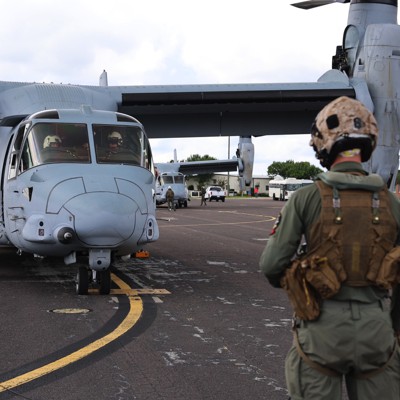
The Army—the last of the U.S. services to introduce a tiltrotor aircraft—is gathering lessons and working through challenges as it prepares to send the first Bell MV-75s to units for testing and feedback later this year.
It’s a different kind of effort than bringing a new helicopter or tank online, because the Army is making the move 30 years after the Marine Corps began testing the V-22 Osprey, 20 years after Air Force special operations started training on its version, and 10 years after the Navy selected it to take over the carrier on-board delivery mission.
Part of that delay has been the Army’s insistence on developing its own platform, an ongoing effort since Bell-Textron unveiled its V-280 offering for the Army’s Future Vertical Lift Program at the AUSA annual meeting in 2013. In January, then-Army Chief of Staff Gen. Randy George announced that the aircraft, now called MV-75, would head to units this year for evaluation.
With the MV-75, the Army is hoping to take the best of the Osprey—a much faster aircraft than the UH-60 Black Hawk, with a longer range and the ability to carry a lot more soldiers—and leave behind the Osprey’s safety concerns. A total of 65 military personnel and civilians have died in V-22s since 1991, when the fourth prototype crashed. Twenty of the deaths occurred in four crashes in 2022 and 2023.
“I can’t comment on the readiness or reliability of the Marine Corps, Navy and Air Force’s programs, and I won’t,” Mike Obadal, the Army undersecretary, told reporters March 24 at the AUSA Global Force Symposium.
Still, Obadal added, the Osprey’s reputation may be overwrought, even if it has made so many headlines over the course of its operation.
“I do know they’ve flown about 900,000 hours, and in the Marine Corps, I think their accident rate is probably less than their large helicopters,” he said.
And it is: less than half of the CH-53 King Stallion’s rate of class-A mishaps—incidents that cause a death or total loss of the aircraft—as of 2024. Whether that’s good news for the Osprey or just extremely bad news for the CH-53 is a matter of perspective.
“So I think we have to be very careful about making sweeping statements about tiltrotor technology—and especially when you look at what Bell-Textron and the Army are doing, because it is the most advanced manufacturing and digital backbone that exists,” Obadal said.
For its part, the Army is hoping to eliminate one recurring problem—engine fires—by building its airframe with fixed engines, rather than ones that tilt with the rotors like the Osprey.
“Now that may seem like a minor difference, but when it comes to maintenance, reliability, cost, impact from vibration or utilization, we found that fixed engine is likely to result in less maintenance requirements, less complexity,” Col. Tyler Partridge, who commands the 101st Combat Aviation Brigade at Fort Campbelly, Ky., told Defense One.
Patridge’s brigade is leading the Army’s tiltrotor integration as a Transformation-in-Contact unit. His soldiers got to see what an air assault from a tiltrotor looks like earlier this year during their annual Operation Lethal Eagle exercise.
A career CH-47 Chinook pilot, with experience in both conventional units and special operations, Partridge said his first impression is that the tiltrotor’s speed is impressive, but that comes with its own considerations.
“I think that’s probably the biggest sales pitch—the Army has been looking at this, how do we go farther faster? Really, that’s the challenge, or the question of the day that we’ve been trying to solve,” he said. “So from my perspective, looking at the tiltrotor platforms, integrating them into the plan, it’s always been the challenge.”
‘A smoother process’
The MV-75 outperforms a UH-60 in several ways: it flies about twice as fast, reaching 300 mph; its thousand-mile range is longer than the Black Hawk’s 600; and it can carry about 24 kitted-out troops, twice as many as the helicopter.
But an air assault mission isn’t just moving troops, so integrating a tiltrotor involves some timing issues. The CH-47 Chinooks carrying heavy equipment and the AH-64 Apache providing security are not as fast as a tiltrotor, so they have to take off on a different schedule than they would traditionally.
“How do we integrate them and utilize them across all the warfighting functions smoothly is probably the biggest challenge. And the speed is a challenge there, specifically sequence and timing,” Partridge said. “What time do they take off? They may take off after helicopters that are landing after they are, in the air-assault plan.”
Last year, 101st CAB used tabletop exercises to model how they would integrate a tiltrotor into an operation.
“To kind of compare icons moving over a map at different speeds, and kind of thinking through how that changes the speed of decision-making, or perhaps the complexity of planning or logistical resupply,” Partridge said.
During Lethal Eagle, they got to test those AI models in the real world, including the ways their equipment and battle rhythm will need to change.
“A forward area refueling point seems simple enough, but when it comes to ensuring we have the right nozzles, the right fuel pressures, the flow rate—all those things matter when it comes to synchronizing and integrating an air assault mission with as many platforms as we normally have, especially at the scale and speed that this division wants to operate at,” Partridge said.
The soldiers also have to get used to the sound and the intensity of the rotor, which is much different than a helicopter.
“I would say, as you compare a tiltrotor versus a fixed rotor on a Black Hawk, it’s smaller. And so definitely sounds different and it’s a little more intense if you’re directly underneath the tiltrotor portion,” Partridge said.
Just learning where to stand and what sounds normal when working with a tiltrotor is part of the familiarization process, he said.
As a TiC unit, the 10st Airborne’s feedback will go into initial design of the MV-75, and that relationship will continue as the first prototypes are fielded and then updated.
“And I think that the seeking experience from the fixed-wing and the rotary-wing side of the house is probably the exactly the right thing to do here, particularly with the platform that is so dynamic,” Partridge said. “I think there’s the focus on more maneuverability in the helicopter mode that the Army has specified for the MV-75. I do believe that those requirements will be met by industry partners.”
Army leaders have also been convening with Marine Corps counterparts to get their lessons learned and best practices, he said.
“I know that we’ve got some of our maintainers integrated with the Marine Corps on the academic side of the house, with regards to their maintenance programs, so that we can learn the differences between tiltrotor maintenance and rotary-wing maintenance,” he said.
At the same time, the aviation Captain’s Career Course has added MV-75 instruction, Gen. David Hodne, then the head of Transformation and Training Command, told reporters in March. There’s also a training simulator at Fort Rucker, Ala., where the Army aviation schools are housed, to give prospective MV-75 pilots an idea of what it’s like.
Said Partridge, “And so I do anticipate that these efforts will ensure that it’s a smoother process, you know, than perhaps other platforms have experienced in the past.”
