

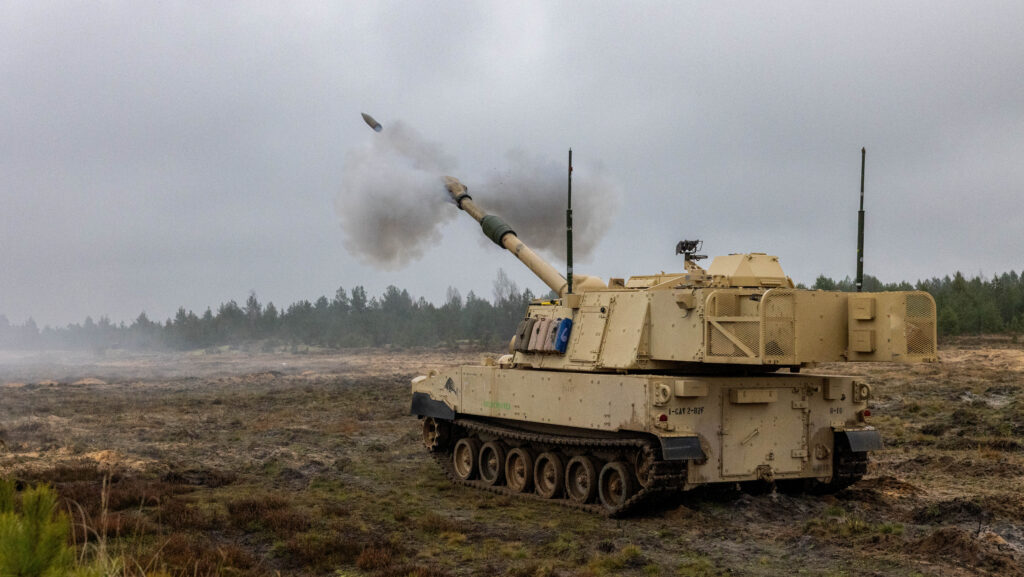
WASHINGTON — If the US Army gets its way, it will not be buying additional M109A7 Paladin Integrated Management (PIM) howitzers next year as it looks at alternative options to fill the gap, service Secretary Dan Driscoll told lawmakers today.
“We are looking at a mobile tactical cannon, which can in place … [in] 40 seconds versus 15 minutes [with the PIM] which matters a lot with the drone threat,” Driscoll told members of a House Appropriations subcommittee today.
“If you look at the [fight] in Ukraine on either side, it’s really hard to move out and get fires ready to go. … The Paladin is just incapable of it at speed,” he added. “And so while we think the Paladin will be in our lives for a while, because we want to be good custodians of the assets the American taxpayer has given us, we think that new purchases to balance that platform out should be something different.”
Driscoll appeared before the subcommittee to discuss the service’s plans to spend $60.5 billion in fiscal 2027, with $36 billion in the base budget request and $24 billion in a future reconciliation request. Although the Army has not yet released justification documents detailing in-depth spending plans, initial documents lay out a steep cut to the PIM line with only $84 million requested for procurement. Those dollars, though, will not be used to purchase additional PIMs, according to the documents. The cut comes after the service received $715 million in FY26 for 40 Paladins.
“We’re looking forward to our pacing threat,” Army Acting Chief of Staff Gen. Christopher LaNeve told lawmakers today. “We need to move to systems that weigh a lot less, so we can get it where it needs to be in a time.”
BAE Systems, which produces the the PIM, did not immediately respond to questions about the projected budget cuts. However, the service has been looking for alternatives to the Paladin line for decades, including the work on the XM2001 Crusader that was cancelled in 2002.
More recently, the service embarked on the ill-fated internal development of the Extended Range Cannon Artillery (ERCA) platform. That prototype added a 30-foot, 58-caliber gun tube to the Paladin M109A7 to launch 155-mm rounds out to 70 kilometers, an increase from the current max range of up to 30 kilometers. However, in 2024 the service announced that it had stopped work on that platform after encountering technical challenges during live fire testing that included excessive wear and tear on the cannon.
Service officials were then torn over whether to relaunch development of a new platform or pull an existing one from industry, and launched an international roadshow to visit a handful of companies from Europe to Asia to the Middle East — Rheinmetall, BAE Systems, Hanwha, General Dynamics and Elbit Systems.
Their decision? Forgo a lengthy development process and find an existing self-propelled howitzer.
If all goes as planned, the Army wants to award a contract for the new self-propelled howitzer program by July, a spokesperson for the Program Acquisition Executive for Fires said in February.
