

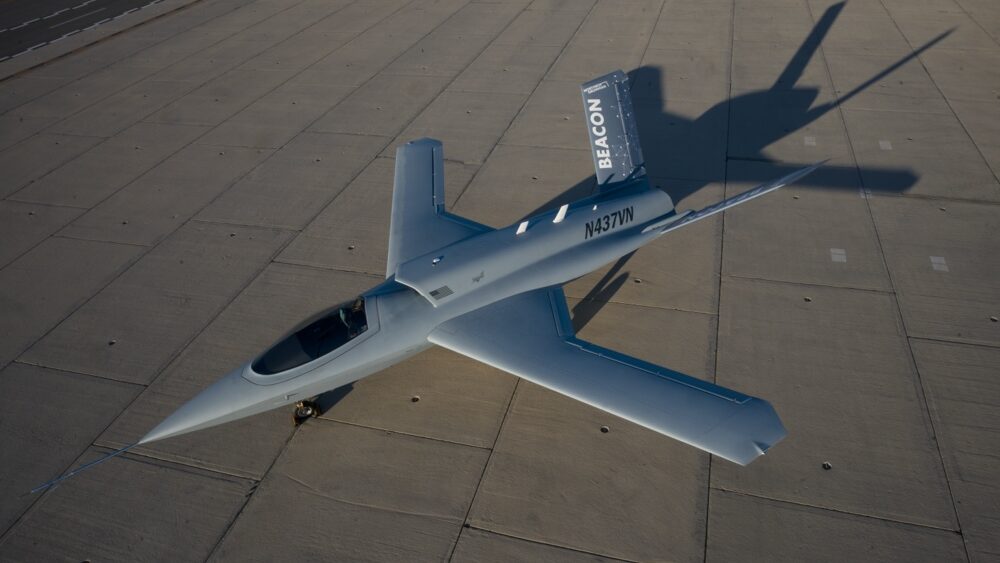
WASHINGTON — Northrop Grumman and three artificial intelligence firms — Shield AI, Accelint and Applied Intuition — showcased how different AIs could swap control of a single aircraft “seamlessly” mid-flight in recent testing, the companies said, which could offer US forces unprecedented flexibility in future fights.
The flight tests — one last month involving Shield, the latest Wednesday with Accelint and Applied — were part of a Northrop initiative called Talon IQ (formerly Beacon), which turned a manned demonstrator, Scaled Composite’s Vanguard Model 437, into a testbed for both Northrop’s own Prism autonomy system and AI software from a growing group of partner companies.
“We just completed our eighth flight test of the Talon IQ platform,” said Dan Salluce, Northrop’s senior director for aerospace systems. “While the aircraft was flying, the software was queued up so that we could have different companies’ behaviors take control of the platform and fly [it].”
In essence, the AIs took turns controlling the aircraft, the companies said. What made that possible is a layered and modular open architecture that lets the airplane plug-and-play different software programs — either specialist AIs for specific tasks or generalist ones to run an entire mission — without disrupting the microsecond-by-microsecond operations of the flight controls that keep the airplane from falling out of the sky.
“The mission autonomy is really about what do you do with that airplane to perform the mission,” Salluce explained. “Where do you go? How fast do you fly? What direction? What altitude?”
In this week’s flight test, Northrop’s Prism handled the overall mission, but it handed control to Applied Intuition’s Acuity AI at one point, and to Accelint’s AI at another, for them to execute specific functions or “skills” such as performing a Combat Air Patrol.
In the March test flight, by contrast, once the aircraft was aloft, Prism handed full control to Shield’s Hivemind AI. Shield’s AI then put the aircraft through some standard military maneuvers — “Combat Air Patrol maneuvers, then doing simulated target engagement maneuvers,” explained Shield’s Vice President for Hivemind, Todd Wesley — before returning control to Prism.
Because the baseline software handles the flight controls, the higher-level mission-autonomy AIs don’t have to be tailored to the specific characteristics of a given aircraft, the executives said: Instead, you can test AI on one plane and then port it over to another, much like an experienced pilot can fly several kinds of (related) aircraft.
“[After] we develop our capability on one platform, it can rapidly be deployed and integrated and show value on another platform,” said Wesley. “This really shows we can rapidly port the software using that standard interface layer, and that when you’ve got good code quality and good architectures, you can mature and go through flight testing activities very quickly.”
For now, the aircraft still flies with a human pilot aboard as back-up, which allows new software to go straight to test flights after a day or so of ground tests, without the full and time-consuming test regimen required for entirely unmanned aircraft, executives told reporters. But, Scaled Composites Vice President Jenn Santiago told reporters that the pilot’s “mostly hands-off” while algorithms fly the plane.
