

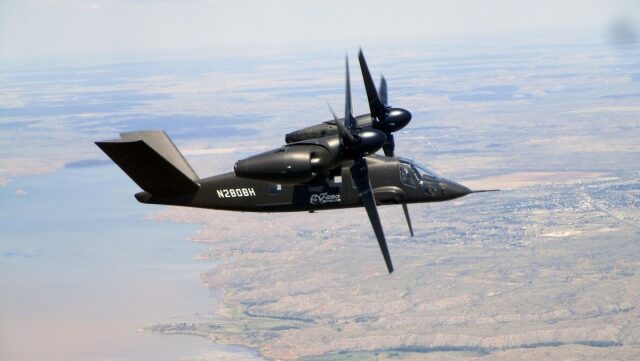
NASHVILLE — The Army is weighing the possibility of creating a requirement to provide air refueling to the service’s Bell-made Cheyenne II MV-75 tiltrotor fleet, a senior Army aviation official said.
Maj. Gen. Clair Gill, program acquisition executive for Maneuver Air, said Thursday that the Army is exploring the option of adding a refueling kit similar to ones designed for a different variant of the MV-75.
“We’re also thinking creatively about if we put aerial refueling, which you’re gonna see on the SOCOM variants, if we put that on a conventional variant, then how do we refuel it?” Gill said during a media roundtable at the AAAA conference Thursday. “We’re thinking through, do we need to develop a requirement for aerial refueling for ourselves now that we have really enhanced our capability?”
Frank Lazzara, director of sales and strategy for advanced vertical lift systems at Bell, told Breaking Defense that the MV-75 was designed with the option for a removable refueling kit, mostly to be used by the Special Operations Command.
Gill, who is dual-hatted as the commanding general of the Army Aviation Center of Excellence, explained that one of the “most challenging tasks” for Army special operation aviators is helicopter aerial refueling. Oftentimes people assume the challenge is just with training aviators how do the refueling, which is a part of the issue he said, but the lack of an “asset” that does the refueling is the main issue.
“We don’t have those organic to the Army. So I think we need to solve our own problems, and think about how do we do our own, let’s call it logistical resupply in the air, of an MV-75,” Gill said, adding that a fixed-wing option would be the best solution for the refueling, since traditional rotorcraft “certainly” couldn’t do the job.
“We don’t have a requirement written right now, but I’ve talked with Army leaders,” Gill added.
Though Gill did not give exact details on what the refueling capability could look like, Bell released a video Wednesday of an MV-75 seemingly being refueled by the Boeing-made MQ-25 Stingray. The Stingray is slated to be the Navy’s first carrier-based unmanned aircraft that’s central goal is for unmanned refueling.
Though Gill did not explicitly call out the Stingray, he did say during a keynote address Wednesday when introducing the new name of the MV-75 that the Navy has “got some pretty good unmanned ideas there, if you want to kind of follow where we’re going” while talking about air refueling.
