

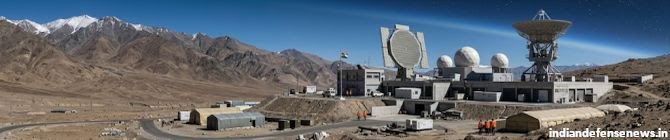
The Indian Space Research Organisation (ISRO) is expanding its network of facilities to track space objects in Earth’s orbit, with plans to establish a phased array radar in the north-eastern region of India and an optical telescope at Hanle in Ladakh.
These developments are part of a broader effort to enhance India’s Space Situational Awareness (SSA) capabilities at a time when Low Earth Orbit (LEO), ranging between 500 and 1,000 kilometres above Earth, is becoming increasingly congested with satellites and debris, raising the risk of accidental collisions.
Currently, ISRO operates the Multi-Object Tracking Radar (MOTR) at the Satish Dhawan Space Centre in Sriharikota. This L-Band Active Phased Array Radar is capable of tracking multiple objects simultaneously.
It can monitor objects with a radar cross section of 0.25 square metres at distances of up to 1000 kilometres. The MOTR plays a crucial role in tracking Indian rocket bodies and satellites, ensuring operational safety in orbit.
The upcoming radar in the Northeast is being indigenously developed, with its design and review completed by a national-level expert committee in 2025. Alongside this, the optical telescope at Hanle is being installed in the high-altitude cold desert region of Ladakh, chosen for its clear skies and minimal atmospheric interference. Optical telescopes, unlike radars, can only operate at night and rely on detecting sunlight reflected off satellites and other space objects.
ISRO also highlighted the refurbishment of the Baker Nunn Schmidt Telescope (BNST) at Nainital, in collaboration with ARIES. Once operational, this telescope will further strengthen India’s ability to track space objects. Together, these facilities will provide a complementary mix of radar and optical systems, essential for comprehensive SSA.
Radars, which use radio waves and their reflections to estimate the position of objects, have the advantage of functioning both day and night. Optical telescopes, however, are limited to night-time operations but are invaluable in detecting objects at higher altitudes.
By combining these technologies across multiple locations, ISRO aims to build a robust network capable of monitoring satellites and debris across different orbital ranges.
SSA involves tracking, monitoring, and predicting the positions of satellites and debris to ensure safe and sustainable space operations. It requires data gathered from ground-based sensors and telescopes to avoid collisions and assess risks to space assets.
ISRO’s expansion of facilities reflects India’s growing commitment to safeguarding its space infrastructure and contributing to global efforts in managing orbital congestion.
WION
