

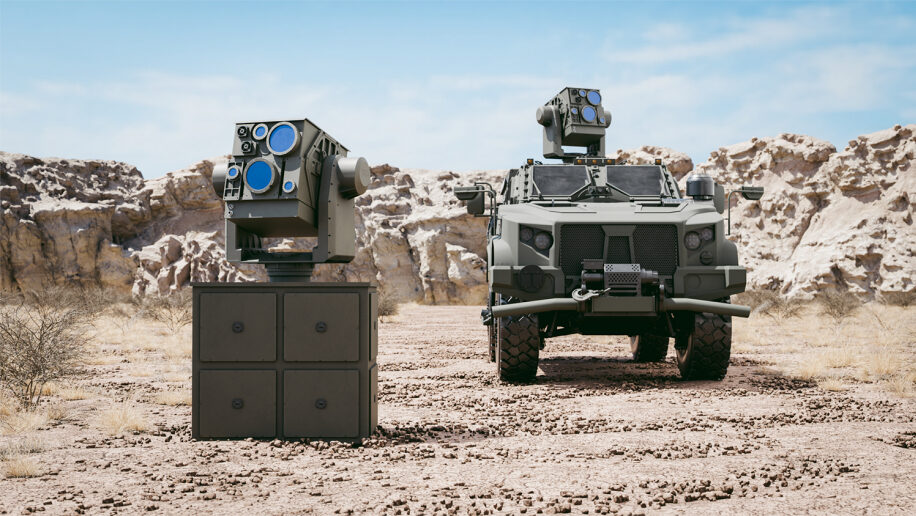
GLOBAL FORCE 2026 — Virginia-based defense firm AeroVironment (AV) revealed the LOCUST X3 counter-small unmanned aerial systems (C-sUAS) platform today, designed to take out small- to medium-sized drones with a laser.
The system uses a 20-30 kw laser along with “AI-enabled detection, tracking and engagement automation” run by an AV software platform, according to a company press release. It can be used mounted on vehicles or from fixed positions, AV says.
Aaron Westman, senior director of business development at AV, told Breaking Defense at the AUSA Global Force in Alabama that the latest incarnation of LOCUST was informed by real-world demands.
“The earlier versions of LOCUST were developed and fielded, and we put them in the hands of soldiers, we got a lot of feedback from them on improvements that they’d like, different enhancements, and we took all that feedback and X3 is the result of that,” Westman said.
RELATED: Turkey’s Aselsan tests laser counter-drone system, part of Steel Dome project
Westman was formerly a senior official at defense tech firm BlueHalo, which produced the LOCUST laser system and in 2025 was acquired by AV. He said the X3, the third generation of the LOCUST system, was designed to combat drones up to Group 3 and was made with high-profile threats such as Iran’s Shahed and Russia’s Geran drones in mind.
“The traditional way of dealing with [Group 3] threats is using interceptors, and that’s well and good when you only have one, or two, or three threats,” Westman said. “But the amount of drones that they are able to create and have them fly at targets is really stressing the logistics of being able to replace and maintain interceptors.
“And so that’s what’s really great about a laser weapons system, is there’s no logistic chain to reload the system,” he said. “As long as there’s energy, there’s a battery inside the system, [and] as long as that battery is charged, the laser can fire essentially limitlessly.”
The cost-benefit analysis for laser weapons has been on the minds of military planners for years, and AV is hardly alone in pursuing laser- or microwave-based counter-drone systems. In December Israel declared its Iron Beam laser defense system officially active, after having already seen real-world combat. Just earlier today a team led by General Dynamics unvelied a new mobile microwave-based cUAS platform.
Outside of Global Force, AV is competing in the Army’s Enduring-High Energy Laser (E-HEL) and is an active participant in the Army Multi-Purpose High Energy Laser (AMP-HEL) prototype program, according to Westman.
Westman acknowledged that the system has not been tested as a full, cohesive system, but said that all of the subsystems have been tested individually and AV is hoping to have complete X3s under testing within the next few months.
