

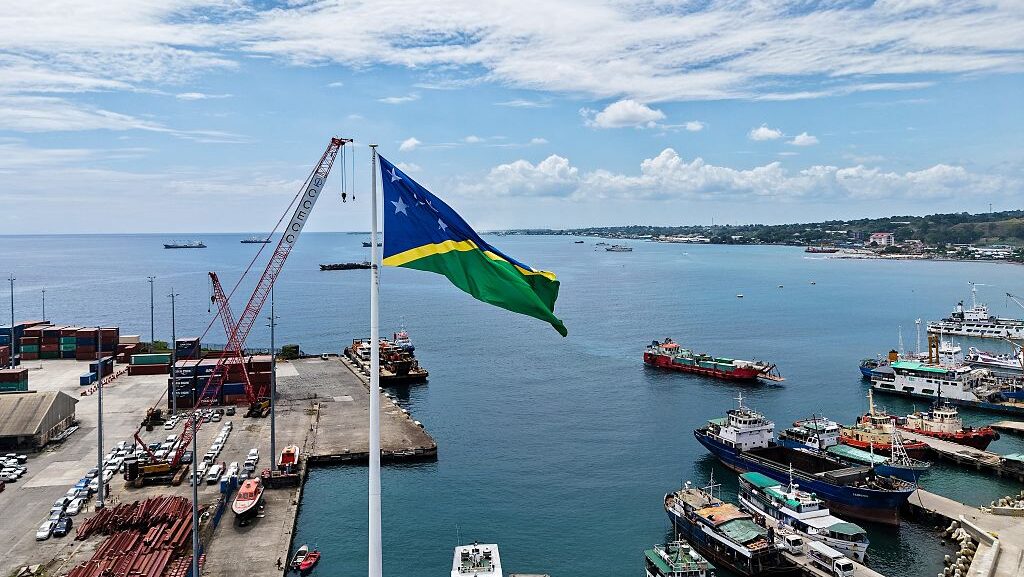
While the world’s attention has been elsewhere, Beijing appears to be quietly weaponizing critical infrastructure across the South Pacific.
Under the guise of commercial development, Chinese state-owned enterprises reportedly have begun repurposing local airstrips and ports in ways that could accommodate Chinese military vessels and aircraft. The Luganville Wharf in Vanuatu, for instance, has undergone significant renovations and is now capable of docking large Chinese warships.
A 2025 Sinopsis report, among the few comprehensive assessments of the issue, identifies close to 40 of what it calls dual-use facilities throughout the region. These projects, which include proposals to lengthen airport runways and expand ports and harbors, total roughly $3.55 billion. The report warns that such multipurpose infrastructure may have “far-reaching security implications” that could “reshape the geopolitical landscape of the Indo-Pacific.”
These efforts, not widely acknowledged by Chinese diplomats or military planners, portend ambitions to develop a regional network of dual-use infrastructure. If realized, Beijing could operate with unmatched maneuverability and operational reach during a crisis.
Washington has yet to fully appreciate what is taking shape: neither the National Defense Strategy, the National Security Strategy, nor the China Military Power Report so much as recognizes these developments.
Much remains unknown about the eventual utility of these facilities. At a minimum, dual-use infrastructure will likely serve some military function. It aligns with Beijing’s broader push to strengthen “military-civil fusion,” a stated effort to integrate civilian and military operations that has been repeatedly stressed in Chinese doctrinal writing, including the latest 15th Five-Year Plan. China’s deployment of Type 055 destroyers, among its most advanced surface combatants, to small regional ports suggests these facilities may already be under strategic consideration.
In this context, these island ports and airstrips could plausibly become operating bases or logistics supply points. Dual-use facilities in Vanuatu or the Solomon Islands could empower China to deny shipments of fuel and ammunition, disrupt coordination between US and allied forces, or create new staging grounds for combat operations. While only a possibility, this scenario must be taken seriously.
In response, US defense planners should formulate a counterstrategy. That might not be straightforward.
Washington could press Pacific Island nations to reduce their dependence on China. But Beijing’s investment offers have proven at times too tempting to refuse. The more prudent approach is to assume the worst: dual-use facilities will be employed during a conflict. Starting there, defense officials can build a layered strategy to counter the threat dual-use infrastructure poses.
The first step would be to increase maritime cooperation with South Pacific nations. The US Coast Guard maintains shiprider arrangements with 12 Pacific Island nations, which enable foreign law enforcement officers to deploy on board US vessels for patrols. Distance, however, remains the problem. Fast response cutters deployed from Honolulu take days to reach the South Pacific. That constrains the scope of collaboration.
The US Coast Guard could enhance these agreements by extending deployment periods, increasing patrol frequency, or establishing a logistics hub in American Samoa for refueling.
These arrangements bolster regional law enforcement and disaster relief capacity, addressing the same needs China uses to justify dual-use infrastructure. Beijing frames port renovations as enabling greater participation in anti-piracy and humanitarian assistance. Shiprider arrangements deliver on the same promises without forcing regional countries to cede operational control of key facilities.
These deployments also provide US defense planners with valuable information. During its Operation Blue Pacific patrol, the crew of the US Cutter Harriet Lane visited Port Vila in Vanuatu, the same harbor where two Chinese destroyers, a Type 055 and a Type 052D guided-missile destroyer, would arrive just months later. Port calls provide insight into a facility’s operating conditions.
The second element is to incorporate dual-use hubs into contingency planning. The Department of Defense should standardize a criterion for defining “dual-use.” Once created, defense planners should perform comprehensive assessments on identified dual-use facilities: their specifications, the forces they could sustain, and how Beijing might leverage them in a crisis. Priority should be given to sites at strategically vital locations.
The Department of Defense should publish that analysis in its annual China Military Power Report. The report already comprehensively covers dual-use technology. But officials need visibility into commercial facilities that can project hard power – where they are located and what risks they pose. The real stress test comes in wargaming, which should be used to determine whether Beijing could negotiate access to these facilities during a simulated crisis.
The final step involves real-time monitoring of dual-use developments. The Compact of Free Association (COFA) already obligates the US to provide military assistance to the Marshall Islands, Palau, and the Federated States of Micronesia. Washington could push for a Pacific Fusion Center to aggregate maritime intelligence. This would be a welcome development for COFA nations, which currently lack the capacity and technology to effectively patrol their waters. Against China’s dual-use ambitions, improving maritime domain awareness serves two purposes: it enables regional partners to monitor renovations to key infrastructure and to track the movement of Chinese naval vessels.
There will be limitations to what can be known. Beijing will inevitably attempt to conceal its activities. It may set up subsidiary companies or conduct construction underground. That makes painting a complete picture all the more difficult. That said, commercial satellite imagery, port data, and on-the-ground intelligence still provide vital information. A regional intelligence hub may remain the most practical means of gauging Beijing’s present and future ambitions.
A final consideration is resources. Additional Coast Guard deployments, Pentagon assessments, and a possible Pacific Fusion Center will all require funding. COFA countries can be encouraged to redirect some of the $7.1 billion in COFA funding to these initiatives, though additional appropriations would still be needed. Even so, this remains a cost-effective approach. The alternative is offering infrastructure investments to dissuade Pacific Island nations from accepting Chinese financing. That would cost many times more.
Dual-use facilities remain a major unknown: how they factor into military strategy or affect force posture is not fully understood. Despite that uncertainty, Washington cannot afford complacency. Defense planners must begin to account for them through a layered approach predicated on sustained presence and careful planning.
Brent Sadler is a senior research fellow specializing in naval warfare and advanced technology at The Heritage Foundation’s Allison Center for National Defense. Allen Zhang is a research assistant in the Foundation’s Asian Studies Center.
