

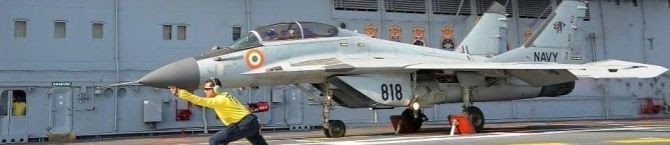
In a significant move towards greater indigenisation, the Indian Navy has initiated a major project to invite domestic companies to develop and manufacture critical subsystems for its fleet of Russian-built MiG-29K carrier-based fighters, reported to TOI.
This strategic push is primarily designed to improve the operational availability of the aircraft while simultaneously reducing a long-standing dependence on foreign suppliers. By fostering local production, the Navy aims to strengthen India’s self-reliance regarding essential aircraft components and national security.
The MiG-29K serves as a sophisticated, all-weather supersonic multi-role fighter and acts as the primary strike platform for the Indian Navy’s carrier-based operations.
These aircraft are currently deployed on the INS Vikramaditya and the indigenous INS Vikrant, where they perform vital roles in air dominance, maritime strike missions, and sea denial. Their presence is crucial for the protection of carrier battle groups and the projection of naval power across the region.
Despite the advanced capabilities of the fleet, the Indian Navy has frequently encountered hurdles regarding maintenance, the procurement of spare parts, and overall serviceability. To address these challenges, the Navy has issued a Request for Information (RFI) seeking Indian firms with the necessary technical expertise, financial stability, and infrastructure to undertake the indigenous design and development of two specific automated test systems.
These systems, known as the NASK 1-29K Ground Automated Test System and the KSAK 1-29K Carrier Based Automated Test System, are fundamental to the upkeep of both the MiG-29K and the twin-seat KUB variants.
They are utilised to execute various scheduled maintenance tasks and ensure the complex machinery is functioning within safety parameters. The scope of the testing required is extensive, covering nearly every vital organ of the fighter jet.
The automated systems will be responsible for checking the fuel and air data systems, avionics suites, and fly-by-wire controls. Furthermore, they will monitor electrical power generation and distribution, and conduct essential preparation for weapon loading by testing armament systems.
Beyond hardware, the systems will evaluate the performance of the onboard radar and its sub-components, as well as investigate specific engine parameters to ensure peak performance during high-stress carrier operations.
By ensuring these fighters remain combat-ready while at sea, the new indigenous systems will provide the Navy with a more resilient supply chain. It is expected that private sector players will collaborate with defence Public Sector Undertakings (PSUs) and various research organisations to fulfil the requirements.
This transition to “desi” systems is intended to bolster national manufacturing capabilities and grant the Indian military greater control over its most critical assets.
TOI
