

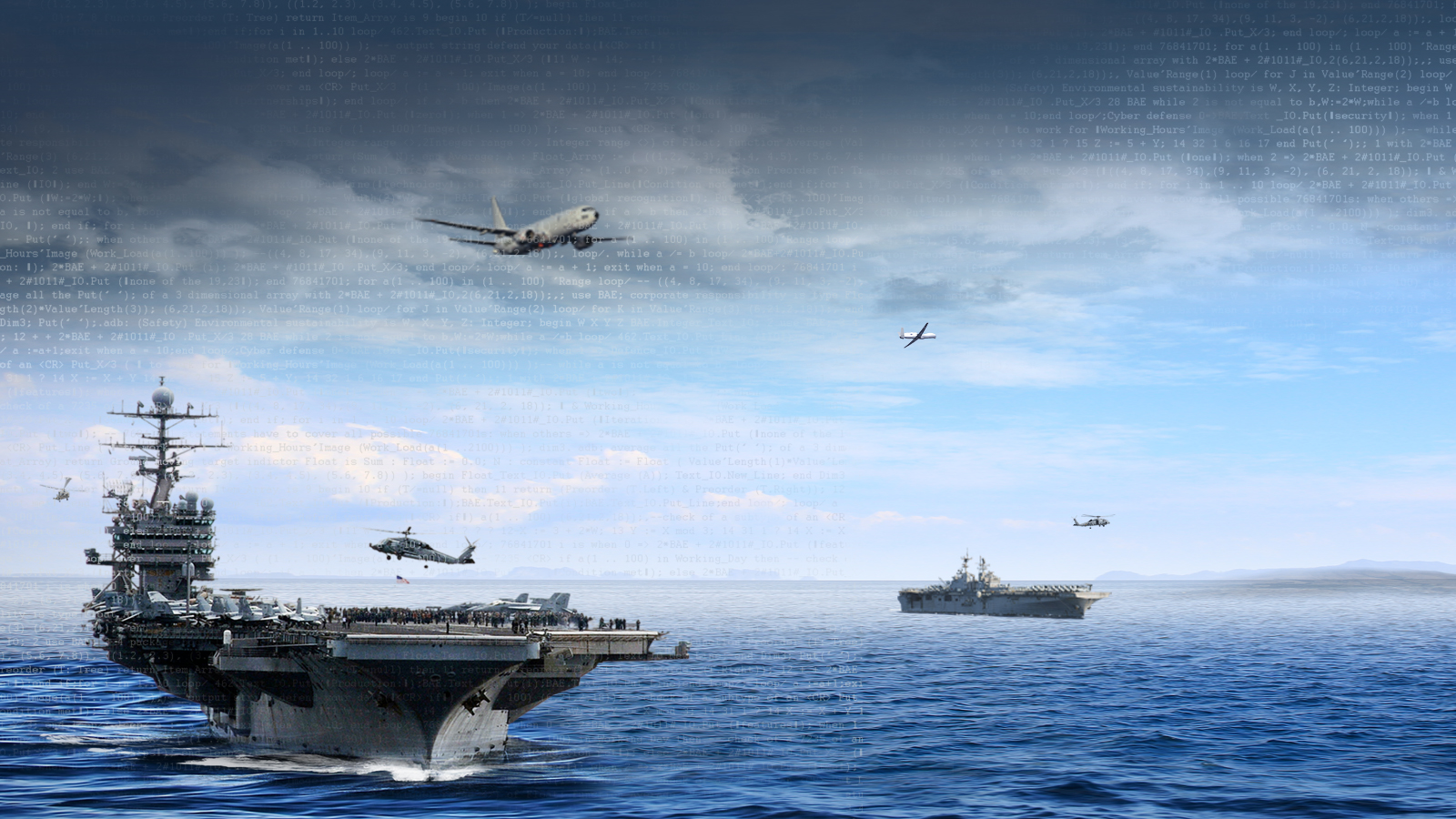
The U.S. Navy faces communications challenges unlike any other service, as ships at sea need to communicate across long distances without a traditional network infrastructure, hindering real-time information sharing.
To meet this challenge, the Navy now uses Network Tactical Common Data Link (NTCDL) to let carrier strike groups share data across different formats. Operators use NTCDL to communicate with multiple air and naval assets in the group, across multiple channels, as opposed to communication with one asset at a time. The NTCDL system is currently deployed on aircraft carriers and is scalable for use on multiple ship classes and sizes as part of an $85 million contract awarded to BAE Systems, the prime contractor on the system.
Breaking Defense spoke with Jeff Regan, Common Data Links program area director for BAE Systems, about the NTCDL, the advantages it offers and how it is shaping naval communications.
Breaking Defense: NTCDL is described as the first of its kind in the world. What makes it different from other systems?
Regan: Yes, this is an exciting and needed new capability. This is real-time, multi-channel data link communication. It essentially extends line of sight for the fleet, giving our assets decision space and the situational awareness they need to protect themselves and execute maritime operations.
Multi-channel data link communications mark our Navy’s advancement into these new capabilities.
NTCDL gives the Navy ships 360-degree, multi-channel communication with multiple different assets — a first of its kind capability.
Historically, why has this not been done? How were you able to do it?
A data link can be described as something that’s a wired link or an over-the-air link. The primary function is to send and receive different types of information, whether it’s voice data or text data with a summary of situational awareness.
NTCDL enables the exchange of voice, data, imagery, and full-motion video simultaneously, allowing decision makers to get to the crux of the decisions that they need to make in real time.
NTCDL is a complex system. It is made up of radios, data links, and antennas – to create an actual communication network. We like to say NTCDL is the network. It comprises all the equipment that is needed to transmit and receive that critical data.
This being a Department of War (DoW) space, all this data that we are transmitting needs to be protected, so NTCDL is a fully locked system that allows for encryption and decryption of data.
Finally, there’s the mission software piece that allows for the data-link user to command and control the data. I want data from this asset, I want to transmit data to this asset, for example.
Let’s talk about the threat scenarios. What does NTCDL mean to the Navy when it comes to identifying and evaluating threats?
As our adversaries continue to become more capable, they’re spread out over broader geographies. The threats have expanded from what we would traditionally say was a physical threat, something that’s right in front of us that we can see in real-time. That’s expanded into attempts to disrupt our ability to communicate and coordinate. Our adversaries in those threat scenarios are looking for data about where we are and what we’re doing. Now (the Navy) requires highly reliable systems with multiple bands, secure anti-jam ability to transmit data and imagery and fully networked communications.
NTCDL ensures that our data is secure across multiple channels because our adversaries will continue to look for ways to disrupt us.
Is this part of giving the Navy a standoff capability where a carrier group can be controlling an ISR UAS while it surveils targets?
That’s exactly right. This capability enables our forces to extend the ranges of our missions by doing those things you’ve described. It enables longer communications, more communications, secure communications, and communications with manned and unmanned platforms. It’s bringing a suite of data transmission capabilities that extend the range of our communications and capabilities.
I want to add that NTCDL is also a modular, scalable system that embraces next-generation waveform evolution. While the system that we’re providing today is unbelievably capable, extends ranges and provides multifaceted communications, it’s also ready for the next generation of waveform evolution and the next phase of DoW enterprise.
Tell us more about the use cases for NTCDL.
I mentioned extending the range of communications and that’s important. It also provides 360-degree coverage.
That could be with, but not limited to, highflyers, rotary-wing aircraft with ISR capabilities for anti-submarine warfare or search and rescue missions. Full-motion video and real-time communications are capabilities that go above and beyond legacy systems.
How does NTCDL handle challenges like cybersecurity?
We consider NTCDL a completely locked down system that’s also designed to prevent insider threats, because it operates under strict cybersecurity risk management framework guidelines. Every part of the system is locked down. It sets itself apart from previous-generation common data link systems that just transmit data to an existing platform. NTCDL controls the data in a cybersecurity risk-management-framework-compliant way.
What does NTCDL mean for naval communications?
NTCDL is the first of its kind and is providing the Navy with new capabilities that amplify a coordinated tactical advantage. We’ve designed this system to meet urgent fielding timeline requirements, to be easily upgraded with new capabilities and support evolving waveforms. It will give operators the ability to use it on both large and small platforms and create more networks.
It’s about providing operators better access to surveillance and reconnaissance data, and exchange command and control information across multiple networks. We are piecing all this data together with NTCDL to create this new network.
