

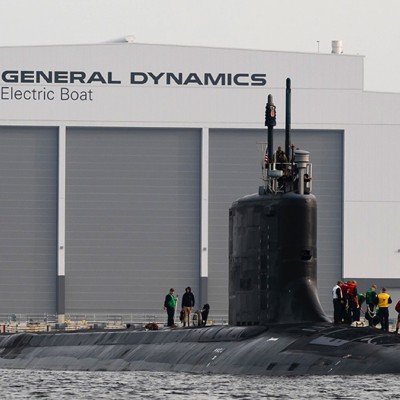
The White House wants nearly $65.8 billion for naval shipbuilding in fiscal 2027, up from about $45.1 billion it requested for the current fiscal year.
If approved by Congress, the sum would pay for 18 warships and 16 “non-battle force ships,” according to documents released by the Office of Management and Budget on Friday. About $5.6 billion would come from a proposed reconciliation bill, the second in as many years, according to Pentagon documents released Friday.
“The 2027 Budget will establish President Trump’s Golden Fleet, including initial funding for the Trump-class battleship and next generation frigates, as well as increasing the capacity of public shipyards and improving overall ship production,” according to a White House fact sheet.
The shipbuilding request is part of a White House proposal to spend $1.5 trillion on defense in 2027, half again as much as this year’s record-breaking amount. The plan requests $1.15 trillion in regular appropriations plus the balance in a reconciliation bill.
Funding for Columbia-class submarines—the missile boats that will replace the Ohios—would rise to $15.2 billion from the $9.3 billion appropriated in 2026. The sum would include $14.9 billion from the Defense Department’s budget and $205.7 million from the proposed reconciliation bill. The White House budget said $250 million would come from the National Sea-Based Deterrence Fund, created in 2014 to boost submarine construction with funds from outside the traditional shipbuilding budget.
The Pentagon documents also include $28.4 billion for “other warships,” such as Virginia-class submarines, aircraft carriers, destroyers, and $1.4 billion for the first next-generation frigate. About $1.9 billion would come from reconciliation.
The battleship would get $1 billion in advanced procurement funding for 2027. Other funding includes $13.9 billion for “auxiliaries, craft, and prior-year program costs,” and $8.3 billion for amphibious ships.
The proposed funding would also “maintain or increase” procurement of existing platforms from submarines to amphibious ships, according to White House budget summary.
The documents released on Friday do not list the types and quantities of the 18 battle force ships.
Landing Ship Mediums—of which six were listed in the Pentagon documents—were likely counted toward the warship total, said Mark Cancian, a budget expert and senior adviser with the Center for Strategic and International Studies.
“Still, nine other battle force ships in a single year is a good program, though they need to build more to reach the 350 battle force ships that the Navy has aimed for,” Cancian said.
The 16 non-battle force ships include “strategic sealift vessels, hospital vessels, Consolidated Cargo Replenishment at Sea tankers, a special mission ship, submarine tenders and other vessels vital for logistics,” according to a White House budget summary document.
The White House summary said some of the requested 2027 funds would be used to increase the repair capacity of the nation’s four public shipyards.
The summary also highlights funding to design and develop the proposed battleship and new frigate.
“Those will involve a lot of development and won’t be actually constructed for several years,” Cancian said. “What the Navy can do in the near term is build a lot of auxiliaries where the U.S. shipbuilding defense industry has some capacity.”
Brent Sadler, a senior fellow and naval expert with the Heritage Foundation, said the $65.8 billion shipbuilding topline should be carried into future years to increase production.
“This is actually the closest to what is needed and it needs to be sustained for several budgets,” Sadler said, proposing legislation that includes a block order for warships the Navy plans to buy in the next five years, boosts worker salaries and provides a mechanism to place underperforming shipyards in a conservatorship.
But even with more funding, the challenge still lies in translating orders into production capacity in the foreseeable future.
That “requires a strategic industrial planning effort, beyond the Navy, to achieve and which the Department of the Navy still not fully organized to achieve nor is the interagency,” Sadler said. “New shipyards need to be funded with orders of new builds with longer delivery times as the goal is, firstly, to grow capacity,” which also means stockpiling key components to shrink supply delays.
Lawmakers’ reaction to the proposed $1.5 trillion defense budget largely split along party lines.
Republican leaders of the congressional defense committee praised the proposal.
“These funds will drive the U.S. toward a defense budget of 5 percent of GDP–-a benchmark we have long supported as necessary to maintain our national defense. President Trump is also sending a clear signal for our allies and partners to build on recent progress and meet this benchmark alongside us,” Sen. Roger Wicker, R-Miss., and Rep. Mike Rogers, R-Ala., who chair the Senate and House Armed Services Committees, respectively, said in a statement.
Sen. Jack Reed, D-R.I., SASC’s ranking member, called the budget request “bloated” and “undisciplined.”
“We must wisely invest in technology and efficiency. We must learn the right lessons from Ukraine and Iran. The military has to adapt to changing threats and invest in smart, cost-effective, advanced technologies that strengthen our defensive capabilities and contribute to America’s economic and technological edge. We must also continue investing in our people and build up our defense manufacturing base to meet America’s needs now and in the future,” Reed said in a statement.
